FSD v15 Is Intended to Identify Hazards Much Earlier
With FSD v15, Tesla is preparing the next major development step for its driver-assistance system. According to Tesla’s head of AI, Ashok Elluswamy, the software is intended to predict risks earlier, respond more quickly, and prevent collisions more reliably.
The comments were prompted by a critical traffic situation in which FSD Supervised swerved to avoid a vehicle that suddenly emerged from a driveway. Individual recordings like this are not standardized safety tests, but they illustrate Tesla’s development focus: rather than waiting to react to a visible obstacle, the system should assess the potential movements of other road users as early as possible.
The central goal of FSD v15 is not just a faster response, but earlier prediction of dangerous situations.
What Is Expected to Change Compared with FSD v14
According to Tesla, FSD v14.3 was already optimized for faster responses and more decisive evasive maneuvers. Version 14.3.9 also introduced Automatic Collision Evasion for vehicles with HW4. This feature can intervene even during manual driving and steer around an obstacle that suddenly appears.
FSD v15 is expected to go significantly further from a technical perspective. According to Elon Musk, the underlying AI model will grow from approximately one billion to around ten billion parameters. Put simply, these are internal weightings that the neural network uses to process visual information and derive driving decisions.
| Area | FSD v14 | FSD v15 |
|---|---|---|
| Model size | Around one billion parameters | Around ten billion parameters announced |
| Hazard detection | Fast response to visible risks | Earlier prediction of potential hazards planned |
| Vehicle hardware | HW3 and HW4, depending on the version | Expected to be exclusive to HW4 |
| Deployment | Customer vehicles and test fleets | Early builds already in robotaxi fleets |
However, more parameters do not automatically mean ten times better driving performance. Training data, model architecture, computing power, and validation across as many traffic situations as possible are equally important. The larger scale could nevertheless help FSD account for more visual relationships simultaneously and detect unusual movements earlier.
Reaction Times in Videos Remain Difficult to Compare
Some published driver recordings have been used to calculate reaction times of just a few tenths of a second. Such frame-by-frame analyses can provide an indication of the system’s speed, but they are no substitute for independent testing under reproducible conditions.
In practice, the initial steering input is not the only relevant factor. What matters is the entire chain of detection, prediction, and safe maneuvering → An early response is of little benefit if the vehicle subsequently creates a new hazard. It is precisely this holistic approach to collision avoidance that v15 is intended to improve.
HW3 Remains the Clear Cutoff
The larger model requires significantly more memory bandwidth and computing power. Based on the information currently available, FSD v15 is therefore expected to run only on vehicles with HW4, also known as AI4. A reduced version called FSD v15 Lite is not currently planned.
Vehicles with HW3 are instead expected to continue receiving optimized and compressed derivatives of FSD v14. Tesla has already distributed a corresponding version, v14.2 Lite, to its first testers. Further Lite releases for older Tesla Model S and Tesla Model X vehicles are therefore conceivable, although their long-term range of features will remain limited.
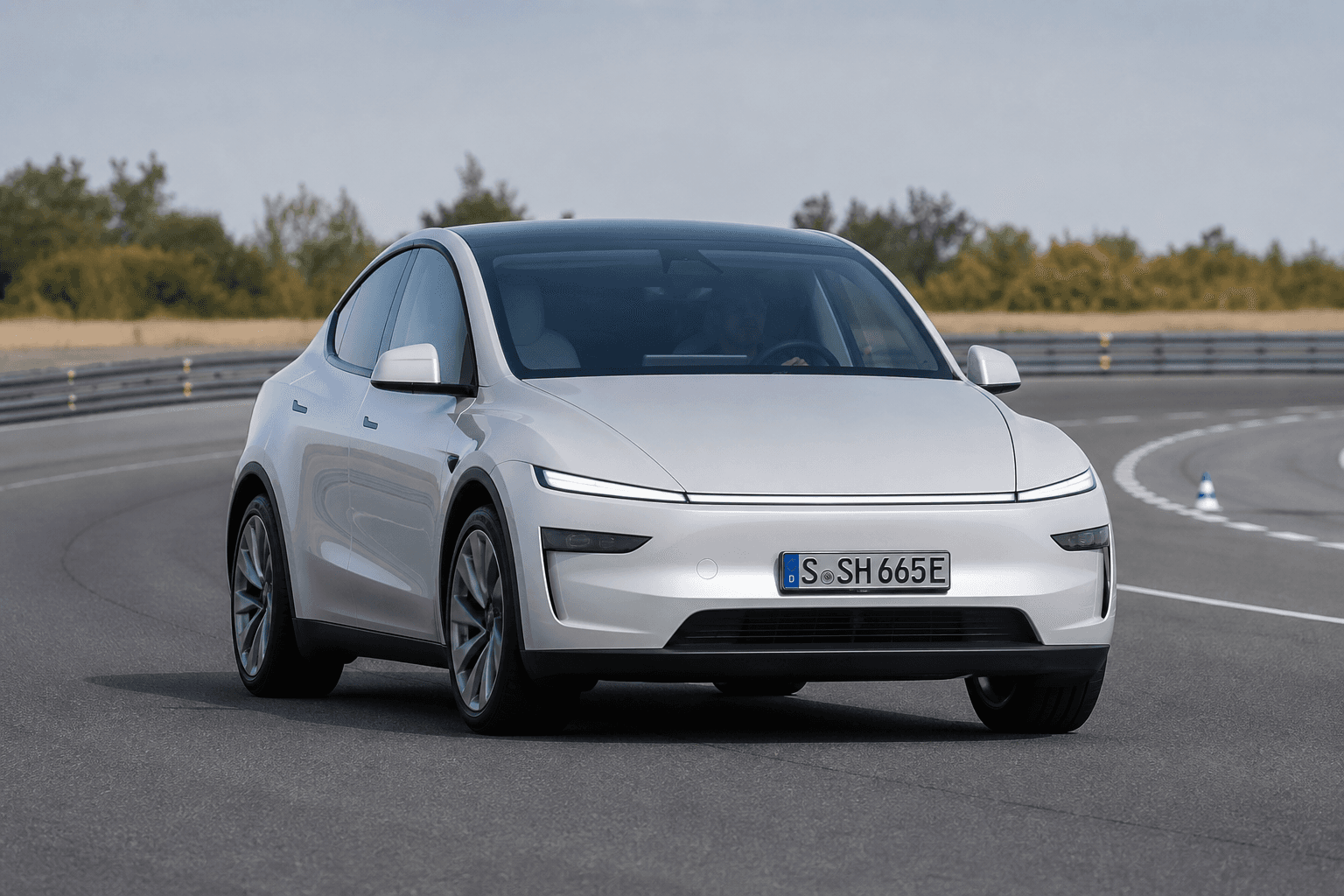
Whether Tesla will offer hardware upgrades, and under what conditions, has not yet been conclusively determined. For buyers of a used Tesla Model Y or Model 3, the installed hardware is therefore becoming an increasingly important consideration when choosing a vehicle.
Robotaxi Fleets Serve as an Early Testing Ground
Tesla is already testing early versions of FSD v15 in its commercial robotaxi fleets. Broader deployment in customer vehicles is not expected until extensive validation has been completed. The timeframe mentioned so far ranges from late 2026 to early 2027, although schedules for safety-critical software can change at any time.
FSD v15 is also closely linked to Tesla’s plans for scalable robotaxi services. Our earlier analysis provides an overview of the announced development of FSD v15, HW4, and Tesla’s AI strategy.
What FSD v15 Means for the DACH Region
The announcements primarily concern North America. In the DACH region—Germany, Austria, and Switzerland—type approval, regulations, and local authorizations determine which functions can actually be used. A US rollout therefore cannot be applied directly to European Tesla vehicles.
Even with faster hazard detection, FSD Supervised will initially remain a supervised driver-assistance system. The driver must stay alert and be able to intervene at any time. Nevertheless, v15 could represent an important technical step because Tesla aims to develop collision avoidance beyond purely reactive behavior toward predictive risk assessment.