Tatra electrifies the Force while staying true to its roots
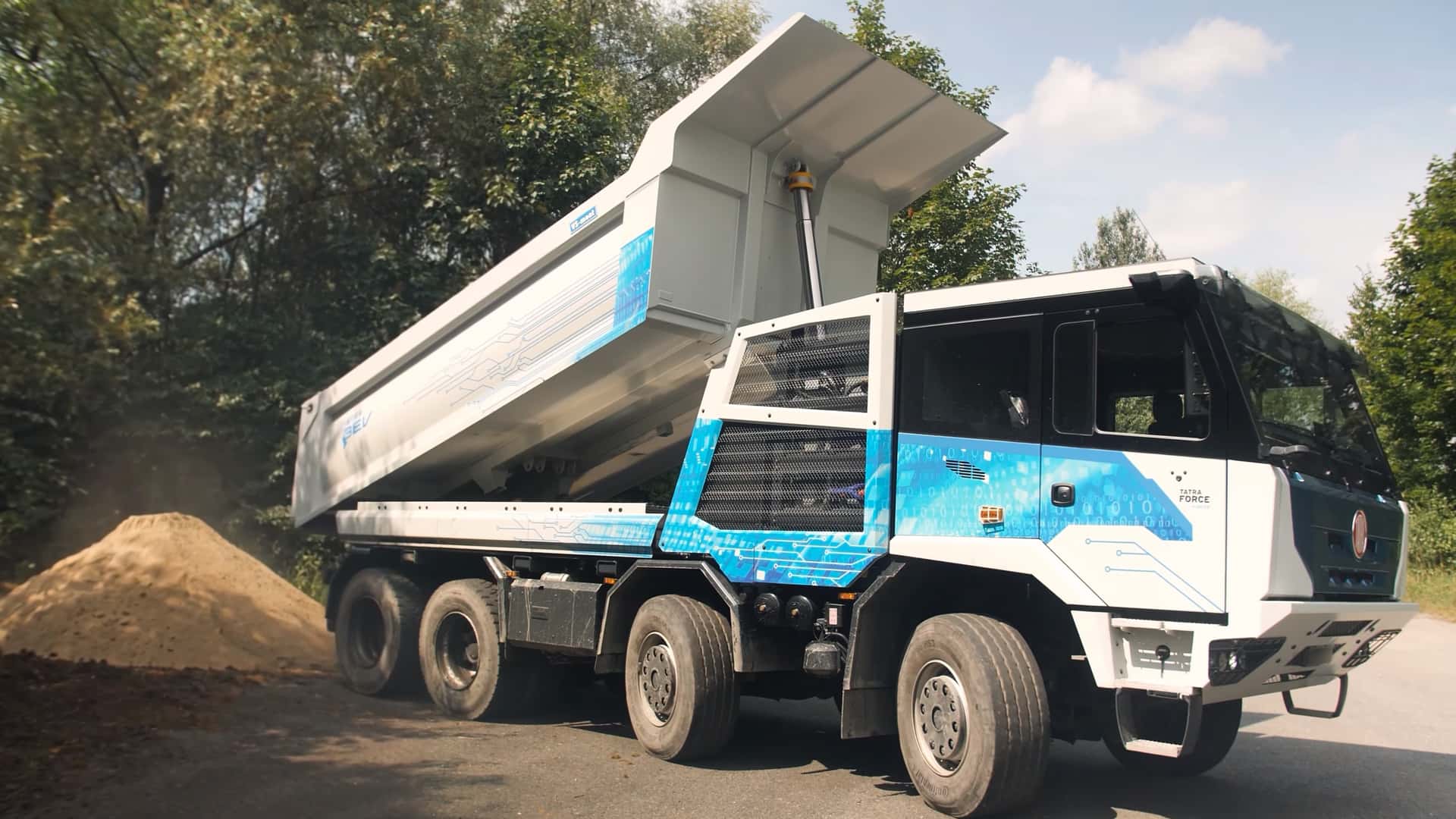
For decades, Tatra has been known for rugged, versatile off-road commercial vehicles. Now the Czech manufacturer is bringing its first fully electric model to both roads and rough terrain: the Tatra Force e-Drive BEV, an 8x8 workhorse.
An important point to note: This is currently a prototype. Its purpose is to validate an all-electric powertrain in a truck that must operate both on the road and in extreme terrain—in other words, exactly the kind of environment where Tatra has traditionally excelled.
Chassis and drivetrain: 8x8 with independent suspension and intelligent all-wheel drive
The vehicle is based on Tatra’s latest chassis generation, featuring a central backbone tube and independently suspended, oscillating half-axles. The design prioritizes traction and durability, particularly when terrain, axle articulation and loads become extreme.
Tatra uses a differentiated all-wheel-drive configuration: The two steerable front axles have selectable drive, while the two rear axles are driven permanently. The truck also features air suspension, one differential per axle and an inter-axle differential.
One electric motor, but two transmissions
Unusually for a BEV, the Force e-Drive combines an electric motor with two transmissions. A Danfoss electric motor beneath the cab sends its power to an automated four-speed Eaton transmission. There is also a second, Tatra-developed transmission for off-road operation.
That may sound mechanically complex, but it offers a tangible benefit: In extremely slow and challenging off-road conditions, an additional gear range can help make optimal use of the available torque without forcing the electric motor to operate inefficiently. The result is maximum control, along with quiet, locally emission-free operation—a real advantage at sensitive worksites.
| Specification | Tatra Force e-Drive BEV 8x8 (prototype) |
|---|---|
| Peak power | 550 kW (737 hp) |
| Continuous power | 360 kW (442 hp) |
| Maximum torque | 2,600 Nm |
| Continuous torque | 2,300 Nm |
| Transmission | Automated four-speed Eaton transmission plus an additional Tatra transmission |
| Battery | 12 traction batteries with a combined capacity of 480 kWh |
| Estimated range | 300 to 400 km |
| Approximate unladen weight | 22 t |
| Maximum payload | Up to 22 t |
| Towing capacity | Up to 18 t |
A 480 kWh battery for 300 to 400 km—and why that can still make sense
The 480 kWh battery capacity is enormous, while the estimated range of 300 to 400 km may appear relatively modest at first glance. But that figure makes more sense when the intended application is considered: An 8x8 truck with an unladen weight of around 22 t, a high payload, extensive off-road use and low average speeds needs energy not only for propulsion, but also to provide constant traction, reserves and durability.
Construction, mining and utility operations are often less concerned with long-distance range than with predictable shifts, defined routes and on-site charging points. This is precisely where a BEV can deliver benefits: fewer local emissions, less noise and, ideally, lower powertrain maintenance requirements.
Alternative powertrains have long been part of Tatra’s strategy
The Force e-Drive BEV is part of Tatra’s broader strategy: Since 2023, the company has presented several versions of the e-Drive platform, including a hydrogen-powered 8x6 work vehicle and a plug-in hybrid 8x8. The plug-in hybrid combines a V8 combustion engine with an electric motor and offers an all-electric range of up to 70 km, for example for urban routes or zones with strict regulations.
Perspective for the DACH region: A specialist, not a highway truck
For the DACH region—Germany, Austria and Switzerland—this sends an interesting signal, as construction, tunneling, quarrying and municipal heavy-duty applications are highly regulated there, with electrification increasingly required. At the same time, Tatra makes one thing very clear: Heavy-duty electrification does not have to follow a one-size-fits-all formula. Two transmissions are unusual in a BEV, but in this niche they could provide precisely the additional level of control that a direct-drive system cannot always deliver.