Solstice solid-state battery gets materials support from Japan
Factorial Energy aims to accelerate the industrialization of its Solstice platform. To achieve this, the US battery developer will work with Mitsui Kinzoku, a Japanese specialist in sulfide-based solid electrolytes.
The roles are clearly defined: Factorial will remain responsible for cell design, process development, supply-chain qualification, production-line integration and manufacturing validation. Mitsui Kinzoku will primarily contribute its materials expertise relating to the solid electrolyte, one of the Solstice cell’s most technically critical components.
The partnership addresses not only cell chemistry, but above all the difficult transition from laboratory samples to reproducible series production.
What Mitsui Kinzoku contributes to the Solstice platform
Mitsui Kinzoku has been developing sulfide solid electrolytes for years and is scaling up their production at a purpose-built plant in Saitama. The company also has experience with ultrathin copper foil, which plays an important role as a current collector in battery cells.
Sulfide-based electrolytes are considered promising because they enable high ionic conductivity and can be integrated comparatively well with electrode materials. At the same time, sensitivity to moisture, interface stability and consistent material quality place stringent demands on equipment and production processes.
This is precisely where the partnership could have an impact. A high-performance laboratory setup alone is not enough: the materials, coating and cell assembly must also work consistently at higher production volumes.
Solstice uses lithium metal and a dry-coated cathode
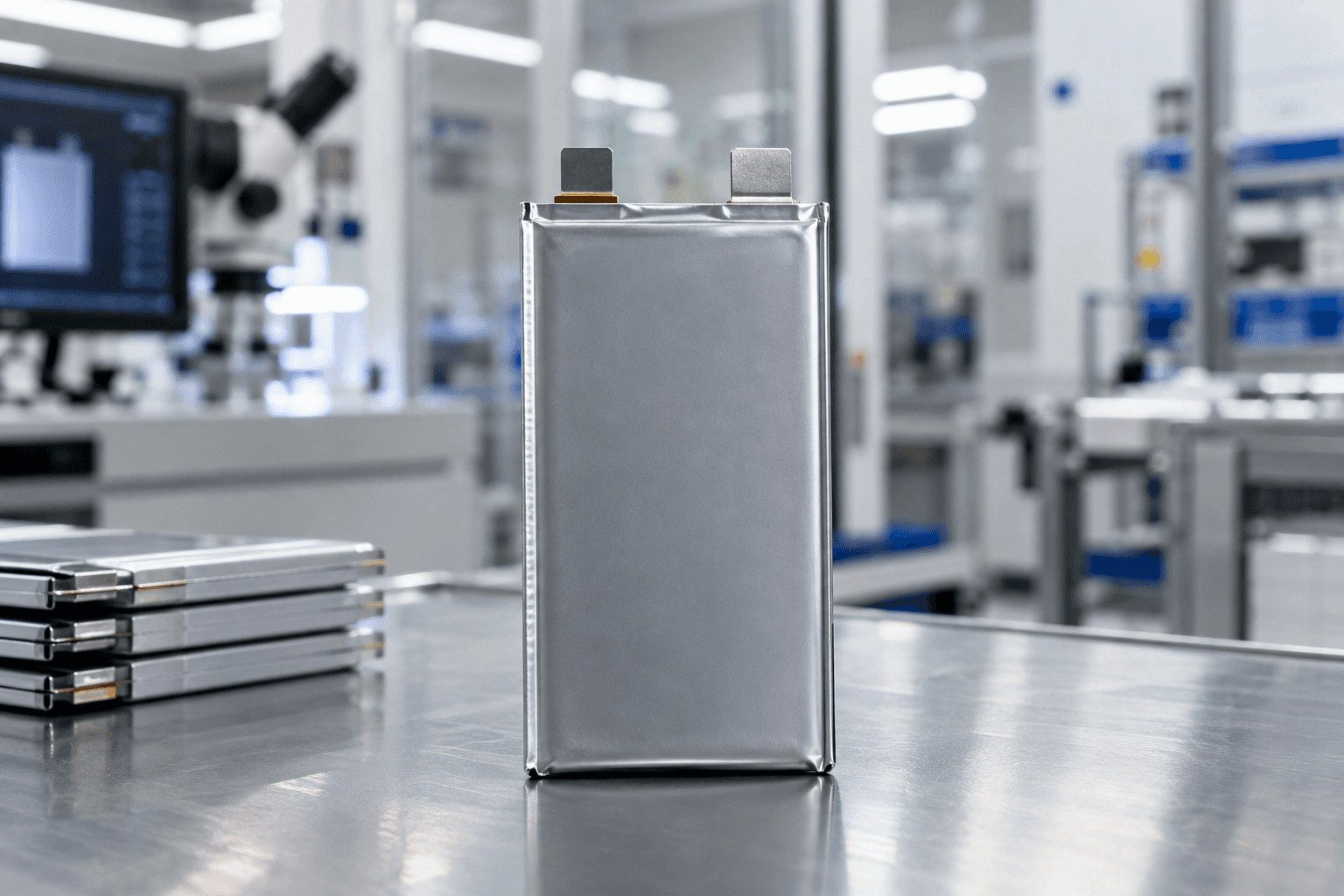
The Solstice cell combines an NMC cathode with a lithium-metal anode. It is also designed to use a dry cathode coating process, which could eventually simplify manufacturing steps and reduce the use of solvents.
Factorial claims an energy density of up to 450 Wh/kg for the technology. However, the company has not yet clearly specified whether this figure applies to an individual cell or a complete battery pack. The figure therefore has limited value for direct comparisons with today’s production vehicles.
Factorial has reported 40 Ah Solstice cells and A-samples, meaning early engineering prototypes. A-samples are primarily used to validate the concept and its functionality. Further development stages, extensive vehicle testing and qualification of the entire supply chain are generally required before robust high-volume production can begin.
FEST and Solstice are at different stages of maturity
Factorial is developing several battery platforms in parallel. Solstice is the more ambitious solid-state concept, while FEST technology has already been delivered to Mercedes-Benz as B-samples—later-stage engineering prototypes—with capacities exceeding 106 Ah.
| Platform | Known development status | Technical focus |
|---|---|---|
| Solstice | A-samples, 40 Ah | Solid electrolyte, lithium-metal anode, dry-coated cathode, up to 450 Wh/kg |
| FEST | B-samples, more than 106 Ah | More advanced validation with automakers |
Mercedes-Benz, Stellantis, Hyundai and Kia are supporting Factorial. FEST is also being developed in partnership with SK On, while cells from this platform are already being tested in connection with Dodge. Solstice is explicitly being developed further together with Mercedes.
Why the partnership matters for electric vehicles
Higher gravimetric energy density could enable lighter batteries with the same capacity. Lower battery weight → potentially lower energy consumption, greater range or more flexibility for chassis and interior design.
Whether Solstice can actually deliver these advantages in a production vehicle depends on more than its peak Wh/kg figure. Other crucial factors include service life, fast-charging capability, performance at low temperatures, safety, production yield and cost.
Factorial’s approach is part of a growing race to develop solid-state cells suitable for industrial production. Another recent development is a solid-state battery with 381 Wh/kg entering limited production. BYD is also preparing a Yangwang prototype with a solid-state battery for vehicle testing.
The agreement with Mitsui Kinzoku is not yet a green light for high-volume production. However, it shows that Factorial is now specifically building the materials expertise needed to bridge the gap between a promising cell and a vehicle battery that can be manufactured reliably.