Porsche Tests a Closed-Loop Battery System
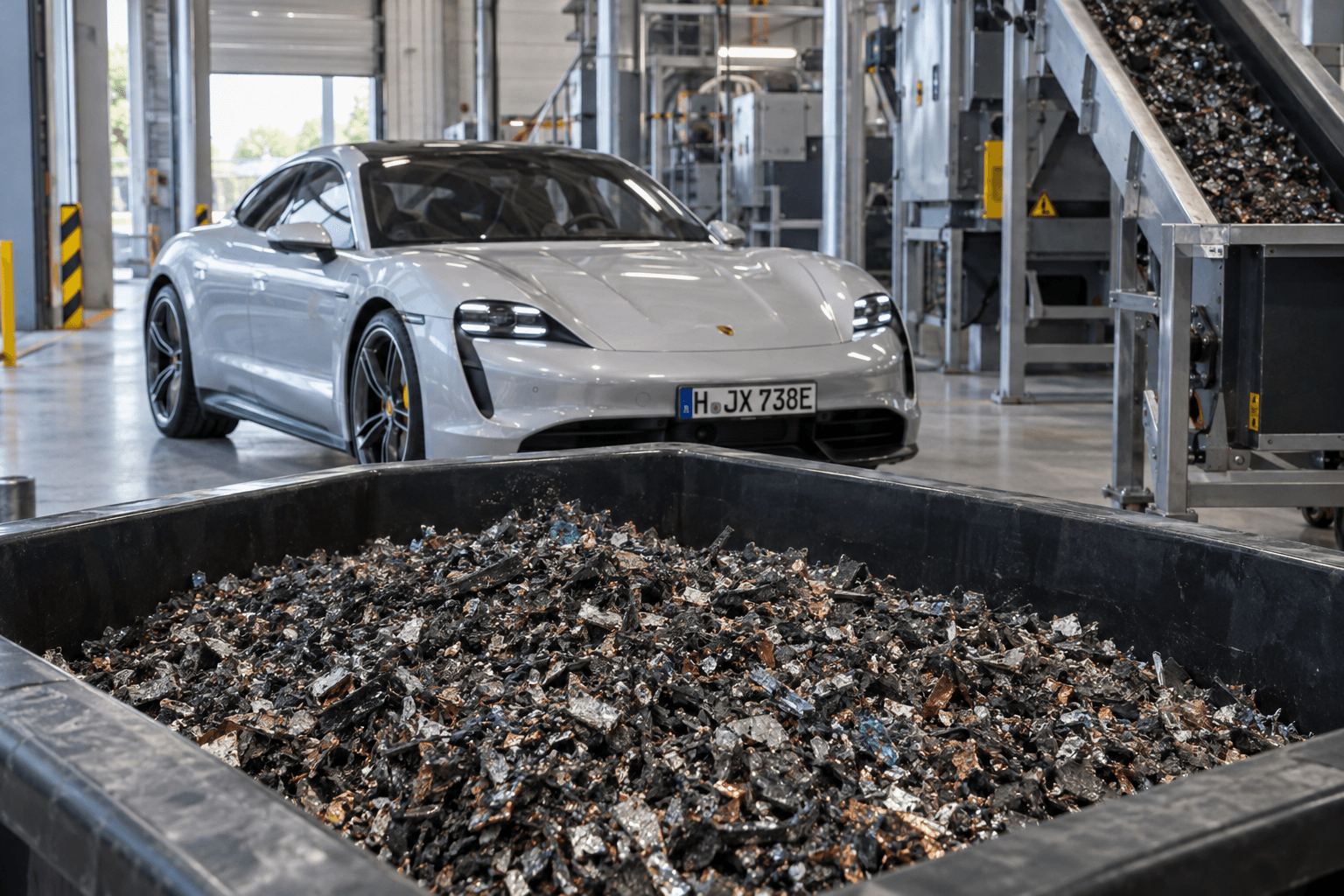
Porsche has reported progress in recycling high-voltage batteries. According to the manufacturer, a collaborative project has for the first time produced the active material for a battery cathode entirely from raw materials recovered from Porsche batteries.
The precise wording is important: The complete battery cell is not made from 100% recycled material. The stated percentage refers to the cathode active material, a particularly resource-intensive component of the cell.
The pilot project demonstrates that recovered battery raw materials can be processed into cathode active material again. However, this does not yet confirm that the process can be transferred to series production.
What Was Recycled From the Porsche Battery?
The active material largely determines how lithium ions are stored between the cathode and anode. Depending on the cell chemistry, it may contain lithium, nickel, manganese, or cobalt, among other materials. Porsche’s announcement does not specify the exact composition used in the pilot project.
To create a closed loop, used batteries must first be dismantled and processed. The relevant raw materials are then separated, purified, and restored to a quality suitable for new cathode material. This final step is particularly demanding because contaminants can impair a cell’s performance and service life.
| Confirmed | Still unknown |
|---|---|
| Cathode active material made from 100% recycled raw materials | Cell chemistry used |
| Raw materials sourced from Porsche high-voltage batteries | Recovery rate and quantity of material |
| Implemented as part of a pilot project | Cell performance, service life, and production yield |
| Material was reprocessed for use in a cathode | Series-production date, costs, and planned vehicle models |
Why Battery Recycling Is Becoming More Important for Europe
For Germany, Austria, and Switzerland, this approach is particularly relevant in terms of supply security and resource use. Recycled raw materials can reduce demand for newly extracted materials and lessen dependence on international supply chains.
In the European Union, the Battery Regulation is gradually tightening requirements for material recovery, recycling efficiency, and the future use of recycled content. Manufacturers must therefore not only develop high-performance batteries but increasingly consider their entire life cycle as well.
Recycling can generally reduce the carbon footprint, but this cannot yet be quantified for Porsche’s project. Information is missing about the energy required for processing, transportation distances, and the comparison with newly extracted raw materials.
Recycling Begins Only After a Long Vehicle Life
For now, the most sustainable battery is one that can remain in use in a vehicle for as long as possible. The potential longevity of modern batteries is demonstrated by examples including the VW ID.3 after 220,000 km and other long-term experiences with electric vehicles in everyday use.
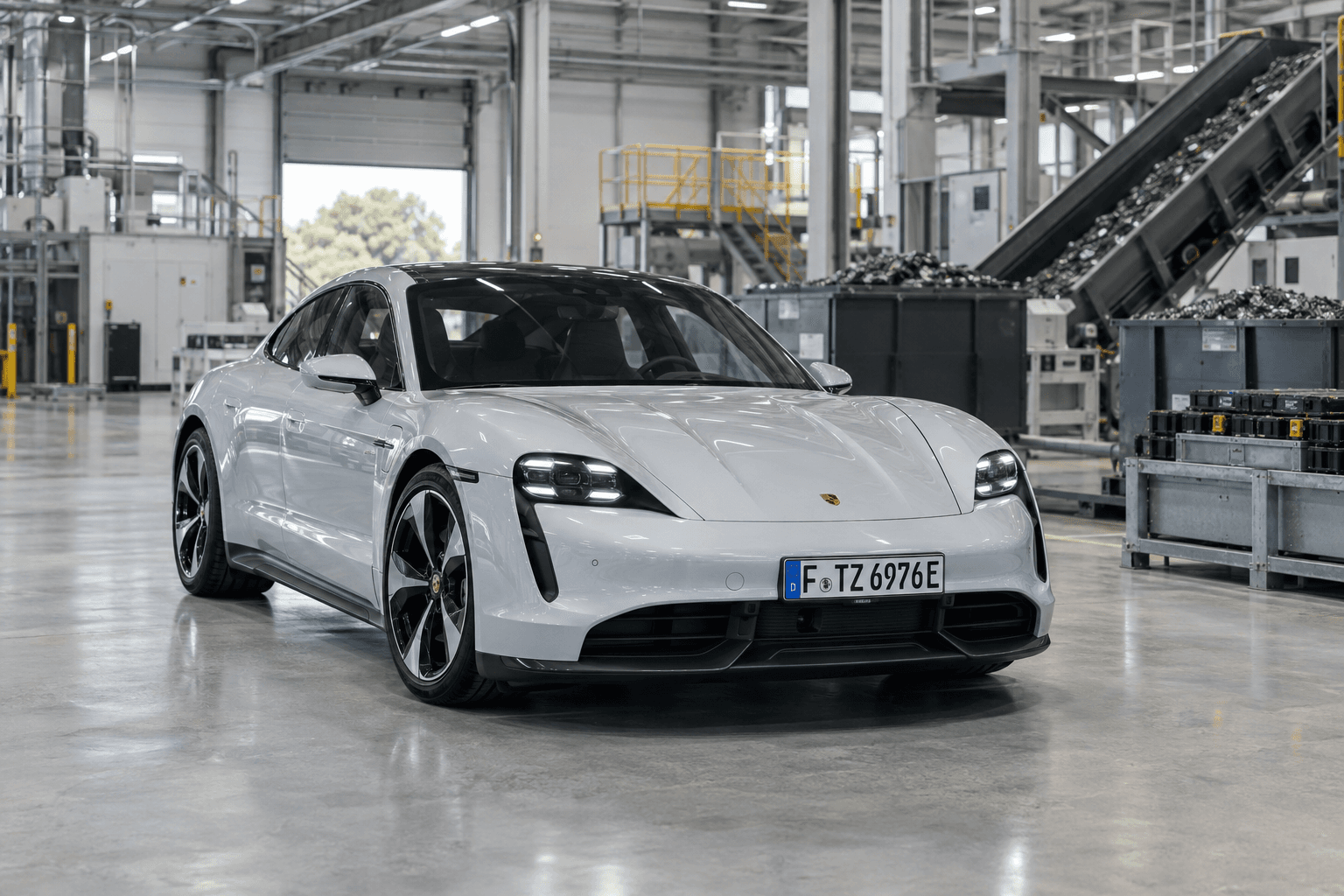
Material recycling comes only when repair, reuse, or deployment as stationary storage is no longer economically viable. For drivers of a Porsche Taycan, the pilot project therefore brings no immediate changes to range, warranty coverage, or battery replacement.
What the Project Means for Porsche Buyers
In the short term, the announcement has no apparent impact on vehicle prices or technical specifications. Porsche has named neither a series-production model that will use the new material nor a date for its deployment in regularly produced cells.
A direct comparison with other manufacturers is also difficult at present. Battery recycling is being advanced across the industry, but without information about costs, scalability, and recovery rates, it is impossible to assess how competitive Porsche’s process is.
An Important Proof of Concept With Unanswered Production Questions
The pilot project provides significant technical proof: Raw materials from end-of-life high-voltage batteries can once again serve as feedstock for a cathode. The next test will be industrial implementation with consistent cell quality and economically viable production volumes.
Only when Porsche publishes data on capacity, fast-charging performance, cycle life, and production volume will it be possible to reliably assess the significance for future electric vehicles. Until then, the project remains a worthwhile development step, but not yet a complete series-production loop.