ProLogium begins production of large solid-state cells
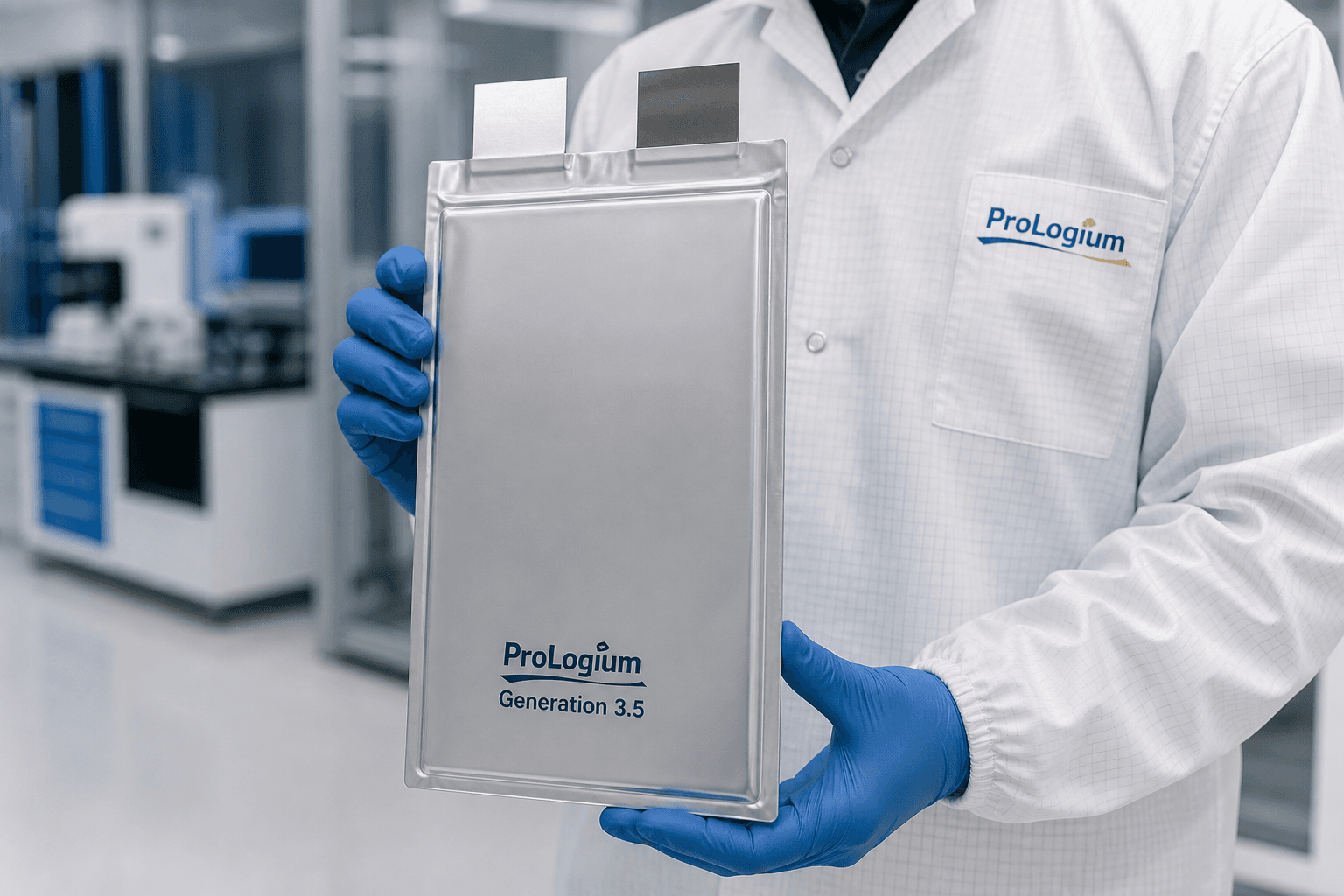
Taiwanese battery manufacturer ProLogium says it has begun series production of its large-format Generation 3.5 lithium-ceramic cell. The pouch cell has a capacity of 185.4 Ah and is being produced on a new assembly line at the Taoyuan site.
Its independently verified energy density is particularly noteworthy. TÜV, an independent German testing and certification organization, measured 381 Wh/kg and 903 Wh/l at cell level. This puts the cell well above the typical figures of today’s NMC and LFP cells.
At 381 Wh/kg, electric cars could be made lighter with the same battery capacity or offer more range with a similar battery weight.
How large the energy-density advantage is
| Cell chemistry | Gravimetric energy density | Assessment |
|---|---|---|
| ProLogium Generation 3.5 | 381 Wh/kg | Independently verified at cell level |
| Current NMC cells | Up to around 300 Wh/kg | High energy density, often used in long-range EVs |
| Current LFP cells | Around 150 to 200 Wh/kg | More affordable and durable, but heavier at the same capacity |
The comparison shows an advantage of around 27% over an NMC cell rated at 300 Wh/kg. The gap is even wider compared with LFP. Nevertheless, LFP batteries remain important because of their cost, robustness, and raw-material base, as developments in the Chinese LFP battery market also show.
For an electric car, higher cell-level energy density does not automatically result in an equally large increase in range. The housing, cooling system, wiring, and safety structures add to the weight of the complete battery pack. As a result, only part of the cell-level advantage carries over to the finished vehicle.
Solid-state status confirmed by heat test
Generation 3.5 was also tested according to the Chinese GB/T 43568-2026 testing method. The cell was kept in a vacuum at a constant 120°C for six hours. The measured weight loss was less than 0.05%, well below the threshold of 0.5%.
This test is intended to determine whether a battery genuinely uses a solid electrolyte system or still contains significant quantities of liquid components. ProLogium uses a composite solid electrolyte, a ceramic separator, and an additional edge structure for electrical insulation.
The test provides important evidence for classifying it as a solid-state cell. On its own, however, it says nothing about service life, production yield, or costs in high-volume manufacturing. These factors will ultimately determine when the technology reaches affordable electric cars.
Eight-minute charging time does not yet apply to Generation 3.5
ProLogium states that the previous Generation 3 can charge from 5% to 80% in around 8.5 minutes. This figure cannot be applied to the newly manufactured Generation 3.5 without verification. Reliable data for the new large-format cell’s complete charging curve is not yet available.
Even a high-performance cell is not enough on its own to enable such short charging stops. The high-voltage system, cooling, power electronics, and charging station must work together. Our comparison of 800-volt and 400-volt architectures shows the role played by the voltage level.
For Generation 3, the company also reports safety tests involving gunfire, temperatures of up to 170°C, and overcharging at twice the rated voltage. The cells reportedly did not catch fire. However, further publicly verifiable stress and aging tests are needed for a conclusive assessment of Generation 3.5.
0.5 GWh is a start, but not yet mass production
Initial annual capacity in Taiwan is 0.5 GWh. In purely mathematical terms, that is enough for around 6,000 electric-car batteries with a capacity of 80 kWh each. This is modest compared with large battery factories, but it represents a significant step toward industrializing a new cell technology.
The capacity of the Taiwanese site is expected to double by 2030. The planned factory in Dunkirk, France, is considerably larger and is scheduled to begin operations in 2028. Initial capacity is set at 4 GWh per year, with the site potentially expanding to as much as 44 GWh later.
Mercedes-Benz is one of the battery manufacturer’s prominent backers. This makes future use in a vehicle plausible in principle, but it does not yet amount to confirmation of a specific model or a binding series-production date.
Generation 4 aims to improve cold-weather performance and charging speed
ProLogium is already working on the next cell generation. Generation 4 is expected to use a fully inorganic electrolyte, enabling even faster charging and better performance at low temperatures.
Another detail is crucial for scaling up industrial production: existing Generation 3.5 production lines are expected to be convertible with changes to only around 10% of the equipment. If this works in practice, ProLogium could manufacture the next development stage more quickly and with lower investment.
The start of production therefore represents more than a laboratory announcement, but it is not yet a breakthrough for the mass market. The verified energy density is compelling; production volumes, durability, and competitive costs must now follow.