Rivian asks selected R2 owners to suspend DC fast charging for now
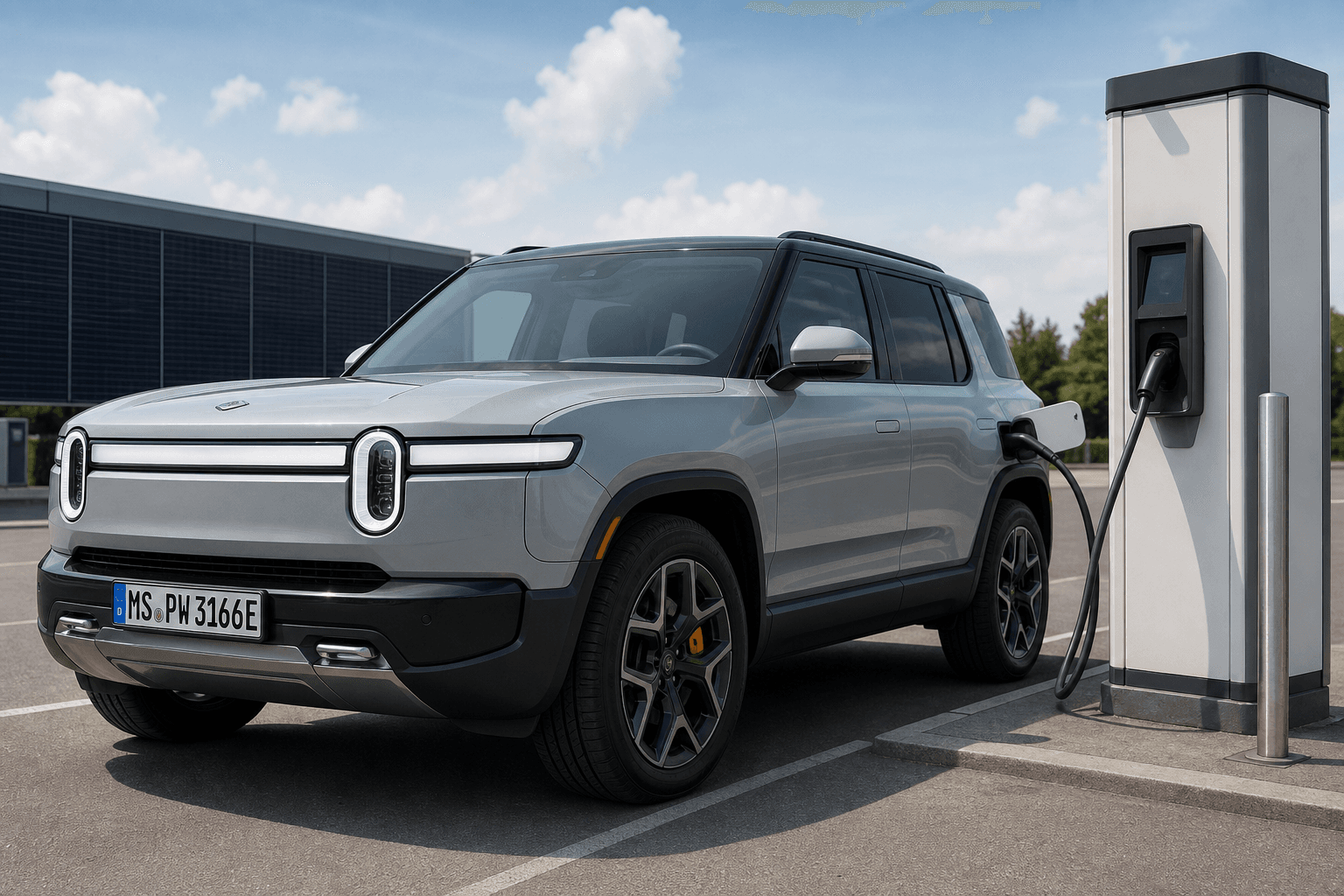
Rivian has contacted individual Rivian R2 owners directly through the app and asked them to avoid DC fast charging (DCFC) until a technical inspection has been completed. The vehicle can reportedly be used normally until the appointment; only fast charging at high-power chargers (HPCs) should be paused. Apparently, not all vehicles are affected, but rather selected units from a specific production batch.
What exactly is being inspected?
According to the details known so far, Rivian is carrying out a technical inspection of the DC charger header, a component of the high-voltage charging hardware. The stated reason is a gap tolerance issue at the connection between the connector and the header. Rivian is examining the high-voltage distribution area, which is subjected to particularly high loads during DC charging.
If necessary, assemblies will be replaced—specifically, a DCFC Header Assembly and a DCFC Connector Assembly. That sounds like a clearly defined hardware fix rather than a software-only update.
Vehicles selected by batch rather than telemetry
What is interesting is how Rivian identifies the affected vehicles: According to reports, the service action is based on vehicle identification numbers (VINs) and therefore on a specific production batch. Some customers initially assumed that Rivian had acted on vehicle data (telemetry), but later found that the selection was apparently linked to production records.
Is this a recall?
At present, there is no indication that a formal recall process has already been initiated through a U.S. authority. That does not necessarily mean the issue is minor, but it suggests that Rivian is initially inspecting specific vehicles and repairing them where necessary. Proactive service actions of this kind are not unusual in practice, especially when manufacturers want to isolate potential production variations early in a model’s life cycle.
What does this mean in everyday use?
For those affected, the impact is primarily logistical: pausing DC charging means relying more on AC charging while traveling or temporarily adjusting charging plans. Drivers who frequently make long-distance trips will notice the limitation immediately. Those who mainly charge at home or at work will generally experience far fewer restrictions.
Assessment: Early deliveries often come with teething problems
The R2 rollout only began a few months ago. At this stage, rework on individual components is not unusual, because manufacturing and supplier tolerances sometimes become apparent in real-world use more quickly than during pre-production testing. Rivian had previously also temporarily paused an order configuration due to a paint or color issue, which likewise falls into the category of smoothing out early production.
Context for the DACH region: Rivian is not yet a major player here
For Germany, Austria and Switzerland—the DACH region—the report is primarily interesting as a technical signal: It shows how sensitive the design of DC charging hardware is, because high currents and heat generation can magnify even minor tolerance issues. This is precisely why many manufacturers are investing in new architectures and more robust charging pathways, including 800-volt systems.
If you are interested in the technical aspects of fast charging, also read our comparison 800V vs. 400V: Which EV architecture will you need in 2026?. And if you are generally struggling with charging efficiency at home, our article EV charging losses: How to save the most at home can help.
Comparison: This is not unique to Rivian
Other manufacturers also repeatedly have to refine hardware details on new models, without this necessarily indicating a broader safety problem. When it comes to charging in particular, stability, thermal management and connector interfaces are persistent challenges. Tesla, for example, has invested considerable expertise in scaling fast-charging use, while new features such as bidirectional charging demonstrate just how complex the overall charging interface is. Related: The Tesla Model Y is getting V2L—here is what is behind the adapter.