Polestar 4 SUV: Less Coupé Show, More Everyday Usability
Polestar is expanding the Polestar 4 range with an SUV version. The approach is quite clear: less of a stylish coupé concept and more practical value. Demand for SUVs remains high, particularly in the DACH region—Germany, Austria and Switzerland—and across Europe in general, so manufacturers respond accordingly when they need higher sales volumes.
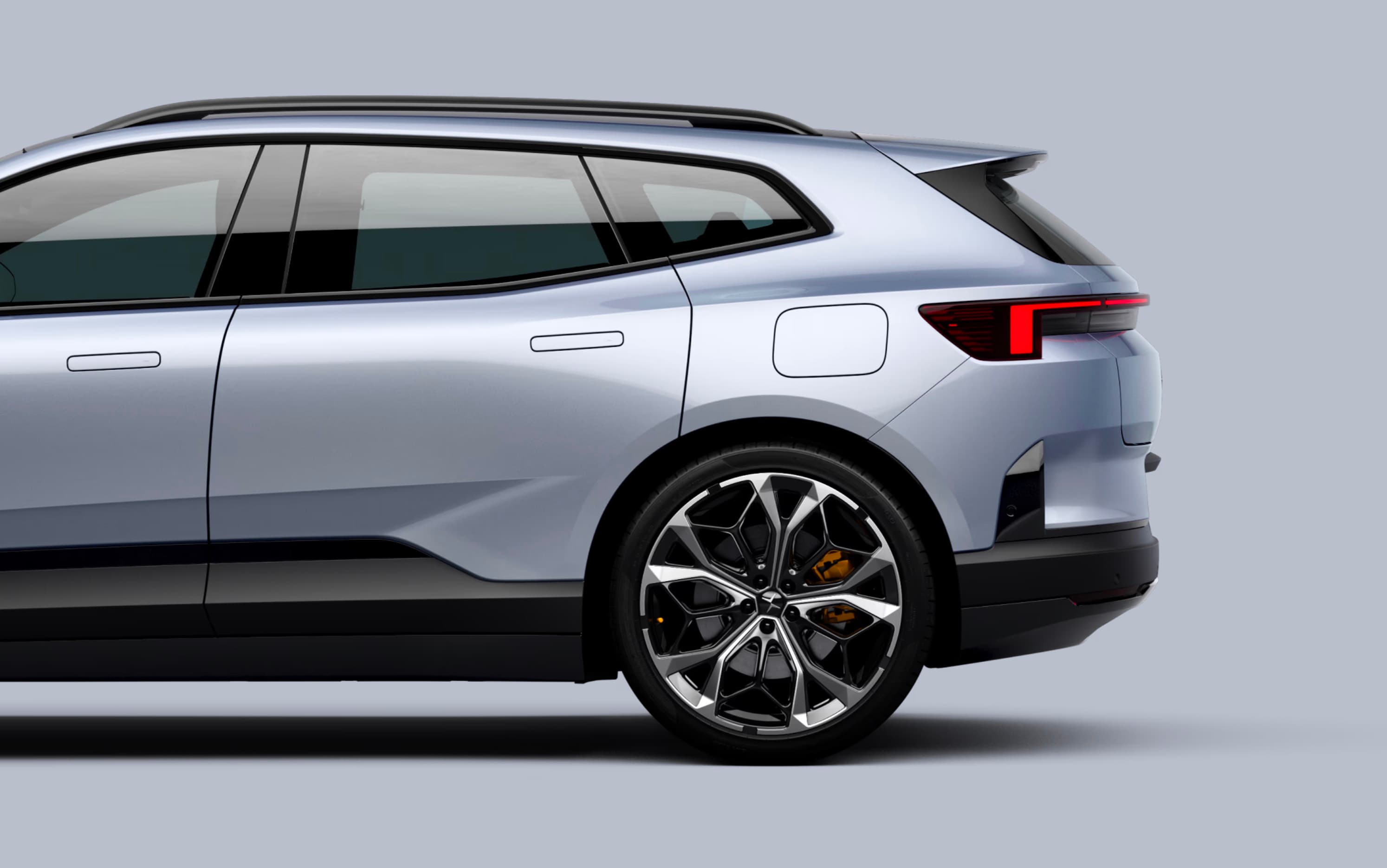
While the existing Polestar 4 has divided opinion with its unusual rear end without a conventional window, the SUV variant moves back toward the mainstream. This is not a capitulation but a pragmatic move: everyday practicality often sells better than a bold design experiment.
The Rear Window and Rearview Mirror Are Back
The SUV version once again features a conventional tailgate with a rear window, which also means the return of a normal rearview mirror. In the existing concept, the view behind the car is displayed via a camera. That may be technically impressive, but it is not for everyone, especially in rain, when the camera is dirty or when drivers simply prefer the familiar view through the rear window.
Ultimately, this means a less futuristic appearance but a more familiar user experience. For many buyers, that is precisely what turns a car from “interesting” into something they would actually order.
Charging: 400 Volts, Up to 200 kW and Around 30 Minutes
Technically, the Polestar 4 SUV retains its 400-volt system. Fast charging is rated at up to 200 kW, with Polestar quoting around 30 minutes to charge from 10% to 80%. That is perfectly suitable for everyday use, but by 2026 standards it appears relatively conservative compared with the wider market, as a growing number of models adopt 800-volt architectures and very short charging times.
Anyone wanting to understand why 800 volts often has an advantage can find an overview in our 800V vs. 400V comparison. Importantly, not every 800-volt car automatically charges faster all the time, but the setup generally makes it easier to achieve high charging power and maintain stable charging curves.
Powertrain and Range: Up to 630 km or More Performance
The rear-wheel-drive version is rated at 200 kW and 343 Nm of torque. It also has a large 100 kWh battery, which is expected to provide a range of up to 630 km. On paper, that is a strong package for an SUV, particularly for commuting and long-distance travel with fewer charging stops.
Alternatively, an all-wheel-drive variant offers 400 kW and 686 Nm. Here, the focus is more on performance, including 0 to 100 km/h in 3.9 seconds. As usual, more power often means slightly less range in practice, depending on how frequently drivers make use of that performance.
Cargo Capacity: Where the SUV Really Improves Everyday Practicality
The practical benefits are most apparent in the cargo area. Polestar quotes 530 liters of cargo capacity, increasing to 655 liters when loaded to the roof. With the rear seats folded, capacity is expected to reach 1,665 liters.
| Cargo configuration | Capacity |
|---|---|
| Standard | 530 liters |
| Loaded to the roof | 655 liters |
| Rear seats folded | 1,665 liters |
For families, dog crates, sports equipment or company-car users in particular, this is often the decisive difference. A coupé-like appearance is nice, but a more upright tailgate is simply better when loading cargo.
Price and Competition: An Appealing Package if You Prioritize Range Over Charging Records
A starting price of around €58,000 is being discussed. That positions the Polestar 4 SUV as a premium SUV with plenty of range and strong performance, although without the headline-grabbing charging speeds currently in vogue.
Buyers looking for a vehicle of a similar size with a particular focus on efficient long-distance travel and an established charging network may quickly turn to the Tesla Model Y. Those shopping in the premium SUV segment who like Polestar’s design language, however, will find this a significantly more practical interpretation of the Polestar 4.