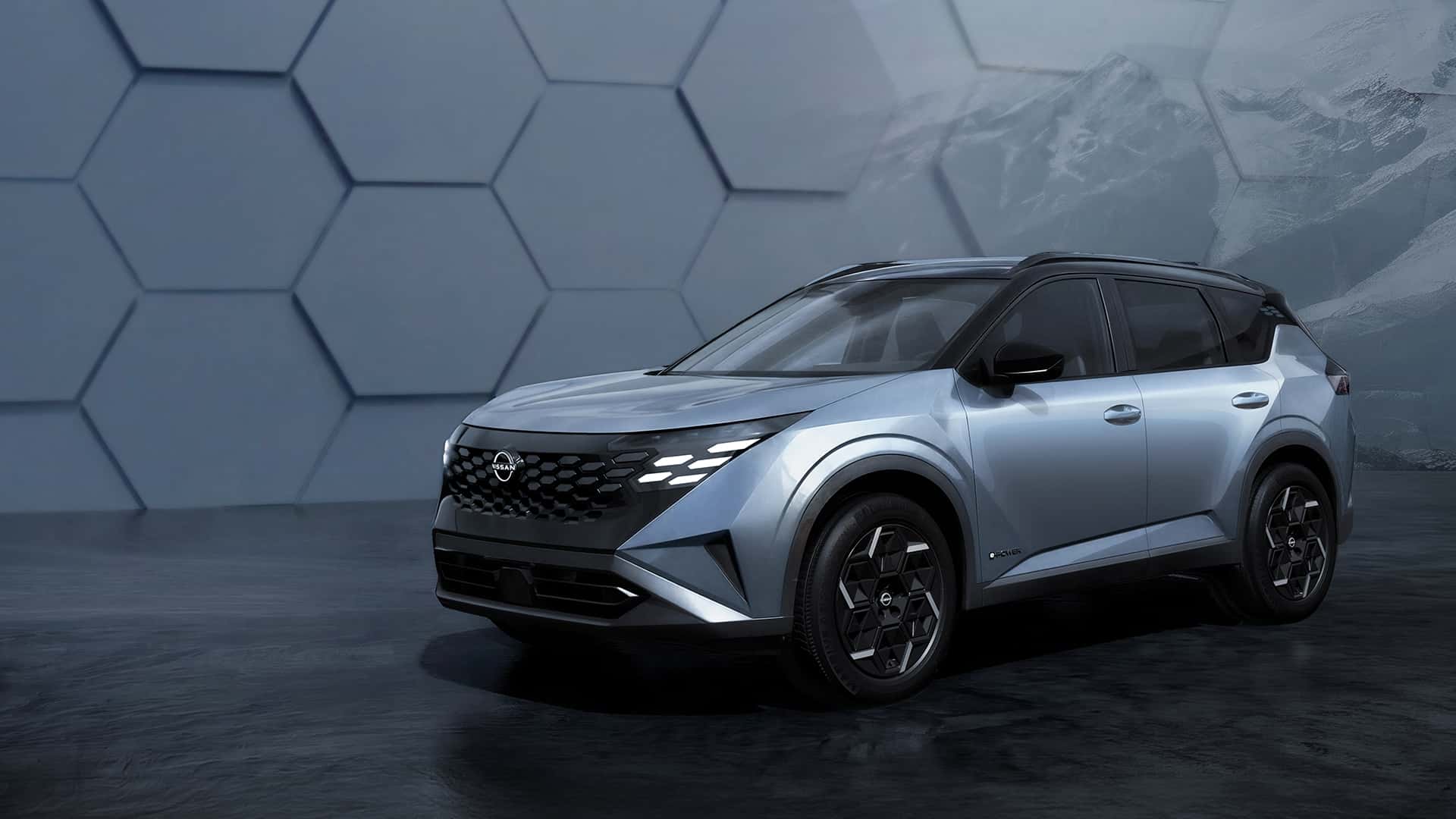
Nissan Accelerates Rogue e-Power Launch, Hybrid Arrives in November
Nissan is launching the Rogue e-Power earlier than planned, with its US debut now scheduled for November. The original timeline had called for a much later launch, and more recently there had even been talk of a date sometime in the next few years. The hybrid is now set to lead the new Rogue generation, before the non-electrified variants follow.
The reason is clear: The hybrid market is booming in the US, as high fuel prices prompt many buyers to choose more efficient SUVs. Toyota and Honda have been exceptionally strong in this segment for years. Nissan wants to close this gap with its own system, based on a different technical approach.
What Is e-Power, and Why Does It Drive Differently From a RAV4 or CR-V?
The Rogue e-Power is not a conventional parallel hybrid like many Honda models, nor does it use a power-split system like Toyota. Instead, Nissan uses a series hybrid: The wheels are always driven by electric motors. The combustion engine primarily acts as a generator, producing electricity for the drivetrain and supplying the small battery.
In everyday driving, this often creates a very EV-like experience: immediate response from the accelerator, smooth power delivery, and fewer conventional gear changes. In short: combustion engine runs → electricity is generated → electric motors drive the wheels.
Key Technical Specifications at a Glance
| Component | Nissan Rogue e-Power (Series Hybrid) |
|---|---|
| Wheel drive | Electric motor(s) only |
| Role of combustion engine | Generator for electricity (does not drive the wheels directly) |
| Engine | 1.5-liter turbocharged three-cylinder |
| Battery | around 2 kWh |
| Plug-in charging | No, charging only via the engine and regenerative braking |
A Series Hybrid Is Not a Plug-In—or the EREV Many Expect
An important distinction: The Rogue e-Power has no charging port. It is therefore not a plug-in hybrid, but a hybrid that charges its battery exclusively through the combustion engine and regenerative braking. At around 2 kWh, the battery is also significantly smaller than those used in plug-in systems.
In practice, the focus is less on long-distance electric driving and more on efficiency and the driving experience. This is particularly interesting from the perspective of the DACH region—Germany, Austria, and Switzerland—where such concepts are often viewed as a bridge technology: as convenient as a conventional hybrid, but closer to driving an EV. However, anyone who can regularly charge at home or work will usually get a more direct and less expensive energy path per kilometer with a true battery-electric vehicle.
Fuel-Economy Target: Nissan Aims to Match the Hybrid Leaders
Nissan says the Rogue e-Power should deliver fuel economy broadly on par with a Toyota RAV4 Hybrid and slightly better than a comparable Honda CR-V Hybrid. However, that does not yet provide figures comparable under EU standards, as US fuel-economy ratings and local European test cycles are only comparable to a limited extent.
The key question will be whether Nissan can deliver on this promise under typical SUV conditions: highway driving, winter operation, and a full load. In the real world, these are often the situations that separate genuinely well-tuned hybrids from those that are merely “okay.”
Market Reality: Why Nissan Is Bringing the Launch Forward
The Rogue already sells strongly in the US, but most of the growth in hybrids is happening among its competitors. Many buyers are now deliberately choosing hybrid variants, which already account for a large share of sales for some models. Nissan wants to capitalize on this momentum before it becomes even more firmly established.
For Europe and the DACH region, the news is particularly interesting as a signal of technological direction: Series hybrids are currently enjoying a global resurgence because they can combine efficiency with an EV-like driving experience, without requiring charging infrastructure or established charging habits.
From an EV Perspective: Benefit or Detour?
From Elektroquatsch’s perspective, the Rogue e-Power is particularly interesting if you want the EV driving experience but cannot yet charge reliably. It is not a substitute for a fully electric car, but it is a technically sound solution for certain use cases. By contrast, anyone who can sensibly integrate a battery-electric vehicle into everyday life will generally be more efficient overall and likely spend less in the long run.
Who This Approach Could Suit
- High-mileage drivers without a dedicated charging option at home or work
- People who like the linear power delivery of an EV but do not want to rely on charging
- SUV buyers seeking efficiency without having to maintain the charging discipline required by a plug-in
Who It Is Less Suited To
- Anyone who can charge regularly and wants maximum energy efficiency
- Buyers who expect genuinely electric commutes without the combustion engine running
If you are generally interested in how quickly range concerns can arise and what really helps in practice, also read our guide to EV range anxiety.
And if “hybrid as a bridge” makes you think more of modern range extenders, this look at their development is worth reading: Xiaomi SkyNomad and the Long Development of Its Range Extender.
For a contrast from the Tesla world, where efficiency and real-world range are widely discussed—especially for the high-volume model—our test-focused article on the Tesla Model Y Standard’s efficiency is also relevant.
The Rogue e-Power is not a plug-in, but for many people it could be the first car that feels like an electric vehicle in everyday use without ever having to handle a charging cable.