131 New Fast Chargers at Highway Rest Areas, with NACS Taking Center Stage
South Korea is further expanding its fast-charging network along its highways. Charging infrastructure provider Chaevi has been selected as the preferred bidder for an expansion program and is set to install a total of 131 new chargers at 29 highway rest areas.
The plans primarily call for 118 high-power chargers rated at 200 kW, supplemented by 13 multichargers. In practical terms, this means more charging points where long-distance travel actually takes place and less risk of ending up in a queue on busy travel days.
Why This Is Particularly Relevant to Tesla Drivers
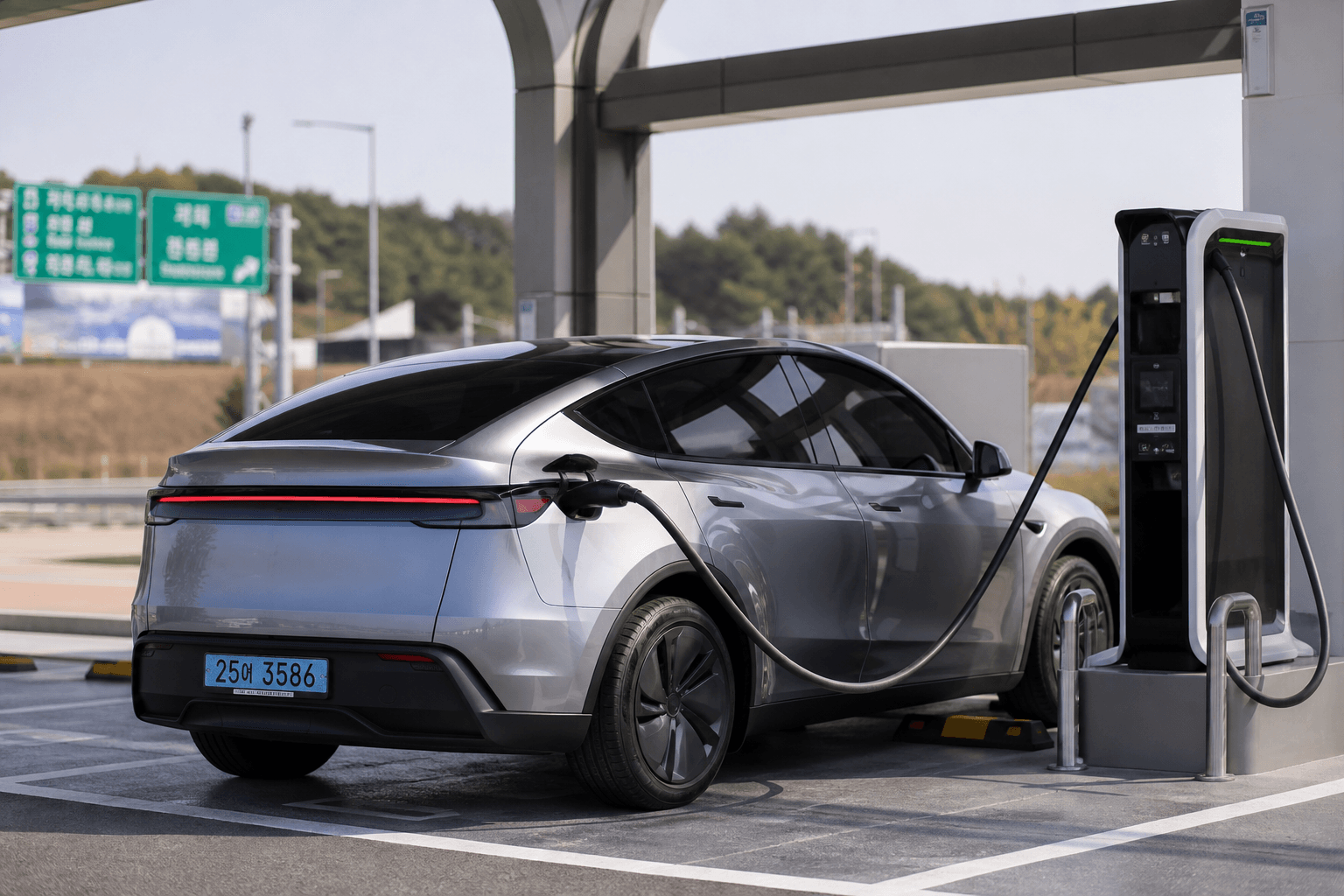
The most interesting aspect is the choice of connector. Chaevi intends to equip a large share of the new chargers with the NACS standard, widely known as the Tesla connector. Specifically, 82 of the new chargers are expected to offer a NACS connector, allowing Tesla drivers in South Korea to charge at these stations without a CCS1 adapter.
Combined with the 2025 and 2026 expansion packages, Chaevi says it aims to operate 167 NACS chargers at highway rest areas. That would represent around 62% of the chargers installed under these projects.
Technical Details: 200 kW and Up to 250 A
The 200 kW chargers with NACS are expected to deliver currents of up to 250 A. Depending on the vehicle and battery voltage, this can help make better use of the DC charging power supported by the car. Ultimately, it is not only the peak figure that matters, but also how consistently the charger maintains its output throughout the charging session and whether it is available—areas where highway hubs have an advantage.
Plug&Charge: Plug In, Charge and Pay
Plug&Charge is also expected to be available. Authentication and billing then take place automatically as soon as the cable is connected. No confusion with cards, no switching between apps and no need to start the session separately on the charger's display. For frequent drivers, this is a genuine convenience, especially when time is tight.
Utilization Cited as an Argument, but Without Firm Figures
Chaevi points to high utilization at sites it has already built: In July, the 109 charging bays installed under the 2025 expansion program reportedly recorded an average of around 2.5 times as many daily charging sessions per bay as “conventional” charging stations. However, the company provides neither absolute usage figures nor a clear description of the exact comparison group. Above all, the claim demonstrates one thing: Highway locations are attractive when the hardware is reliable and the sites are appropriately sized.
Chaevi Continues to Scale, but Charging Remains a Tough Business
According to its own figures, Chaevi operates around 6,000 of its own fast-charging points in South Korea. Including infrastructure managed for third parties, the company oversees about 10,000 fast-charging points. Chaevi is vertically integrated, covering everything from hardware development and manufacturing to installation and operation.
The expansion comes at a time when many charging providers have to prove themselves: The company recently listed on KOSDAQ, South Korea's technology-focused stock exchange, raising around €64 million. At the same time, the market has doubts about growth and profitability in the charging business. Chaevi is targeting positive EBITDA in the fourth quarter of 2026 and an operating profit in 2027. More highway locations could help because high utilization and good sites typically improve profitability.
What This Means for the DACH Region: NACS as a Highway Strategy Sends a Signal
For Germany, Austria and Switzerland—the DACH region—NACS on highways currently offers more of a glimpse into the future, as CCS dominates here. Nevertheless, the move is noteworthy: It shows that operators do not see NACS solely as a US phenomenon, but as a practical option for Tesla drivers in certain markets.
Anyone interested in charging a Tesla and the relevance of connector standards, charger activation and convenience features can find relevant background information and examples from the Tesla world on our site.
Also relevant: Tesla Model Y gets V2L—what is behind the adapter, 800V vs. 400V: Which EV Architecture Will You Need in 2026?, as well as the model page for the Tesla Model Y.