The EQS Is Getting the Technology Boost Many Had Expected
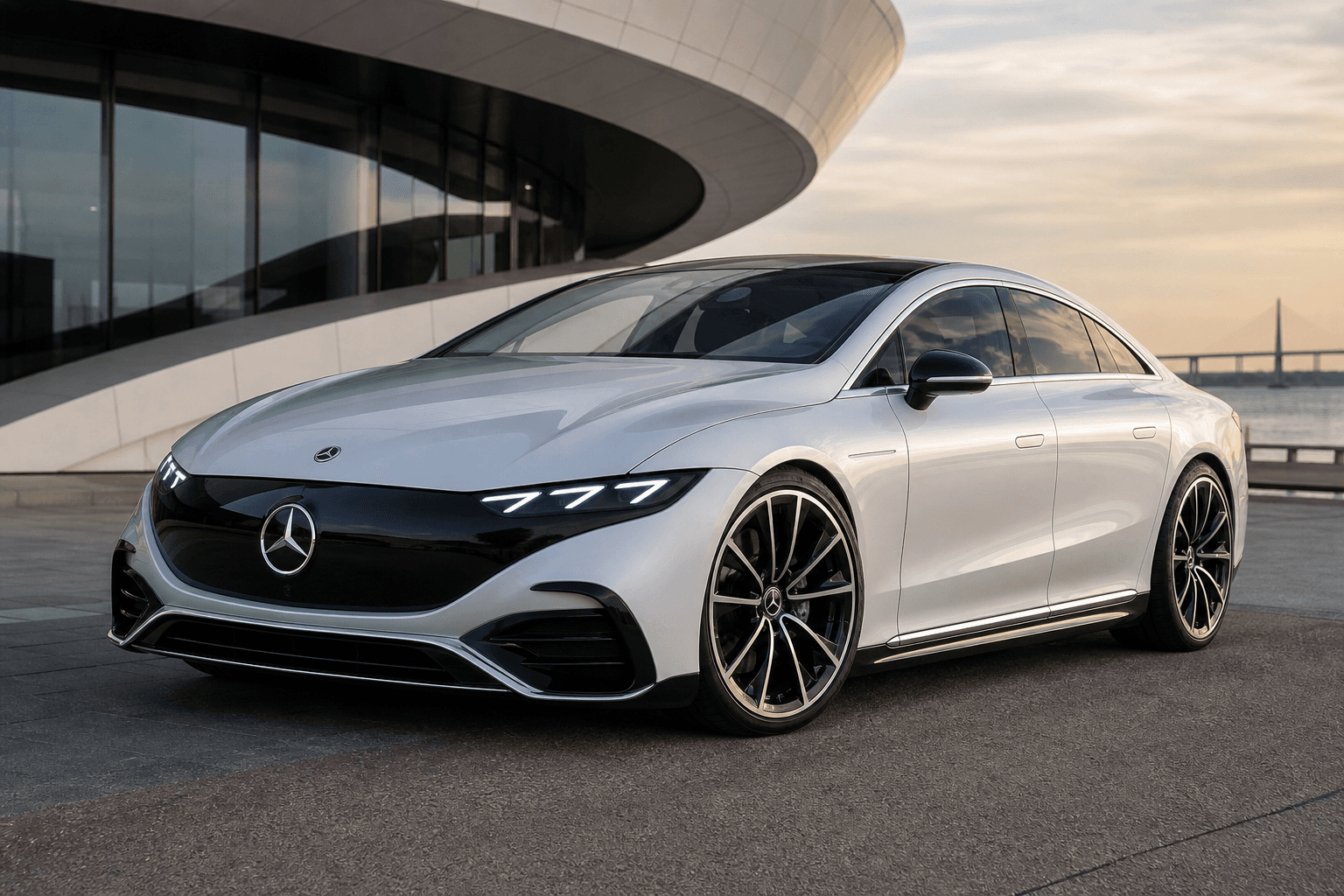
The Mercedes EQS was intended from the outset to be the brand’s electric flagship, but it has had a harder time in the market than Mercedes had hoped. Its design and positioning are polarizing, and customers expecting a traditional S-Class do not automatically feel at home in the EQS. That is precisely why the latest technology update is so important: It does not focus on cosmetic changes, but on the key issues of long-distance driving, charging and high-tech features.
At the center is the EQS 450+ as a comfort-focused cruiser. Mercedes combines a larger amount of usable battery energy with a new 800-volt electrical system, enabling the next advances in fast charging. Optional steer-by-wire is also being added, meaning steering without a mechanical connection between the steering wheel and the front wheels.
800 Volts and 350 kW: What They Really Deliver in Everyday Use
The major change is the switch to 800 volts. This is more than just a buzzword: It directly affects charging performance and thermal management because lower currents are required for the same power output. In practice, that means less strain on cables and components, better conditions for high charging power and more consistent charging windows.
Mercedes quotes a DC charging rate of up to 350 kW for the EQS. From this, the manufacturer makes a very tangible claim: around 300 km of range in 10 minutes at a suitable high-power charging (HPC) station. As always, context matters: Figures like these depend on temperature, battery preconditioning and the starting state of charge. Nevertheless, the direction is clear: Charging stops are intended to become significantly shorter and more predictable.
If you are interested in the fundamental differences between these systems, take a look at our overview of 800V vs. 400V in electric cars, because this is precisely where many platforms and model generations diverge in 2026.
Larger Battery and New Cell Chemistry: Range as a Statement
Mercedes is updating the battery pack with additional capacity and new cell chemistry. After initially being expanded to 118 kWh, the pack is now expected to offer 122 kWh. For the EQS 450+, Mercedes quotes a maximum range of more than 920 km before the next charging stop. That sends a clear signal to company-car users and high-mileage drivers who see range not as a topic for debate, but as a comfort feature.
For customers in the DACH region—Germany, Austria and Switzerland—the absolute maximum figure matters less than the combination of strong highway range and rapid recharging. That is exactly the sweet spot for a large sedan: relaxed travel through Germany, Austria and Switzerland with only a few short stops, including in winter and on vacation trips.
EQS 450+ as a Long-Distance Sedan: Performance Is Not the Problem
The EQS is not primarily about “performance drama,” but about serenity. The specifications for the 450+ list 300 kW and 505 Nm, along with a top speed of 210 km/h. That is more than enough for effortless travel, and in this vehicle class, noise levels, efficiency and seat comfort often matter more than the last tenth of a second in a sprint.
Anyone surveying the segment will notice that benchmark discussions often revolve around range and charging, not just performance. This is also evident in major range comparisons such as our 2026 range ranking, where range is increasingly becoming a purchasing factor when charging speeds are high enough to match.
Steer-by-Wire and the “Pretzel” Steering Wheel: Useful or Just for Show?
An optional steer-by-wire system is expected to become available around the turn of the year, priced by Mercedes at 2,500 euros. Instead of a fixed steering column, sensors and actuators transmit steering inputs to the front and rear axles. The benefit is that the steering ratio can be much more variable, tight maneuvers require less steering-wheel rotation, and the design frees up installation space. It could also make right-hand-drive variants more efficient to develop.
The most striking element is the new steering-wheel design with its “pretzel” look. Similar shapes are already familiar from Tesla, although their usefulness depends heavily on the steering setup. With steer-by-wire, the concept can work better from a technical perspective because large steering angles can be achieved without constantly repositioning your hands. At the same time, it remains a matter of taste, as some drivers find the feel more artificial than that of conventional, mechanically connected steering.
More Rear-Seat Comfort, but the EQS Deliberately Remains Different from the S-Class
Mercedes is also upgrading comfort, particularly in the second row. New optional Executive seats are available for around 3,900 euros, with details such as a specially shaped footrest, a foldable front passenger seat and a rear backrest adjustable by up to 38°. Additional heating functions for the neck and shoulders are also included, along with pneumatic seat-cushion depth adjustment.
The Hyperscreen and heat pump are now fitted as standard. Overall, this makes the EQS more attractive as both a chauffeur-driven and long-distance car. Nevertheless, it is realistic to expect that the traditional S-Class will continue to appeal to more customers seeking a pure “old money” sense of luxury in the interior. The EQS instead plays more heavily to its high-tech and efficiency strengths.
Price and Positioning: Who the EQS Will Suit Better in 2026
An EQS 400 with 270 kW is named as the entry-level model, with a starting price of less than 95,000 euros. Above it will be a range of rear- or all-wheel-drive variants with significantly more power. For many prospective buyers, however, the decisive factor is unlikely to be “the most powerful version,” but rather the combination of long range, fast-charging capability and quiet cruising comfort.
Who Will Find the Technology-Updated EQS Particularly Appealing
- High-mileage drivers who want to keep charging stops short while traveling in maximum comfort
- Company-car users for whom range and high-power charging provide the greatest everyday convenience
- Technology enthusiasts who see 800 volts and steer-by-wire as genuine advances for the platform
Who May Still Not See the EQS as the Automatic First Choice
- Buyers who explicitly expect the appearance and presence of an “S-Class”
- Rear-seat passengers who prioritize the ultimate focus on luxury above everything else
Assessment: Why 800 Volts Is More Than a Specification Upgrade for the EQS
The EQS never fundamentally had a problem with what it could do, but rather with not feeling like what customers expect in this class. The update addresses precisely those expectations: long range, rapid recharging and modern, scalable technology. If Mercedes can deliver consistently high charging performance in everyday use, the EQS 450+ will become a much easier proposition to justify as a long-distance sedan.
And yes, Tesla shaped the segment early on with its focus on efficiency and the charging ecosystem. Mercedes is taking its own path here and is now catching up technologically without turning the EQS into a copy. That is good news for the market, because real competition is not created by slogans, but by shorter charging times, better efficiency and greater comfort over long distances.