Chinese Mazda CX-6e Gets a Technology Upgrade
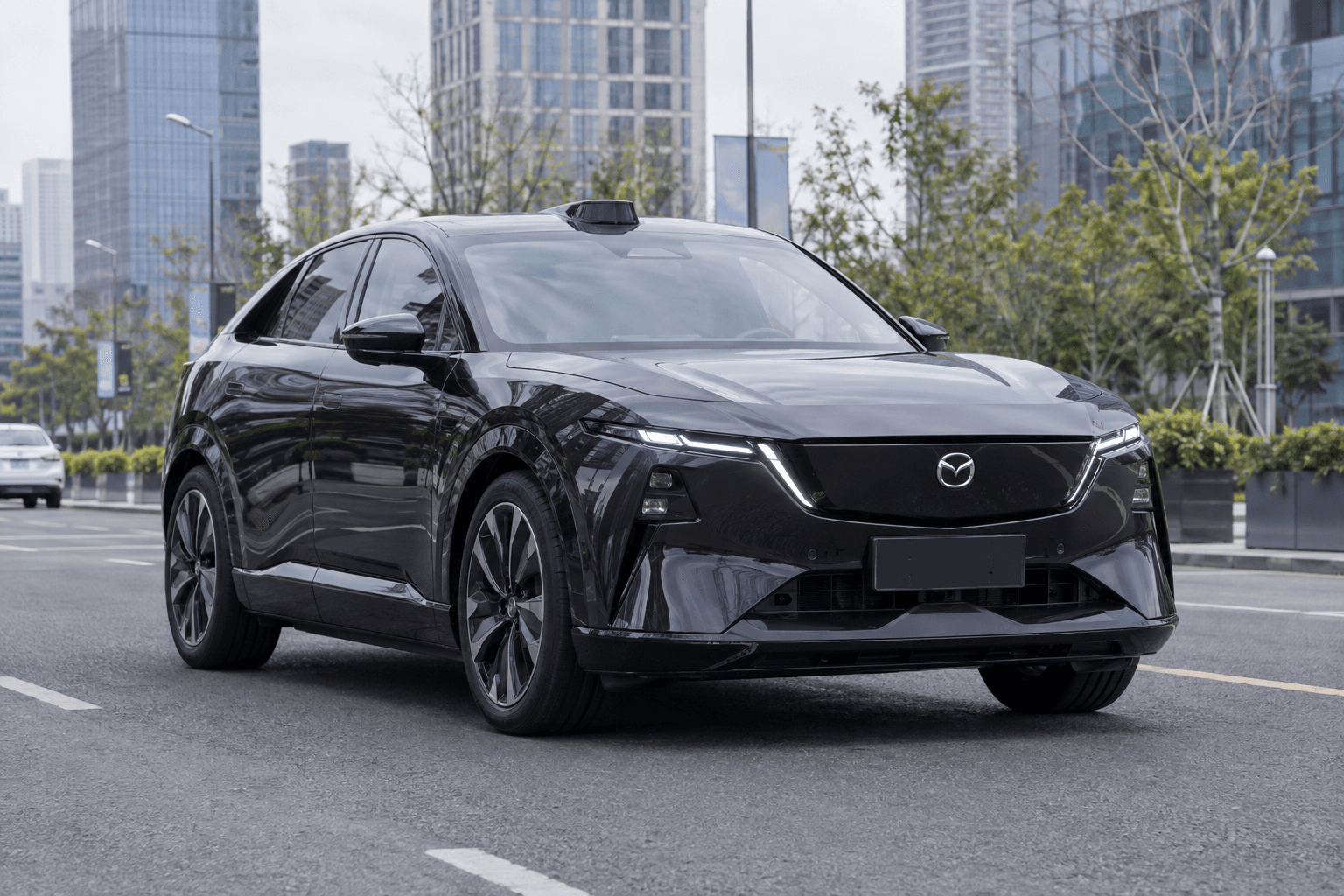
Mazda is adding a LiDAR-based driver assistance system to the electric CX-6e. The upgrade will initially launch in China in the Laser Edition of the electric SUV sold there as the EZ-60. The technology has not yet been confirmed for Germany, Austria or Switzerland.
The EZ-60 and the European CX-6e were developed through the partnership between Mazda and Changan. According to the available specifications, the powertrain remains unchanged, with an electric motor on the rear axle producing 190 kW and around 290 Nm. It is paired with an LFP battery with a capacity of just under 78 kWh, for which a range of up to 600 km is quoted in China under the local test cycle.
This range figure is not directly comparable with WLTP figures. Readers interested in the European version can find the specifications confirmed to date for the Mazda CX-6e for Germany in our model overview.
LiDAR Supplements Cameras and Radar Sensors
The new system does not rely solely on camera images. The LiDAR sensor uses laser pulses to scan the surroundings and create a three-dimensional representation. This can provide additional data, particularly when calculating distances, detecting hard-to-see obstacles and navigating complex traffic situations.
| Component | Quantity | Function |
|---|---|---|
| LiDAR | 1 sensor | Three-dimensional detection and distance measurement |
| Cameras | 11 | Detection of lanes, vehicles and other road users |
| Ultrasonic sensors | 12 | Close-range detection and parking maneuvers |
| Millimeter-wave radar | 3 sensors | Distance and speed measurement |
The sensor data is combined so that the vehicle can detect cars, bicycles and pedestrians. Mazda says this allows for more natural behavior during lane changes, evasive maneuvers and merging. Automated parking is also included.
Navigation on Highways and in Cities
On Chinese highways, the Level 2 system can assist with navigation-based driving maneuvers at speeds from 0 to 130 km/h. These include changing lanes, avoiding obstacles, and entering and exiting highways and rest areas.
In urban traffic, the system uses lane-level navigation from Tencent and an end-to-end architecture. Among other things, it is designed to respond to vehicles cutting in, construction detours and narrow roads. A group feature planned for a later OTA update will also allow the Mazda to follow a vehicle ahead along a route.
Despite LiDAR, Level 2 does not mean full autonomy: The driver remains responsible and must continuously monitor traffic.
This puts Mazda in a similar category to other navigation-assisted driving systems on the Chinese market. The precise distinction between driver assistance and autonomous driving is also crucial for Tesla’s upcoming FSD generation.
Emergency Braking System Is Also Designed to Take Evasive Action
Mazda specifies concrete operating limits for automatic emergency braking. The system is designed to respond to a stationary obstacle ahead at speeds of up to 110 km/h. For pedestrians detected moving parallel to the road, the stated limit is 90 km/h, while for pedestrians and cyclists crossing the road it is 60 km/h.
The technology is designed to account for people who suddenly appear or vehicles crossing the road at speeds of up to 50 km/h. If the braking distance is insufficient, the system can combine braking with assisted evasive steering. However, these figures describe defined test scenarios and do not guarantee that every accident will be successfully avoided.
According to the manufacturer, the Laser Edition completed eleven officially supervised safety scenarios. These included narrow mountain roads and nighttime highway driving in the rain. The vehicle subsequently received a safety certificate from CATARC, the China Automotive Technology and Research Center.
Europe Must Wait for Confirmation
For Mazda, the LiDAR version represents an important technological step because the CX-6e is positioned as an international model. Nevertheless, the Chinese equipment cannot automatically be transferred to the DACH market—the German-speaking region comprising Germany, Austria and Switzerland. Sensors, map data, type approval and software features vary considerably by region.
Tencent’s lane-level navigation in particular is tailored to Chinese roads and digital services. A European version would therefore require adapted maps, separate validation and regulatory approvals. If Mazda later brings the package to Europe, it could make the CX-6e significantly more competitive in terms of driver assistance systems.