Croatia opens its roads to Tesla FSD
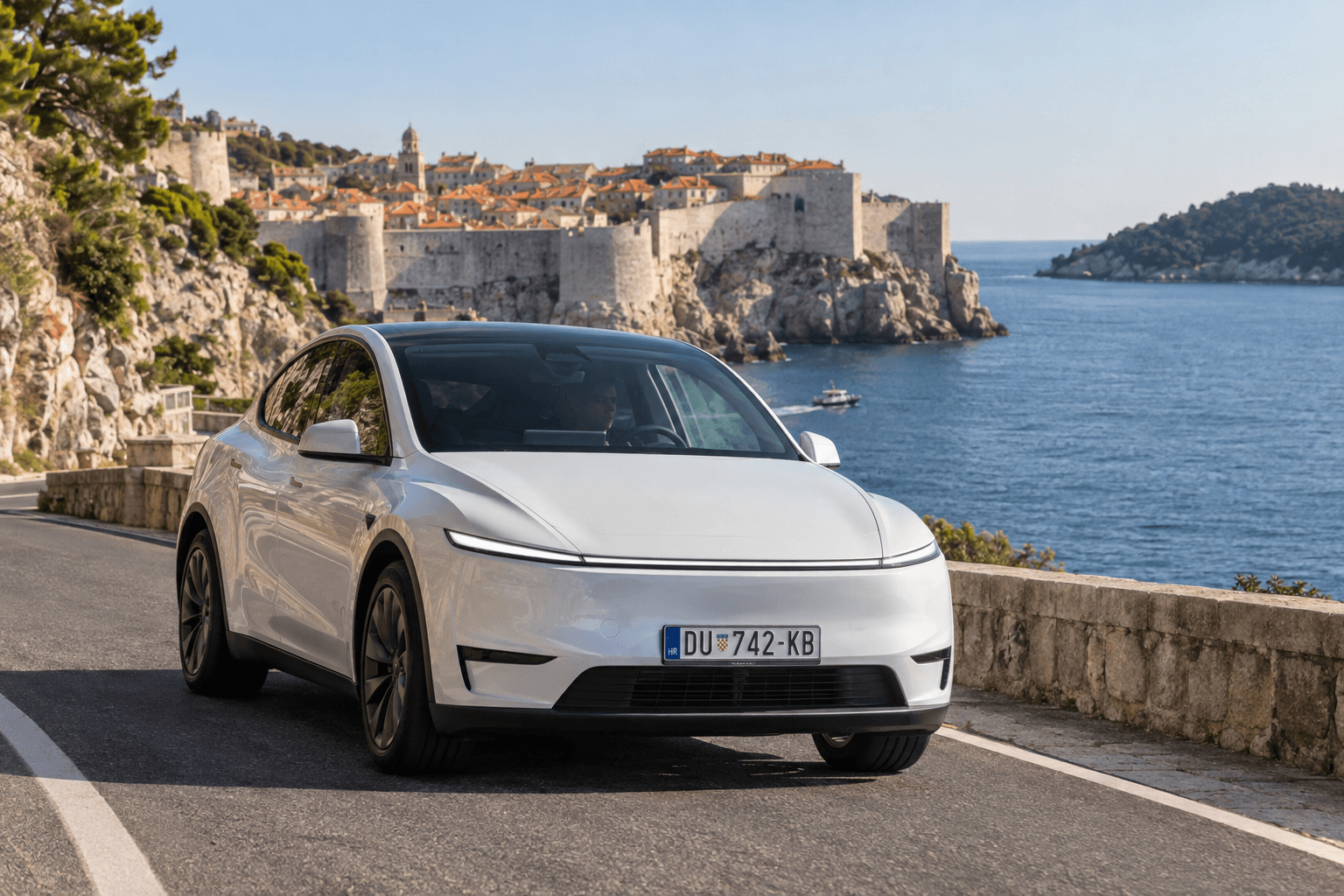
Tesla has received regulatory approval for FSD (Supervised) in Croatia. This brings the number of European markets where the system has been approved to eight. The software rollout has already been announced but had not yet begun at the time approval was granted.
The “Supervised” qualifier remains important. Despite the name Full Self-Driving, this is not fully autonomous driving. The person behind the wheel must continuously monitor traffic and be ready to intervene at any time.
Croatia is another important building block in Tesla’s gradual introduction of FSD in Europe, but it is not yet a breakthrough for the EU as a whole.
European countries where FSD has been approved
So far, Tesla has pursued a strategy of obtaining individual national approvals in Europe. To do so, the company uses a regulatory framework based on an exemption granted by the RDW, the Dutch vehicle authority. However, such national approval does not replace a single authorization covering the entire European Union.
| Country | Approval or launch | Status |
|---|---|---|
| Netherlands | April 2026 | Active |
| Lithuania | May 2026 | Active |
| Estonia | May 2026 | Active |
| Denmark | June 2026 | Active |
| Belgium | June 2026 | Active |
| Slovenia | September 2026 | Active |
| Czechia | September 2026 | Rollout announced |
| Croatia | September 2026 | Rollout announced |
Czechia, Slovenia, and Croatia joined the list in September alone. Ireland and Italy are considered possible next candidates, but talks with the relevant authorities are still underway. This does not yet indicate that approval will be granted.
European FSD version to launch only on Hardware 4
An adapted European version of FSD v14 is expected to be used in Croatia and Czechia. It accounts for local traffic rules and is therefore intended to behave differently from the North American software in certain situations. This includes speed limits, road markings, and traffic situations specific to each country.
At launch, FSD v14 will likely be limited to vehicles equipped with Hardware 4, also known as AI4. This may include newer versions of the Tesla Model 3 and Tesla Model Y. However, the hardware actually installed in the vehicle is what matters, not merely the model name.
Owners of Teslas with Hardware 3 will have to wait for now. A technically scaled-back version called FSD v14 Lite is planned for these vehicles, but no binding European timetable is available yet. Tesla’s broader FSD roadmap also shows that the hardware generation is becoming increasingly relevant for new features.
EU-wide decision remains the major hurdle
A vote on broader European approval, originally expected on October 6, has reportedly been postponed until December at the earliest under the current schedule. Tesla needs a qualified majority comprising at least 15 EU member states for approval. Eight national authorizations are therefore politically significant, but they are not sufficient on their own.
At the same time, reservations remain. Sweden and France have raised concerns about a feature that, in the authorities’ view, could encourage problematic behavior around speed limits. Such objections do not automatically amount to a fundamental rejection of FSD, but they must be resolved from both a technical and regulatory perspective before broader approval can be granted.
What the approval means for the DACH region
For Tesla drivers in Germany, Austria, and Switzerland—the countries commonly referred to as the DACH region—nothing changes for now. Croatia’s decision does not automatically carry over to other countries. An EU-wide solution would be particularly relevant for Germany and Austria, while Switzerland, as a non-EU member, follows its own regulatory path.
Nevertheless, every successful launch adds to the practical experience gained on European roads. This allows Tesla to demonstrate how FSD performs under different traffic rules, road layouts, and weather conditions. Croatia is therefore less of an end goal than another test of Tesla’s strategy to expand across Europe one country at a time.