Maxus enters the heavy-duty electric truck market
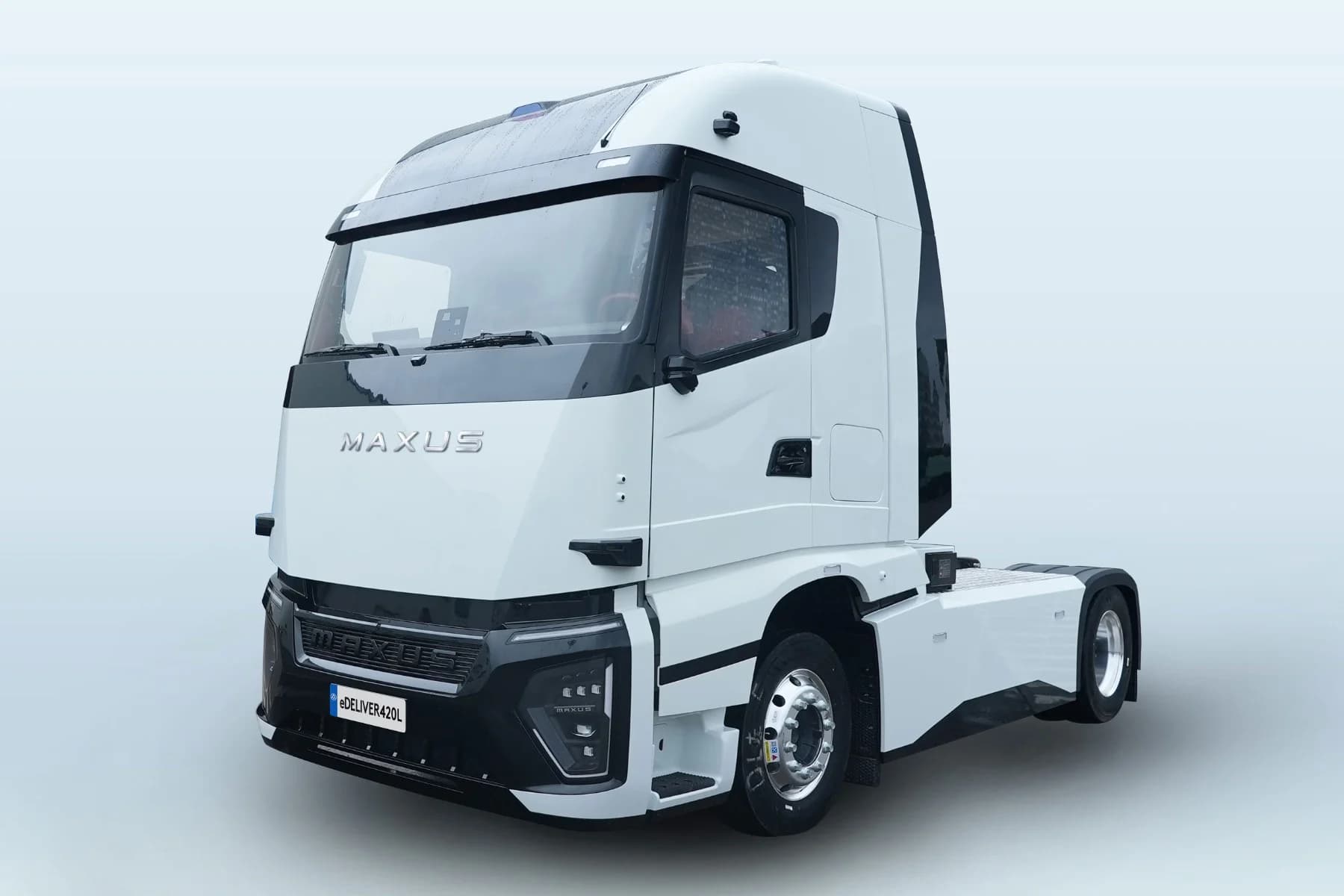
Until now, Maxus was known in Europe primarily for electric vans and pickup trucks. The brand, which belongs to China’s SAIC Group, is now significantly expanding its commercial vehicle range and, with the eDeliver 420L, is presenting its first fully electric tractor unit for gross combination weights of up to 42 tonnes.
The range is complemented by the eDeliver 75 in the 7.5-tonne class and an autonomous RoboVan. This will allow Maxus to cover numerous applications, from urban deliveries to long-haul transport, although there will initially be a gap between 7.5 and 18 tonnes. Other manufacturers are also expanding their ranges, including with the announced Kia PV7 as a large electric van.
| Model | Vehicle class | Battery | Range and charging |
|---|---|---|---|
| Maxus eDeliver 420L | Tractor unit for up to 42 tonnes | 615 kWh from CATL | Range not specified, 20% to 80% in 25 minutes |
| Maxus eDeliver 75 | Chassis in the 7.5-tonne class | 120 kWh | Up to 250 km WLTP, 20% to 80% in around 30 minutes |
| Maxus RoboVan | Autonomous delivery vehicle | Not specified | Payload of up to 1,500 kg and more than 6 m³ of cargo volume |
eDeliver 420L uses a 615 kWh battery
The eDeliver 420L is based on the modular AILink architecture and is designed for heavy-duty road freight. Intelligent energy management and five levels of regenerative braking are intended to reduce energy consumption per tonne-kilometre.
According to Maxus, the CATL battery is designed for a service life of up to 1.5 million km. The manufacturer has not yet provided a specific range figure. For a 42-tonne truck in particular, range depends heavily on the load, speed, route profile and outside temperature.
The 615 kWh battery is impressive, but real-world range, payload and reliable megawatt charging infrastructure will be crucial for day-to-day fleet operations.
Charging from 20% to 80% in 25 minutes would mathematically require an average of just under 890 kW to flow into the battery, excluding charging losses. Maxus has not yet specified either the connector system used or the maximum charging power. However, the short charging window could fit well with mandatory rest breaks in long-haul transport, provided a sufficiently powerful charging point is available.
The cab has also been newly developed for heavy-duty use. According to the manufacturer, it meets the crash requirements of ECE R29 V3.0 and can move backward by up to 50 cm in a collision to create additional survival space for the occupants.
eDeliver 75 for distribution transport and municipalities
The eDeliver 75 is aimed at regional delivery services, municipalities and body manufacturers. Its 120 kWh battery provides a WLTP range of up to 250 km, while DC charging power is capped at 120 kW.
The chassis offers a payload of up to 4,590 kg. An integrated electric power take-off can supply refrigerated bodies, tail lifts or other equipment, for example, without requiring a separate combustion engine.
RoboVan offers Level 4 autonomy
With the RoboVan, Maxus is also presenting a driverless delivery vehicle for urban logistics. Three LiDAR sensors and eleven cameras monitor the surroundings, while SAIC’s automation technology controls the vehicle independently within a defined operating area.
Maxus says it has completed more than ten million kilometres of accident-free testing. However, this manufacturer claim does not constitute approval for unrestricted use on public roads. In practice, Level 4 always applies only under defined conditions and within specified operating areas.
Bidirectional charging aims to reduce fleet costs
Another area of focus is the integration of commercial electric vehicles into energy systems. Certified smart DC chargers are intended to allow multiple vehicles to be grouped together to draw electricity or feed it back when needed.
For logistics centres, this can reduce peak loads and improve the use of on-site solar power. At the same time, it creates the technical foundation for grid services, similar to the bidirectional charging solutions from Hyundai and Kia. Whether this is economically viable depends on electricity tariffs, vehicle idle times, regulation and the cost of the charging hardware.
European launch requires pricing and reliable operational data
Maxus is supporting its product offensive by expanding its German service network to 170 locations by the end of 2026. This infrastructure is particularly important for fleet operators because downtime involving heavy commercial vehicles can quickly result in high costs.
Specific prices, order dates and range figures for the eDeliver 420L have yet to be announced. No comparable network expansion targets have been provided for Austria or Switzerland either. Nevertheless, Maxus is sending a clear technical signal: the brand no longer wants to sell only vans in Europe but aims to establish itself as a broad-based supplier of electric commercial vehicles.