600 Wh/kg in a lithium-metal battery: a major leap on paper
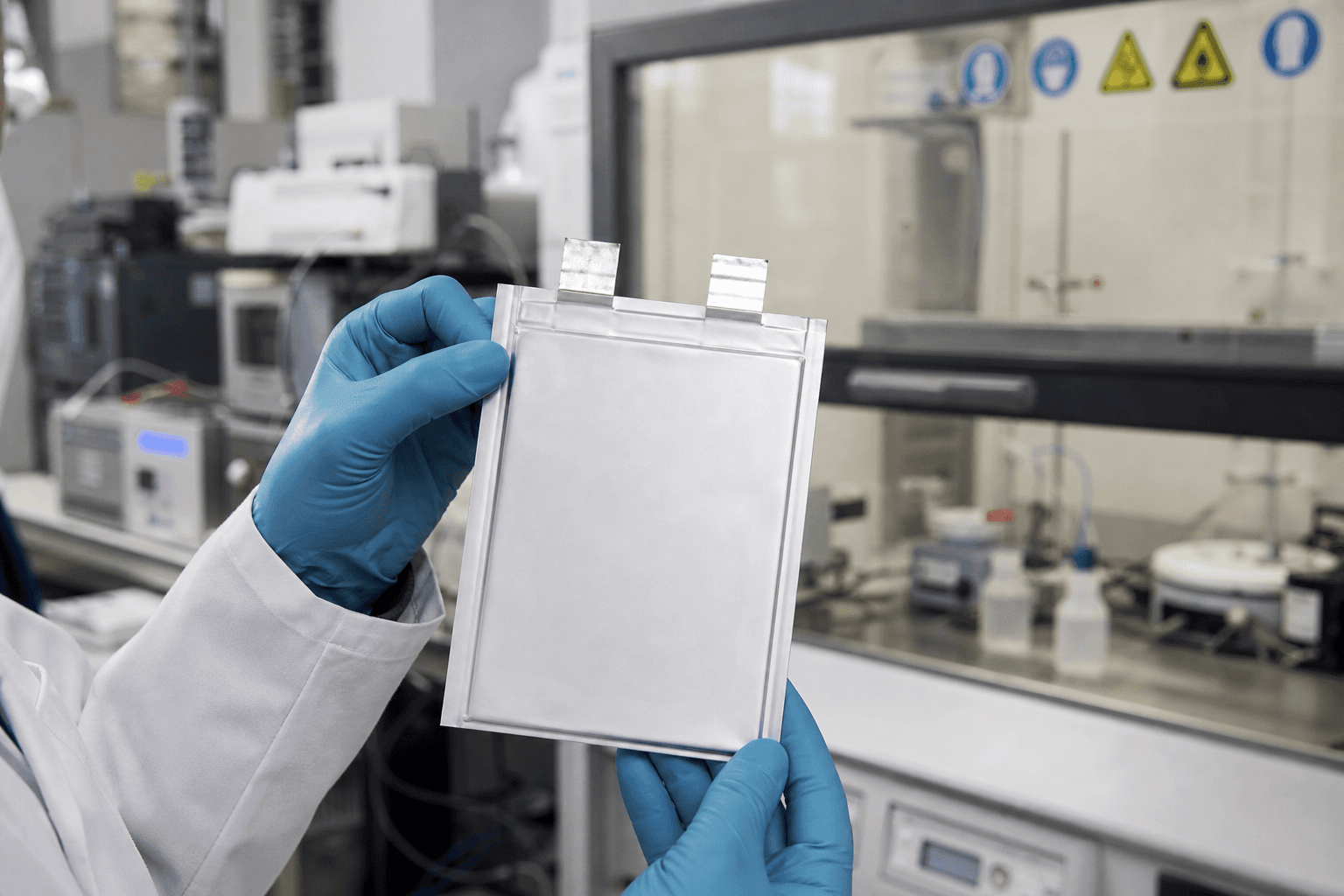
A joint team from Tianmushan Lab and Tsinghua University has reported highly stable lithium-metal pouch cells that achieve an energy density in the 600 Wh/kg range. The results were presented in a scientific publication and target a problem that is becoming increasingly urgent in aviation applications: too little energy per unit of weight.
An important point for context: this is not a battery that will appear in production vehicles next week. The researchers explicitly describe it as being at the laboratory stage, with several more technical iterations still required before scaling, costs and manufacturing tolerances can be realistically addressed.
Why this is particularly exciting for drones and eVTOLs
In the so-called low-altitude economy, meaning drones and electric vertical take-off and landing aircraft, battery weight directly determines range, payload and economic viability. Conventional lithium-ion cells with graphite anodes are approaching the limits of what is practically achievable, which is why flight time has become the real-world bottleneck for many systems.
Lithium metal has long been considered a candidate for pushing these limits because the anode theoretically offers significantly greater capacity. In practice, however, there is a difficult three-way challenge: achieving high energy density, cycle life and safety at the same time.
The core problem: electrolyte decomposition and dendrites
Under high voltages and currents, lithium-metal systems tend to develop unstable interfaces. The electrolyte can decompose, while lithium dendrites can form on the lithium-metal anode. These needle-like structures not only reduce efficiency but also increase the risk of internal short circuits.
This is precisely where the team’s approach comes in: rather than using a completely new cell concept, it relies on targeted electrolyte regulation through additive design.
The idea: an additive forms protective layers on the cathode and anode
The researchers describe a new electrolyte strategy featuring a strongly coordinating solvation structure created by an additive. Put simply, the additive is intended to achieve two things at once:
- On the cathode, it creates a thin, dense protective film that reduces damage caused by high-voltage cycling.
- On the lithium-metal anode, it forms a more stable interfacial layer that suppresses dendrites and improves ion transport.
The practical effect, if this can eventually be translated into products: fewer side reactions → more stable capacity over many cycles and a wider safety margin, despite the very high specific energy.
Overview of the reported test data
The tests included 10 Ah pouch cells. The results varied significantly depending on the cathode chemistry, showing how strongly the overall system depends on the combination of materials.
| Configuration (simplified) | Reported energy density | Cycle/capacity figure | Assessment |
|---|---|---|---|
| High-nickel ternary cathode, 10 Ah pouch | 550.7 Wh/kg | 80% capacity after 180 cycles | Very high, but the cycle count is still far short of automotive requirements |
| Lithium-rich manganese cathode | 602.5 Wh/kg | Reversible specific energy reported | Peak value, but scalability and service life remain uncertain |
Broadly speaking, the 600 Wh/kg class would represent a leap of well over 50% compared with what is common in mainstream traction batteries today. But for electric cars, it is not just Wh/kg that matters: Wh/L (packaging space), fast-charging performance, aging under thermal stress, crash behavior and, of course, cost are also crucial.
What this means for electric cars in Germany—and what it does not
For the European market, this is primarily a signal that research continues to move toward significantly higher energy density without relying solely on solid-state buzzwords. If approaches like this can eventually be translated into production processes, they could also reach passenger cars in the medium term, for example in versions focused particularly heavily on range or in premium segments.
For now, however, it should not be overinterpreted. Reaching 80% capacity after 180 cycles may need to be assessed differently for aircraft than for a car that, under typical conditions in the DACH region—Germany, Austria and Switzerland—is expected to last for many years and sometimes cover high annual mileages. Anyone making a purchase decision today is still on safer ground with established platforms and batteries.
Context: energy density is not everything
The race for higher figures is taking place alongside other optimizations, such as faster 800-volt systems and more efficient vehicles. If you are interested in charging and platform architecture, our comparison 800V vs. 400V is worth reading.
Industry context: 350 Wh/kg is currently considered a tough benchmark
Cell concepts for eVTOLs rated at around 350 Wh/kg are already circulating in the industry, although they often come with warnings about high costs. The new research approach explicitly addresses the typical pain points of lithium-metal batteries—interface stability and dendrites—making it technically relevant even though mass production remains a long way off.
For those who want to follow the broader battery landscape: market shares and chemistries continue to shift significantly in China, particularly toward LFP. Our overview of the Chinese battery market and LFP’s share provides relevant context. And for the highest real-world range figures among production cars, the 2026 range ranking is a useful reference.