Kia EV3 launches at an attractive US price and replaces the Niro EV
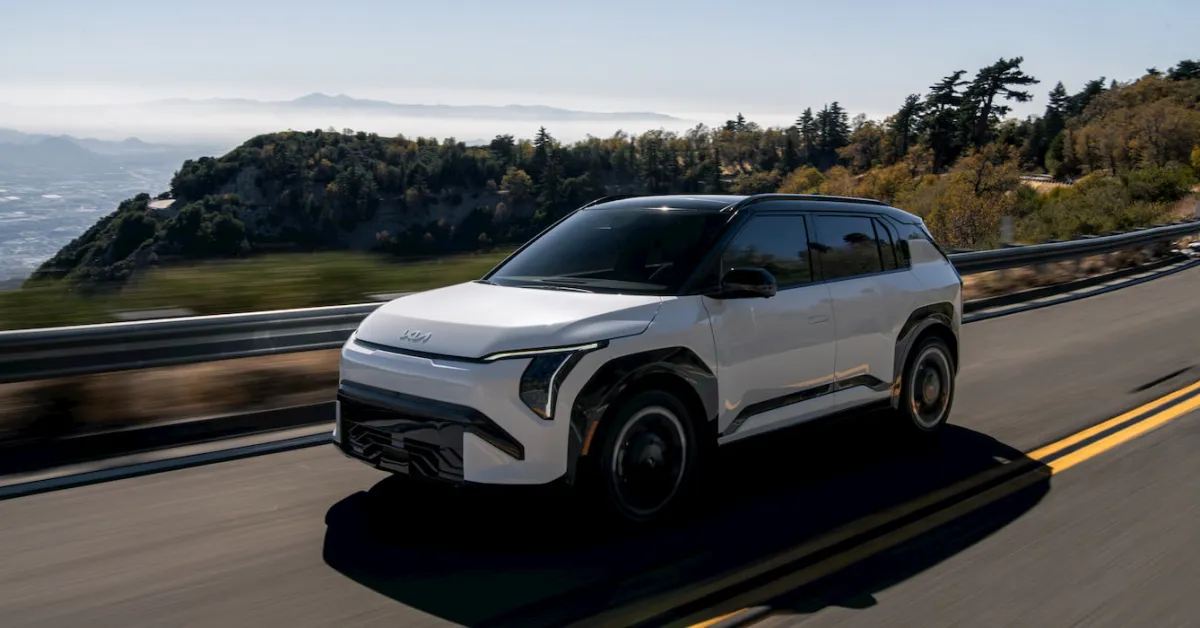
Kia is positioning the EV3 particularly aggressively in the US: The entry-level model is priced on a par with the updated Niro Hybrid. At the same time, the EV3 is significantly cheaper than the outgoing Niro EV, which it effectively replaces in the model lineup.
This is particularly appealing to buyers because the EV3 does not feel like a “converted combustion-engine vehicle,” but rather like a modern electric SUV with up-to-date charging hardware and a new infotainment system. In Europe, the EV3 has already shown that its combination of compact dimensions and practical range works very well in everyday use.
Price and range by version: what the five trims offer
In the US, the EV3 is available in five trims (Light, Wind, Land, GT-Line, GT) and with two battery sizes. The base model uses a 58.3 kWh battery, while the higher trims have a larger 81.4 kWh battery. Depending on the version, Kia quotes ranges of up to around 356 km or around 517 km per charge.
For context, the outgoing Niro EV was significantly more expensive and offered a range of around 407 km. This puts the EV3 in the spotlight as the “new standard” for Kia’s compact electric SUVs.
| EV3 version (US) | Drivetrain | Battery | Range |
|---|---|---|---|
| Light | FWD | 58.3 kWh | around 356 km |
| Wind | FWD | 81.4 kWh | around 517 km |
| Wind | AWD | 81.4 kWh | around 451 km |
| Land | FWD | 81.4 kWh | around 517 km |
| Land | AWD | 81.4 kWh | around 451 km |
| GT-Line | AWD | 81.4 kWh | around 451 km |
| GT | AWD | 81.4 kWh | around 451 km |
FWD or AWD: more power, but less range
The front-wheel-drive models use a single electric motor at the front producing 201 hp. All-wheel drive is available for almost every version in the US and uses two motors producing a combined 261 hp. The EV3 GT raises output a little further, delivering up to 288 hp.
The trade-off is typical: AWD provides more traction and power, but less range. For many people in the DACH region—Germany, Austria, and Switzerland—this would be particularly relevant in wintry and mountainous areas, while FWD often remains the more efficient choice on flatter terrain.
Charging: factory-fitted NACS, Superchargers without an adapter
A genuine US highlight is the built-in NACS port on every EV3 version. This means access to Tesla Superchargers without an additional adapter. In practice, that is a major convenience because it simplifies charging plans and reduces the need for “dongle management.”
NACS is not currently the standard in Europe, where CCS dominates. Nevertheless, the direction is interesting because it shows how strongly the market is consolidating around Tesla’s charging network and connector standard. If you are interested in Tesla opening its ecosystem and in adapter-related topics, the Tesla Model Y with a V2L adapter similarly illustrates just how much is currently changing around connectors and accessories.
DC fast charging: 10% to 80% in around half an hour
Kia quotes charging times at a 350 kW DC station of around 29 minutes for the smaller battery and around 31 minutes for the larger battery, from 10% to 80%. The fact that the times are close despite the significantly larger battery is useful in everyday driving: Your “break routine” remains similar even if you choose the longer-range version.
Anyone looking to understand charging platforms and voltage architectures can find the appropriate technical overview in our 800V vs. 400V comparison.
Interior: ccNC with almost 30 inches of screen space
In the cockpit, Kia uses its new ccNC infotainment system. The layout combines two 12.3-inch displays in a curved panoramic unit for the instrument cluster and central screen. Below them is an additional 5-inch touchscreen for the climate controls.
In everyday use, this is mainly an advantage if it lets you access functions more quickly without digging through menus. Tesla has demonstrated for years how much can be achieved through software and user-interface design, but traditional manufacturers are also making noticeable progress here.
Dimensions: shorter than the Niro EV, yet similarly spacious
According to Kia, the EV3 is around 4.30 m long, around 1.85 m wide, and around 1.57 m tall, with a wheelbase of around 2.68 m. That makes it slightly shorter and marginally wider than the Niro EV. Kia nevertheless promises a similarly generous amount of interior space, partly thanks to the dedicated EV platform and its more efficient packaging.
In practice, that is likely to hit the sweet spot: compact enough on the outside for cities, parking garages, and narrow parking spaces, but without feeling cramped like a small car inside. Anyone specifically looking for compact electric SUVs in Germany can find a useful market overview in our guide to compact electric SUVs for 2026.
What it means for the DACH region: US prices cannot be transferred directly
The specific pricing announcement comes from the US and cannot be applied directly to Germany, Austria, or Switzerland. Taxes, equipment structures, and import arrangements almost always result in different final prices. Nevertheless, the message is clear: Kia wants to position the EV3 as a high-volume model below its previous compact electric options.
If Kia carries over even part of this pricing strategy to Europe, the EV3 will become an appealing alternative for many prospective buyers, including compared with established EVs such as the Tesla Model Y, which is often regarded in the DACH region as a benchmark for efficiency, software, and fast charging.