Ora Was Once an EV-Only Brand—Now It Is “Powertrain-Agnostic”
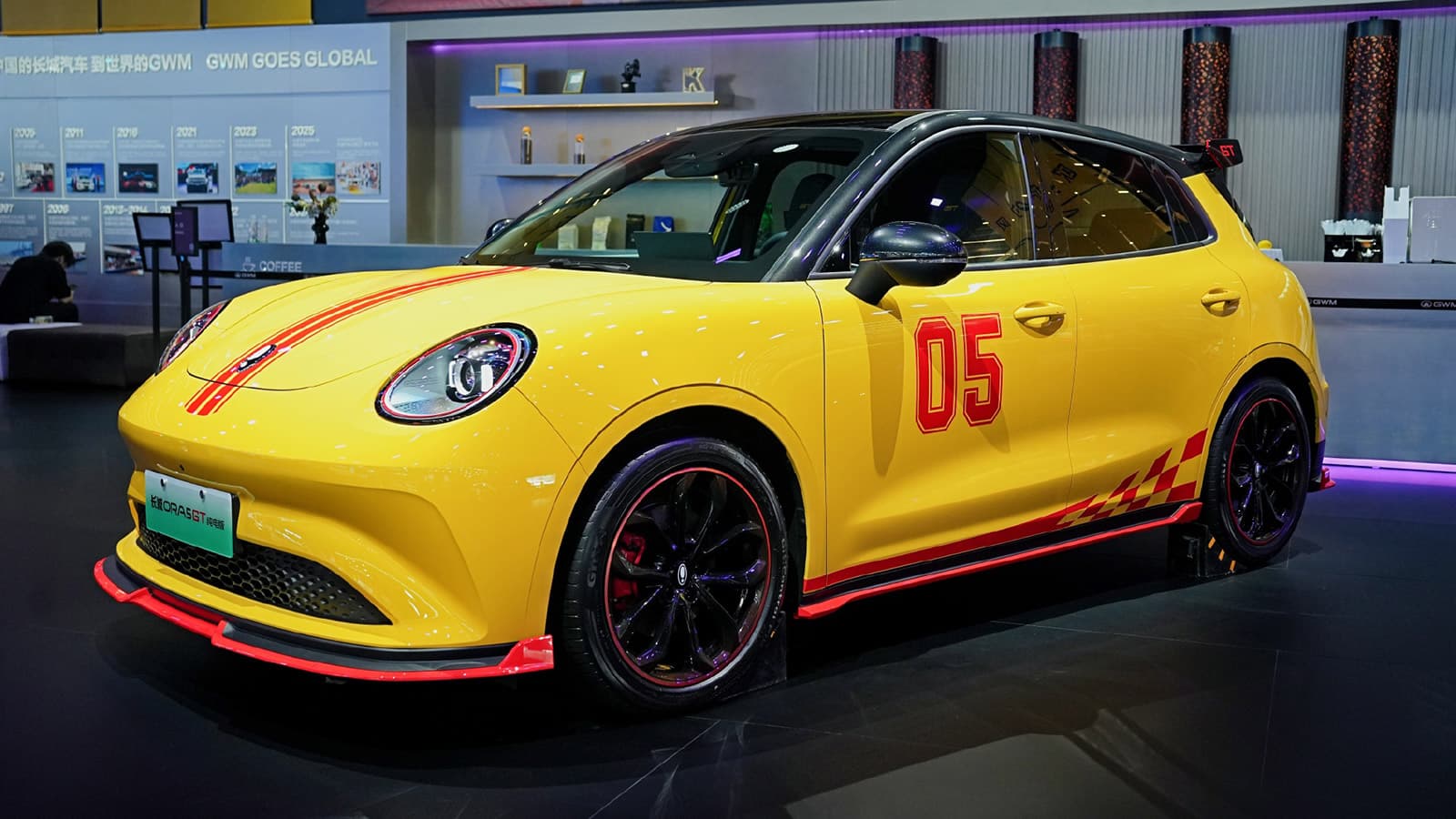
GWM (Great Wall Motor) is introducing two new derivatives of its Ora 5 series: the Ora 5 Sport and the Ora 5 GT. The interesting part is not so much the body kit as the strategy: Both models are available not only as battery-electric cars, but also as hybrids and pure gasoline models. This marks a move away from Ora’s original identity as an all-electric brand.
Context for the DACH region (Germany, Austria, and Switzerland): These kinds of multi-powertrain platforms are primarily a Chinese-market phenomenon, driven by price pressure and extremely rapid model turnover. This will only become relevant to Europe if GWM expands Ora’s presence here or imports the vehicles at a later date. Nevertheless, it shows just how fierce the competition has become and how pragmatically manufacturers are responding.
Electric-Version Technology: 58.3 kWh, 150 kW, and Fast Charging
The electric variants use a 14-in-1 electric drive system from Svolt Energy and a second-generation “Short Blade” battery. The electric motor delivers 150 kW and 260 Nm, while the battery has a capacity of 58.3 kWh. Rated energy consumption is 11.6 kWh/100 km.
GWM quotes a range of 580 km (CLTC) for the Ora 5 Sport and 550 km (CLTC) for the Ora 5 GT. Importantly, the China Light-Duty Vehicle Test Cycle (CLTC) is generally more optimistic than WLTP, so drivers in Germany, Austria, and Switzerland should use more conservative estimates for everyday use.
Charging is said to be quick: Both electric versions are rated to charge from 30% to 80% in 20 minutes. They also accelerate from 0 to 100 km/h in 7.4 seconds, making them more than adequate for everyday driving without aiming for hot-hatch performance.
At a Glance: Electric Specifications of the Ora 5 Sport and Ora 5 GT
| Specification | Ora 5 Sport (BEV) | Ora 5 GT (BEV) |
|---|---|---|
| Battery | 58.3 kWh | 58.3 kWh |
| Power / Torque | 150 kW / 260 Nm | 150 kW / 260 Nm |
| Range (Official Rating) | 580 km (CLTC) | 550 km (CLTC) |
| Charging | 30% to 80% in 20 min | 30% to 80% in 20 min |
| 0 to 100 km/h | 7.4 sec | 7.4 sec |
| Consumption (Official Rating) | 11.6 kWh/100 km | 11.6 kWh/100 km |
Hybrid and Gasoline Models: Unusual for an EV Brand, but Strategically Logical
The hybrid versions use GWM’s fifth-generation Hi2 system and, according to the manufacturer, deliver a combined 166 kW and 476 Nm. WLTC fuel consumption is rated at 4.5 L/100 km.
For the pure gasoline model, GWM uses a 1.5-liter turbocharged engine with a seven-speed wet dual-clutch transmission. Maximum output is 135 kW, while WLTC fuel consumption is rated at 6.4 L/100 km.
An EV brand offering gasoline models may initially look like a step backward. In its home market of China, however, it is primarily a way to stabilize sales volumes and cover more price points. At the same time, Chinese manufacturers continue to invest heavily in BEV technology, including fast charging. One example of how aggressively this technology is being developed is the emergence of new LFP approaches such as the BYD Seal 06 with nine-minute charging.
Driver Assistance and Cockpit: LiDAR, Map-Free NOA, and Modern Infotainment
Higher-priced versions are expected to feature LiDAR and GWM’s Coffee Pilot 3. “NOA” (Navigation on Autopilot) functions are supported on highways and in cities, and according to the manufacturer they operate without relying on high-definition maps. A “Memory Parking” function is also available for routes of up to 3 km.
Inside, Ora uses a 15.6-inch central display with 2.5K resolution and a 4 nm automotive chip delivering 20 TOPS of computing power. Voice functions are powered by the company’s own large language model, “Coffee GPT.”
For context, “NOA” is functionally similar to the driver-assistance capabilities Tesla targets with Autopilot and FSD, but actual performance ultimately depends heavily on software maturity, sensors, and market-specific activation. Readers interested in Tesla’s current position can find details about its roadmap and hardware in Tesla FSD v15, HW4, and Optimus.
Ora 5 GT: Sporty Styling, Downforce Figures, and Artificial V8 Sound
The Ora 5 GT is clearly positioned as the sportier model, with a low-slung appearance, an aerodynamic kit, 19-inch wheels, and a large rear wing. GWM claims that the electric version generates 37 kg of downforce at 180 km/h.
It also features a “Super Sport” button and a simulated V8 sound. This will be a matter of personal taste, but it shows how manufacturers are attempting to add emotion through software in the electric era.
Dimensions and Platform: One Model, Three Powertrains
The Ora 5 Sport measures 4,482 mm long, 1,833 mm wide, and 1,559 mm tall, with a wheelbase of 2,720 mm. The length of the Ora 5 GT varies by powertrain: The hybrid and gasoline models are 4,500 mm long, while the electric version measures 4,430 mm.
This is made possible by a platform strategy that accommodates multiple powertrains within a single model series. It reduces complexity and costs, particularly in highly price-sensitive markets. The trade-off is that the engineering is not always as cleanly optimized as it would be on a dedicated electric platform.
Market Context: China’s Price War and Competitive Pressure
Ora is a smaller but visible brand within GWM. From January through July, it sold 37,209 vehicles, accounting for 5.38% of GWM’s total sales during that period. Figures like these explain why manufacturers want to appeal to every target group: Pure BEV strategies can be risky in the short term when the market is competing so brutally on price.
Models such as the BYD Atto 3 are often cited for comparison in China’s compact SUV segment. BYD in particular demonstrates how strongly scale and a broad portfolio can affect pricing and the pace of technological development.