EnBW upgrades its fast-charging network to 480 kW
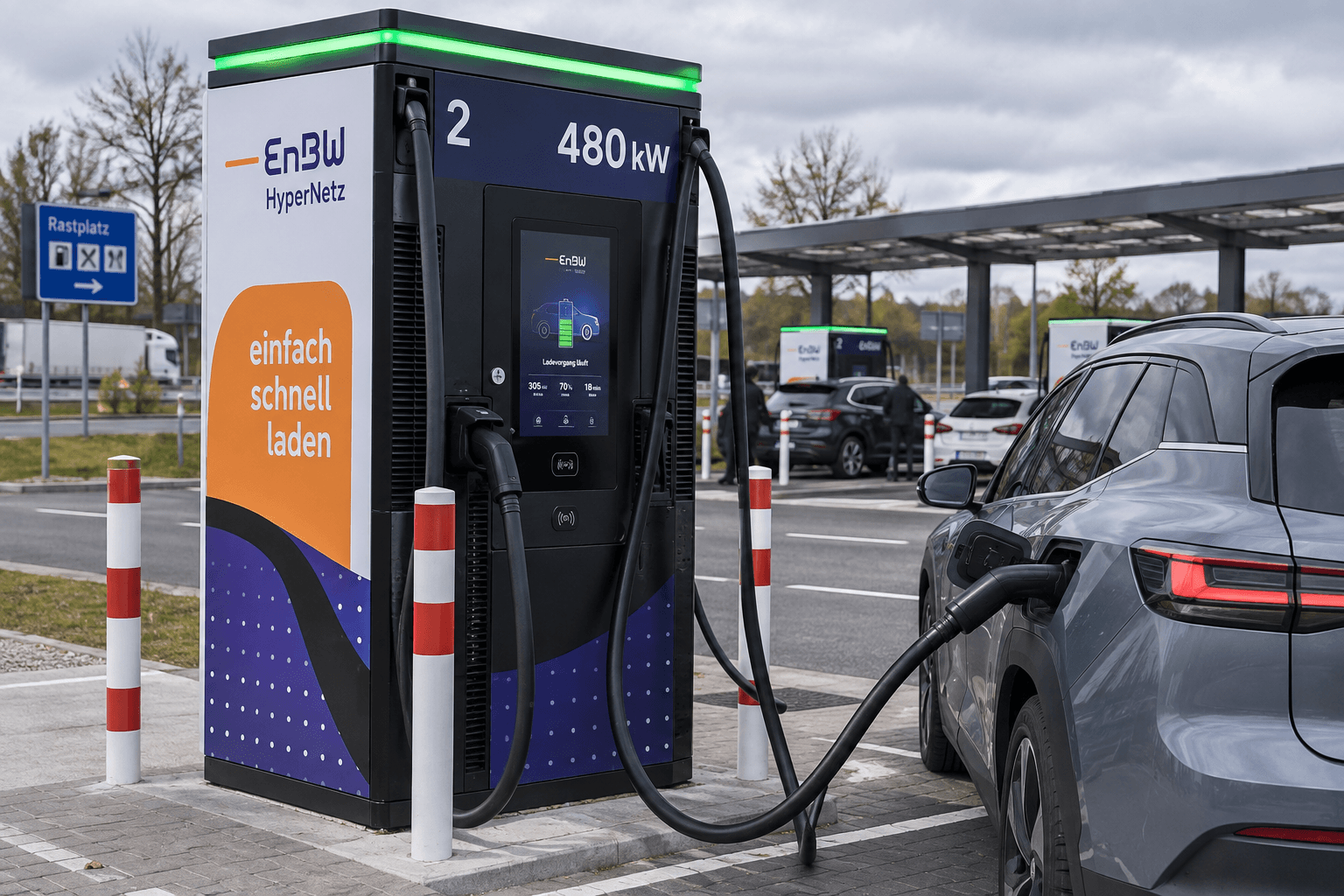
EnBW is beginning to roll out a new generation of high-power chargers in Germany. The first is XCharge’s C7 at the company’s headquarters in Karlsruhe, which delivers a rated output of up to 480 kW.
The additional power reserves are primarily intended for upcoming electric cars with high charging rates. By the end of 2026, EnBW plans to equip a double-digit number of its fast-charging parks with the new technology, particularly along heavily traveled long-distance routes.
| Metric | Details |
|---|---|
| Charging system | XCharge C7 |
| Maximum rated output | 480 kW |
| Planned rollout | A double-digit number of fast-charging parks by the end of 2026 |
| EnBW fast-charging network | More than 9,000 fast-charging points in Germany |
| Preferred locations | Long-distance routes and places with short dwell times |
480 kW does not automatically mean 480 kW in the car
The figure shown on the charging station is initially the system’s maximum output. How much power actually reaches the battery is determined by the vehicle, its state of charge, the battery temperature, and its charging curve.
Many current electric cars remain well below 480 kW. Even models with a powerful 800-volt architecture usually reach their peak only during a limited portion of the charging session. The key to a short charging stop is therefore not just the maximum figure, but the highest possible average charging power.
The 480 kW technology is primarily an investment in additional power capacity and future generations of vehicles.
Depending on the vehicle, EnBW says drivers could add up to 640 km of range within 20 minutes. However, this figure cannot be applied universally to every electric car, because range is not a direct measure of the energy added and depends heavily on consumption.
Power sharing benefits from greater reserves
The new hardware is also of interest when two vehicles are charging at the same time. With power sharing, the system distributes its available output among multiple connectors according to demand.
A higher total output can prevent two vehicles capable of fast charging from slowing each other down too much. Two cars connected to the system → more power reserves for both charging points. However, the individual charging power still depends on the configuration of the site and the vehicles connected.
Long-distance routes are the focus of the rollout
According to its own figures, EnBW already operates more than 9,000 fast-charging points in Germany. The network is expanding along highways and long-distance routes, in urban areas, and at retail locations.
The 480 kW systems are intended in particular for charging parks where drivers want to spend as little time as possible. In everyday use, this could enable shorter stops once more vehicles have sufficiently large batteries, high charging rates, and stable charging curves.
EnBW is therefore also addressing an important factor in EV range anxiety. Comfortable long-distance travel depends not only on maximum range, but also on a dense network of reliable, high-power charging points.
Field test involving tens of thousands of charging sessions
The wider rollout was preceded by a field test using XCharge charging stations. According to EnBW, tens of thousands of charging sessions were analyzed before the C7 systems were added to its regular portfolio.
In addition to charging power, the test focused on reliability, safety, and sustained performance. For heavily used fast-charging parks, these factors are at least as important as a high peak figure, because impressive rated output is of little use if individual charging points frequently fail.
What the rollout means for EV drivers
For most current vehicles, a 480 kW charger will not yet deliver an immediate increase in charging speed. They will only charge as quickly as their own technology allows.
Nevertheless, the rollout makes sense. EnBW is creating capacity early for more powerful electric cars and can respond more flexibly when several vehicles charge at the same time. The key questions now are how reliably the systems perform in widespread use and how quickly the new technology is scaled beyond the initially planned locations.