One Year, Nationwide and with a Clear Goal: Safer Connected Cars
China is tightening vehicle quality controls and launching a year-long, nationwide quality campaign for road vehicles. The focus is not only on traditional issues such as production quality and compliance with standards, but explicitly on the safety of intelligent connected vehicles, including systems related to connectivity, driver assistance and increasingly automated driving.
The initiative is a joint effort by several authorities responsible for areas including industry, public security, the environment and market regulation. For manufacturers, this means less scope for experimentation without rigorous validation and more extensive documentation requirements throughout the entire process, from development to series production.
What Exactly Will Be Inspected
According to the report, the announced inspections will focus primarily on three areas: safety capabilities in intelligent connected cars, companies’ design, development and production expertise, and product compliance with market approval requirements and national standards. Details of the full announcement were not yet available at the time of reporting.
However, the move clearly consolidates the increased scrutiny recently applied to manufacturers, models and inspection organizations into a large-scale, coordinated campaign. The reason is clear: Technology cycles are getting shorter, software is becoming more dominant, and this increases the risk that functions will behave differently in real-world use than they do in the laboratory.
How China’s Compliance Inspections Work in Practice
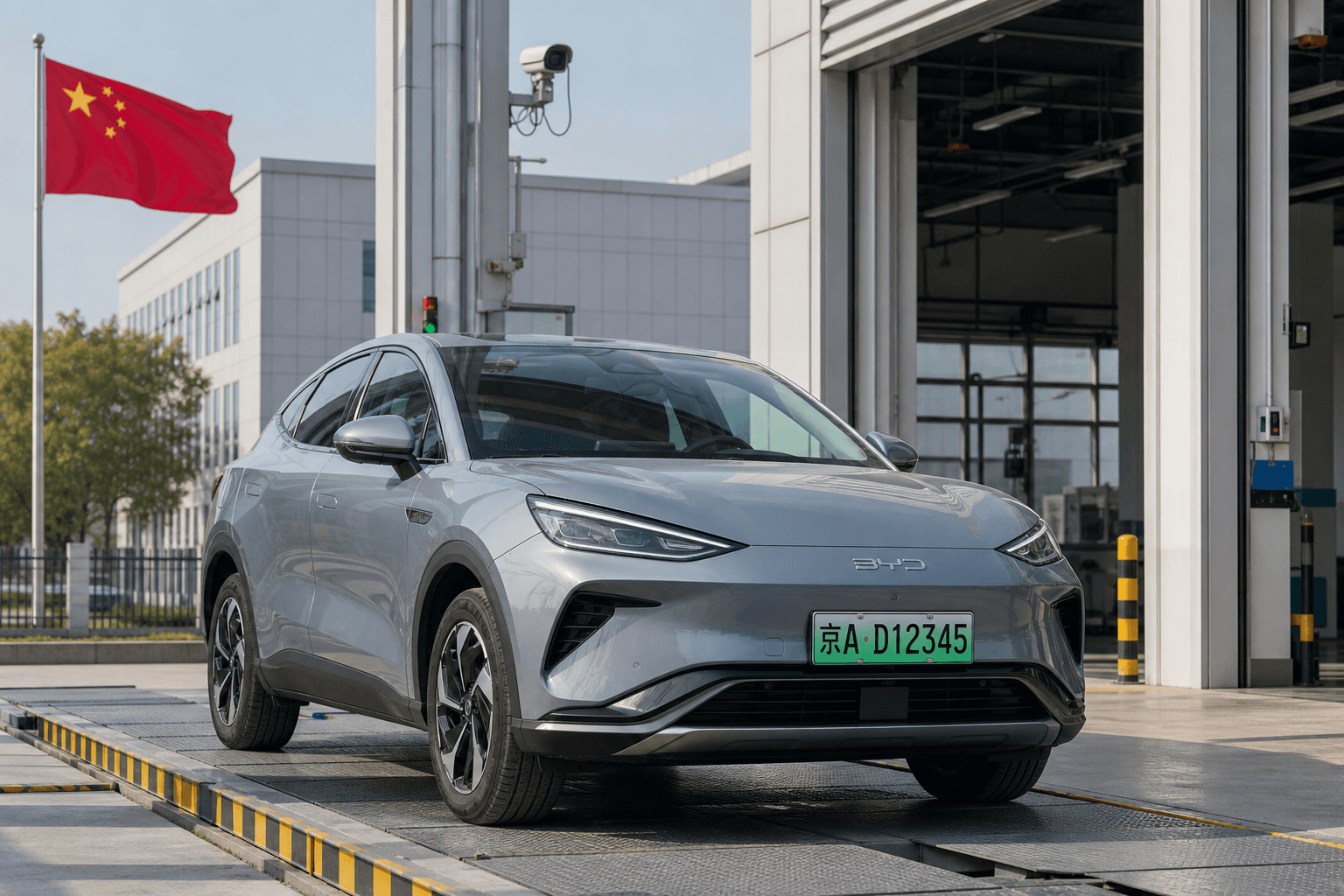
A production and approval compliance program launched in 2026 already exists in parallel and will now feed into the broader campaign. Inspectors can select sample vehicles and key components not only at factories but also at dealerships.
One particularly important point in the software era is that hardware and software configurations can be sealed and then sent to testing facilities. Inspections cover areas including vehicle structure, crash safety, EV safety and traction battery-pack safety, in some cases with additional verification tests.
OTA Updates: No More Quick Tweaks After Sealing
One key mechanism is that, after sealing, manufacturers may not make unauthorized changes to technical parameters via over-the-air updates. This is especially relevant in everyday use because many characteristics of modern vehicles are implemented or subsequently adjusted through software, from driver-assistance logic to protection strategies in the battery system.
For the industry, this does not represent an anti-software stance, but rather a clear demand for proper change management: If a vehicle has been selected for compliance testing in a defined configuration, that exact configuration must meet the requirements.
What Consequences Manufacturers Could Face
According to the program, manufacturers that fail to continuously meet approval requirements or whose products violate national standards could face significant measures. These include being publicly named, the suspension of affected products from government catalogs, or restrictions on new type approvals and filings.
This sends a clear signal to the market: It is not only the pace of innovation that matters, but also documentation, maturity and robustness in series production.
Why Scrutiny of "Aggressive" Designs and Driver-Assistance Functions Is Increasing
Chinese authorities have repeatedly emphasized recently that some particularly ambitious innovations have made their way into vehicles without sufficient validation. In addition, individual quality and safety incidents, including those involving driver-assistance and autonomous-driving functions, have heightened public awareness.
Inspection organizations are therefore expected to strengthen risk identification and test validation, particularly for unconventional design solutions. More rigorous safety assessments are also being called for regarding combined driver-assistance and automated-driving functions.
Millions of Recalls Show How Small Details Can Have Major Consequences
Shortly before the campaign, a major wave of recalls affecting more than 7 million vehicles was also announced. In many cases, the issue involved interior emergency door releases that were difficult to identify. This may seem trivial at first, but it illustrates a fundamental problem in mass production: A seemingly minor usability or design detail can become critical to safety in an emergency.
What This Means for Europe and the DACH Region
The issue is relevant to Germany, Austria and Switzerland—the countries known collectively as the DACH region—for two reasons. First, many electric cars and components come directly or indirectly from China, including software stacks and supplier parts. Second, campaigns of this kind in China often establish de facto standards because manufacturers align their global development with major markets.
The trend is particularly clear where connectivity, driver-assistance systems and OTA updates converge: More regulation, more documentation requirements and more questions of liability. China is also working in parallel on a clearer technical and legal framework for automated driving, including planned standards effective from July 1, 2027.
What This Means for Manufacturers in Practice
Ultimately, the focus is shifting from "roll it out quickly" to "roll it out with verifiable safety." This applies not only to new models, but also to updates for vehicles already on the road. In the medium term, this could benefit drivers through fewer surprises, clearer responsibilities and greater pressure to deliver consistent, reproducible quality.
Readers interested in the technology behind driver assistance and autonomy can also find our latest look at Tesla FSD v15 and HW4. And as safety requirements and regulation for autonomous driving become increasingly important, our guide to EV range anxiety also provides useful background, because trust in technology is ultimately built not only on specification-sheet figures, but on reliable behavior in everyday use.
Anyone who wants to know specifically how driver-assistance systems and robotaxi concepts are evolving in practice should also keep an eye on the trend toward more compact FSD models on Tesla HW4, because software-driven approaches of this kind are increasingly coming under regulatory scrutiny worldwide.