2027 Chevy Bolt EUV: What Is Really Changing
GM is bringing back the Chevy Bolt once again for the 2027 model year, clearly positioning it as a more affordable mass-market EV. For the DACH region—Germany, Austria and Switzerland—it is primarily a glimpse across the Atlantic, as the Bolt is mainly a North American product and is also set to have only a short production run: Production is currently scheduled to continue until summer 2027.
Despite the short production run, the update is more technically interesting than its appearance might suggest. Under the skin, the Bolt switches to a new battery chemistry, while the powertrain combines lower motor torque with revised gearing.
EUV Only: Focus on the More Practical Format
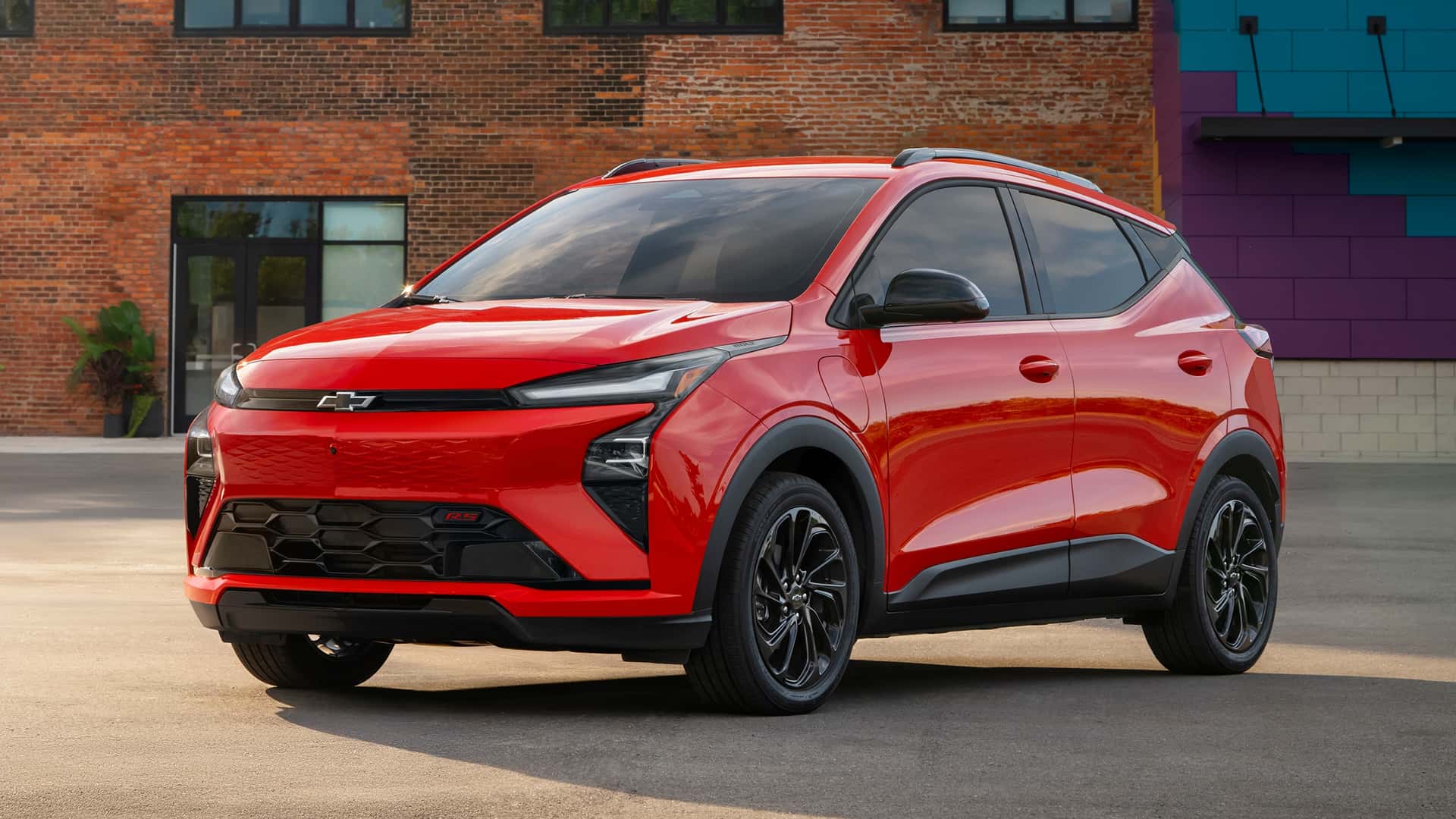
The new Bolt will be offered exclusively as an EUV, meaning the crossover version. This reflects a trend also seen in Europe: Practical, slightly taller vehicles generally sell better than traditional compact hatchbacks.
The basic exterior layout remains familiar, including a new front lighting signature and revised taillights. More black plastic trim is intended to emphasize the crossover look. The bigger leap, however, is inside.
Interior and Technology: A Completely New Cockpit
The 2027 Bolt’s interior has been significantly modernized. The dashboard, displays and infotainment system follow GM’s current EV lineup and have essentially been redesigned from the ground up, even though the control layout should still feel familiar to GM drivers.
For buyers, this is a genuine advantage in everyday use: Faster software, clearer graphics and a modern display setup address precisely the areas where many older “budget EVs” now feel dated.
New Battery Chemistry: LFP Instead of NMC
The most important change is in the battery. Instead of nickel manganese cobalt (NMC), the Bolt now uses LFP cells (lithium iron phosphate). Capacity remains at 65 kWh, yet range increases.
GM quotes a range of around 422 km for the new Bolt, compared with around 398 km for the previous Bolt EUV. This combination of cost control and improved efficiency is particularly noteworthy for affordable EVs. For a deeper look at battery trends, our market overview shows just how dominant LFP has become (LFP’s share of China’s battery market).
Powertrain: Slightly More Power, Significantly Less Motor Torque and a Gearing Trick
The Bolt remains front-wheel drive, while output rises slightly from about 157 to around 200 kW. At the same time, however, motor torque decreases significantly. That may initially sound like a step backward, but it does not necessarily have to be: GM is apparently using a shorter final-drive ratio, which can restore more tractive force at the wheels.
The real-world impact: In city traffic and when pulling away, the Bolt can still feel lively despite its lower torque rating, while benefiting from improved efficiency on longer journeys. Ultimately, that is what matters to buyers—not the raw figure on the specification sheet.
Perspective from the DACH Region: Interesting as a Signal, Not as a Purchase Option
In Germany, Austria and Switzerland, the Bolt is not currently a typical showroom option. Nevertheless, it is interesting because it highlights two major developments: LFP as a way to reduce costs in the mass market, and software and user interfaces as essential features even in “affordable” EVs.
Anyone interested in the local compact segment can find our current overview of which electric compact SUVs will be relevant in Germany in 2026 (electric compact SUVs in 2026). And if your main concern is the question of 800 volts versus 400 volts, the issue remains central to charging times and platform strategies (800V vs. 400V compared).
The 2027 Bolt shows how manufacturers are modernizing affordable EVs: an LFP battery to control costs, a software upgrade to improve the user experience and fine-tuned powertrain engineering for everyday driving.