Chinese Speed Meets German Reality
In China, new models are often developed in 2 to 3 years, while a comparable development cycle in Europe tends to take around 5 years. Changan design chief Klaus Zyciora describes this gap as one of the biggest structural differences between the markets. The issue is not simply speed for speed’s sake, but how products are created and continuously improved.
While feedback in traditional European processes often passes through several internal stages, the Chinese approach is much more direct. Customer feedback often reaches the teams immediately because many users are connected through apps and platforms. The car is seen more as a continuously updated platform than as a “finished” product at the time of delivery.
In China, asking “What have you improved since last month?” is a normal expectation. This fundamentally changes development, production and update cycles.
Why Changan Is Slowing Down for Its German Launch
As quickly as Changan operates in its home market, it intends to approach its German market launch with caution. The core of the strategy is to establish the foundations before a large-scale rollout. This primarily means service infrastructure, parts availability, workshop and partner networks, as well as training and processes that must work reliably in everyday use.
This is an important distinction in the DACH region—Germany, Austria and Switzerland. Here, a new car is not purchased solely on the strength of its specifications, but also based on how reliably it will be supported over the years. A poor service experience can quickly push new brands out of buyers’ consideration sets. Changan clearly wants to minimize precisely this risk, even if it may come at the expense of market share in the short term.
Brand Awareness: Top Five in China, Virtually Starting from Scratch Here
Changan is one of China’s major manufacturers and is regarded there as an established brand. The picture in Germany is completely different: For many potential buyers, Changan and its sub-brands are unfamiliar names. That means sales, communications and positioning all have to start from scratch.
Moreover, even brands with a strong presence in China cannot automatically carry that recognition over to Europe. While sub-brands such as Deepal may be well known in China, German consumers have no such prior awareness. Building trust takes time, which fits with the deliberately restrained rollout strategy.
What Chinese Customers Expect Today Will Reach Europe Tomorrow
According to Zyciora, the Chinese target audience is often younger and highly digitally focused. Smartphone integration, app features, rapid responses to software issues and a convincing infotainment system are demanded even more uncompromisingly there. If the voice controls or on-screen experience fall short, a model can quickly be judged a failure, regardless of its powertrain or energy consumption.
For Germany, this means the bar for software and user experience will continue to rise. This is not purely a Chinese phenomenon, but a trend that is also taking hold here, albeit often with a delay. Tesla introduced this platform-based approach to the mass market early on, and many manufacturers—particularly those from China—are now continuing it with very short iteration cycles.
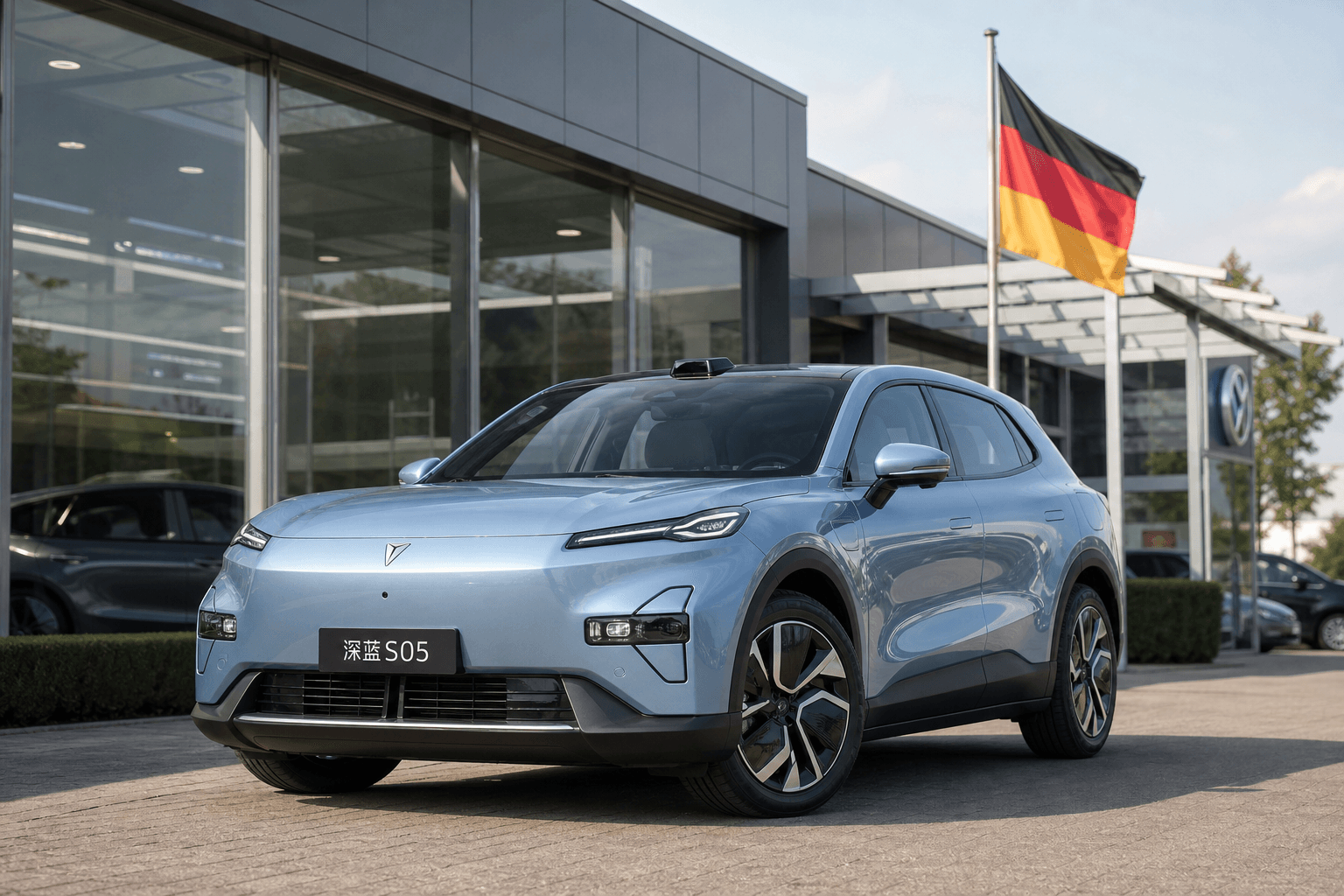
Deepal S05: The First European Model, but as a Plug-in Hybrid
The Deepal S05 is planned as the first model for Europe. It is an SUV with premium aspirations and is intended to feature more European styling. Notably, it will not initially arrive as a fully battery-electric vehicle, but as a plug-in hybrid. This makes strategic sense because many European customers still want to drive electrically but remain hesitant due to charging options or their long-distance driving needs.
At the same time, it sends a clear message: Changan does not want its design to feel like a “Chinese export,” but instead aims to align deliberately with European expectations. This is also supported by the fact that Changan established its own European design center some time ago, giving it experience in translating regional tastes, proportions and brand identity.
Why This Matters for Germany, Even if You Do Not Own a Changan
Changan exemplifies a broader shift: China operates faster and is more data- and software-driven, while customer expectations are being raised over ever-shorter cycles. Europe will not replicate this pace exactly, but the direction is clear, partly because buyers have become accustomed to monthly improvements in the electronics and smartphone industries.
The Case for Changan’s “Slow Start”
- Fewer disappointments thanks to more reliable service and parts processes
- Stronger brand building because the brand’s “story” can be clearly communicated
- Higher customer satisfaction through functioning partner networks rather than a rushed launch
The Risks That Remain
- Less visibility in a rapidly evolving market
- Delayed economies of scale for pricing and availability