BYD reaches its highway target well ahead of schedule
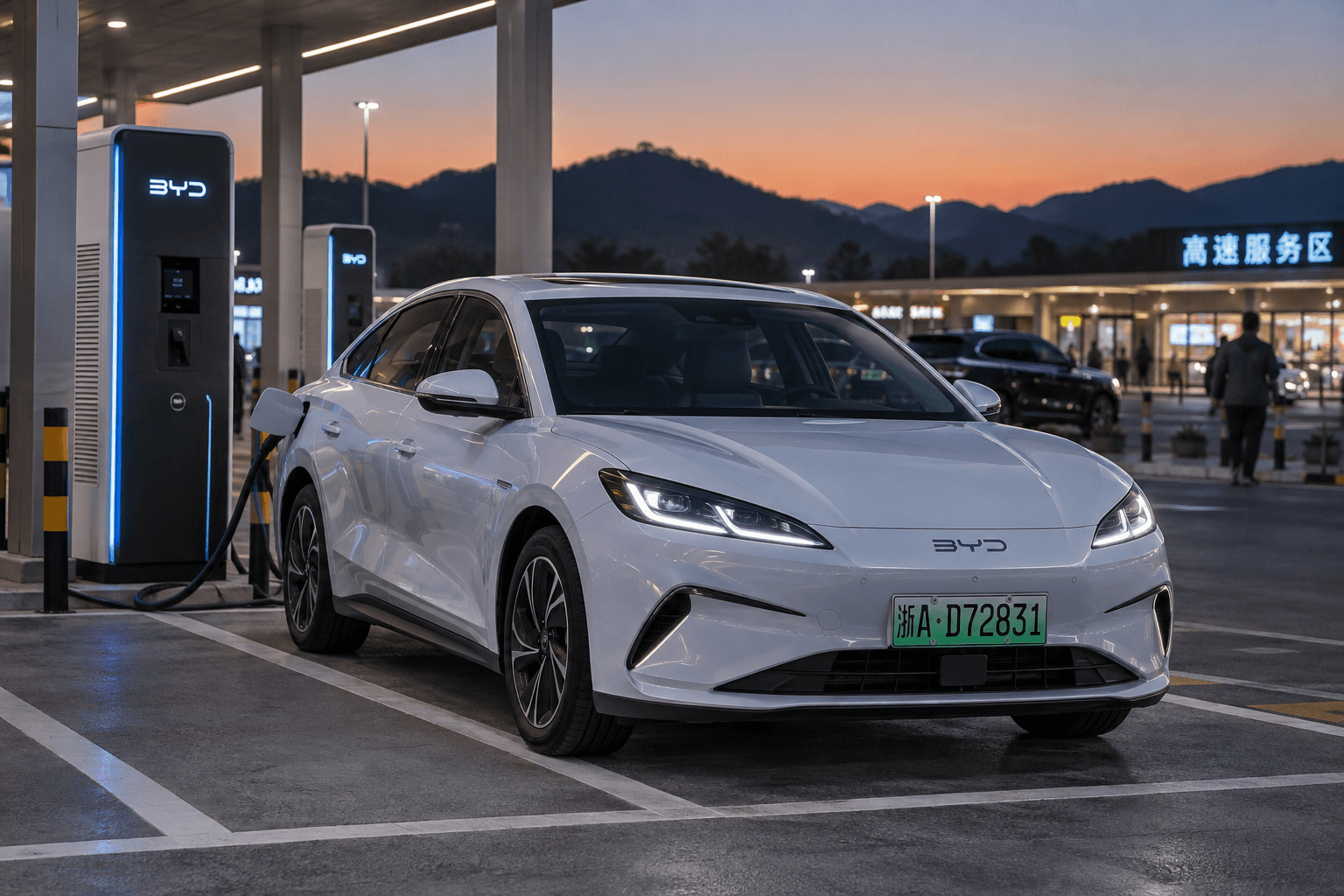
BYD plans to open its 2,000th fast-charging station on a Chinese highway on September 24, 2026. The site is located at the Baoying rest area in Yangzhou and marks the completion of a major phase of the network’s expansion.
The 2,000 stations were originally not expected to be in place until the end of the year. The network will now go into operation in time for China’s Mid-Autumn Festival and the particularly busy National Day holiday week.
According to BYD, its 2,000 highway sites cover almost one-third of the rest areas on China’s expressway network.
Sites spaced around 100 km apart
On average, the charging parks are slightly more than 100 km apart. This is especially relevant during major travel peaks, as queues and fully occupied fast chargers remain a weakness of electric mobility in China during public holidays.
The high density of stations distributes traffic across more sites and makes longer journeys easier to plan. Ideally, this means shorter detours, more alternatives, and less dependence on individual rest areas for drivers.
| Metric | Current figure |
|---|---|
| Highway sites | 2,000 |
| Average distance | slightly more than 100 km |
| Maximum power per connector | 1,500 kW |
| Supported voltage | up to 1,000 volts |
| Energy delivered by the end of August | 210 million kWh |
| Users served | more than 1.83 million |
1,500 kW can only be used with a compatible vehicle
The second generation of BYD Flash Chargers delivers peak power of 1,500 kW per connector and supports vehicle architectures of up to 1,000 volts. This puts BYD well beyond today’s widespread 400-volt systems and many modern 800-volt platforms. Our comparison explains the difference that 800-volt and 400-volt EV architectures make in everyday use.
However, the charging station alone is not the deciding factor. The battery, cell chemistry, thermal management, and vehicle voltage determine how much power is actually delivered. A vehicle with a maximum charging power of 150 or 250 kW will therefore not automatically charge faster at a 1,500 kW connector.
Combined with the second generation of the Blade Battery, BYD claims particularly short charging times. Under normal conditions, the battery is expected to charge from 10% to 70% in five minutes and from 10% to 97% in nine minutes. The announced Flash Charging for the BYD Seal 06 shows how the technology could be used in a specific vehicle.
Low temperatures are also expected to increase charging times by comparatively little. At -30°C, charging from 20% to 97% is said to take only around three minutes longer than under normal conditions. These figures are manufacturer claims and require a compatible battery and optimal operating conditions.
The charging network is open to other brands
The stations are not restricted to BYD vehicles. Electric cars from other manufacturers can also use them, provided their connectors, communication systems, and payment methods are supported. Almost one-third of users to date are said to have charged vehicles from other brands.
BYD is therefore not only pursuing a product strategy but also building its own infrastructure business. This could increase utilization at the sites while strengthening acceptance of the network beyond its own customer base.
20,000 stations remains an ambitious target
By the end of August, BYD had built a total of 10,000 Flash Charging stations in China. The figure is expected to reach 20,000 by the end of the year. To achieve this, the company would need to complete an average of around 80 new stations per day from the end of August onward.
Following the completion of the highway phase, the focus is therefore shifting increasingly toward cities. BYD’s previous milestone of 10,000 Flash Charging stations in China shows how quickly the company has expanded the network so far.
What the expansion means for Europe
No comparable expansion plan has yet been confirmed for Germany, Austria, or Switzerland. However, BYD has already completed its first stations in the United Kingdom and plans to have a total of 300 sites there in 2026. This indicates that the technology is not intended to remain limited to China.
Whether 1,500 kW will offer a major practical advantage in Europe in the near term depends primarily on the availability of compatible vehicles and high-capacity grid connections. Nevertheless, the strategic impact is significant: BYD is combining batteries, vehicles, and charging infrastructure into an integrated system, increasing pressure on other manufacturers and established charging-network operators.