New BYD Han Spotted as a Prototype for the First Time
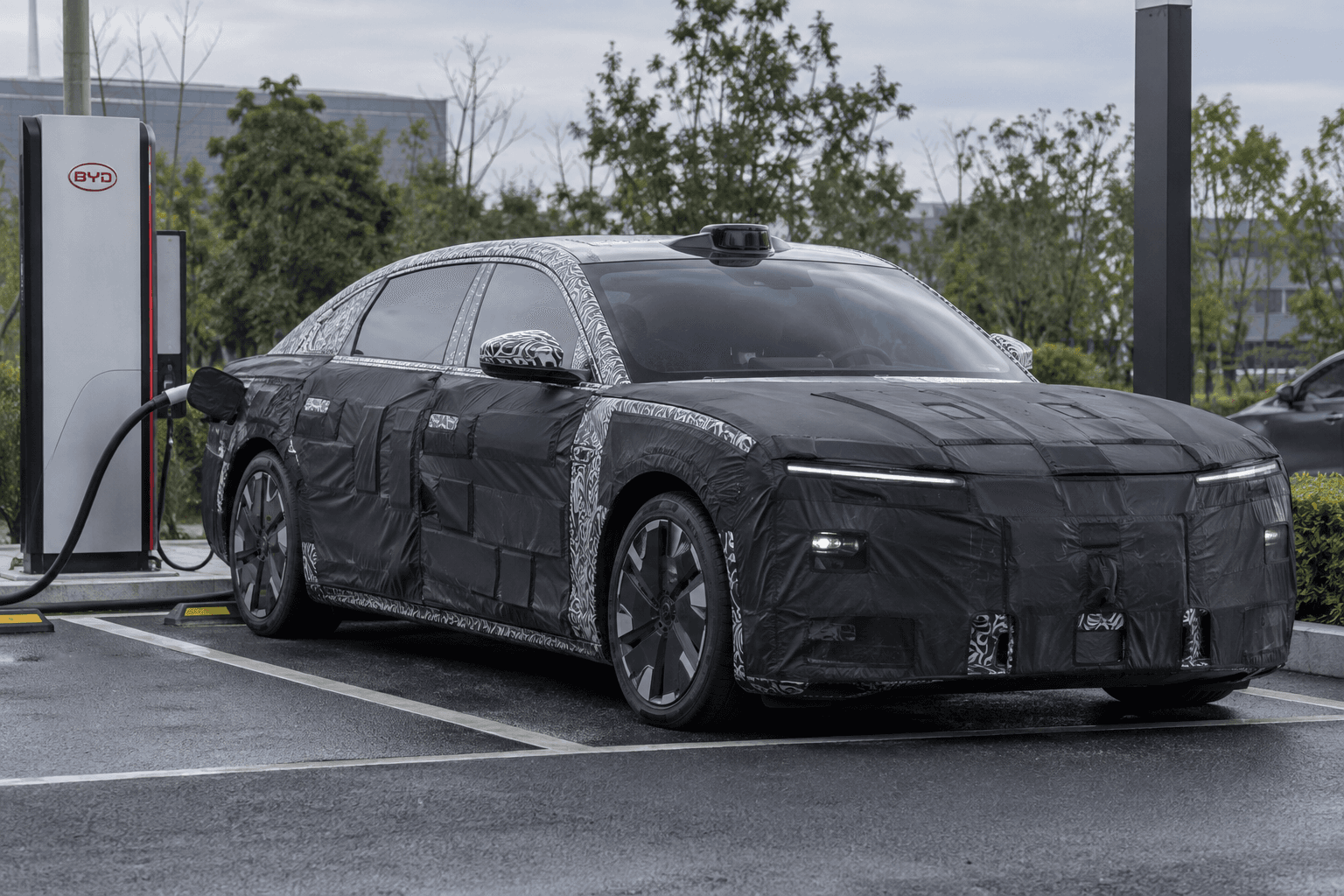
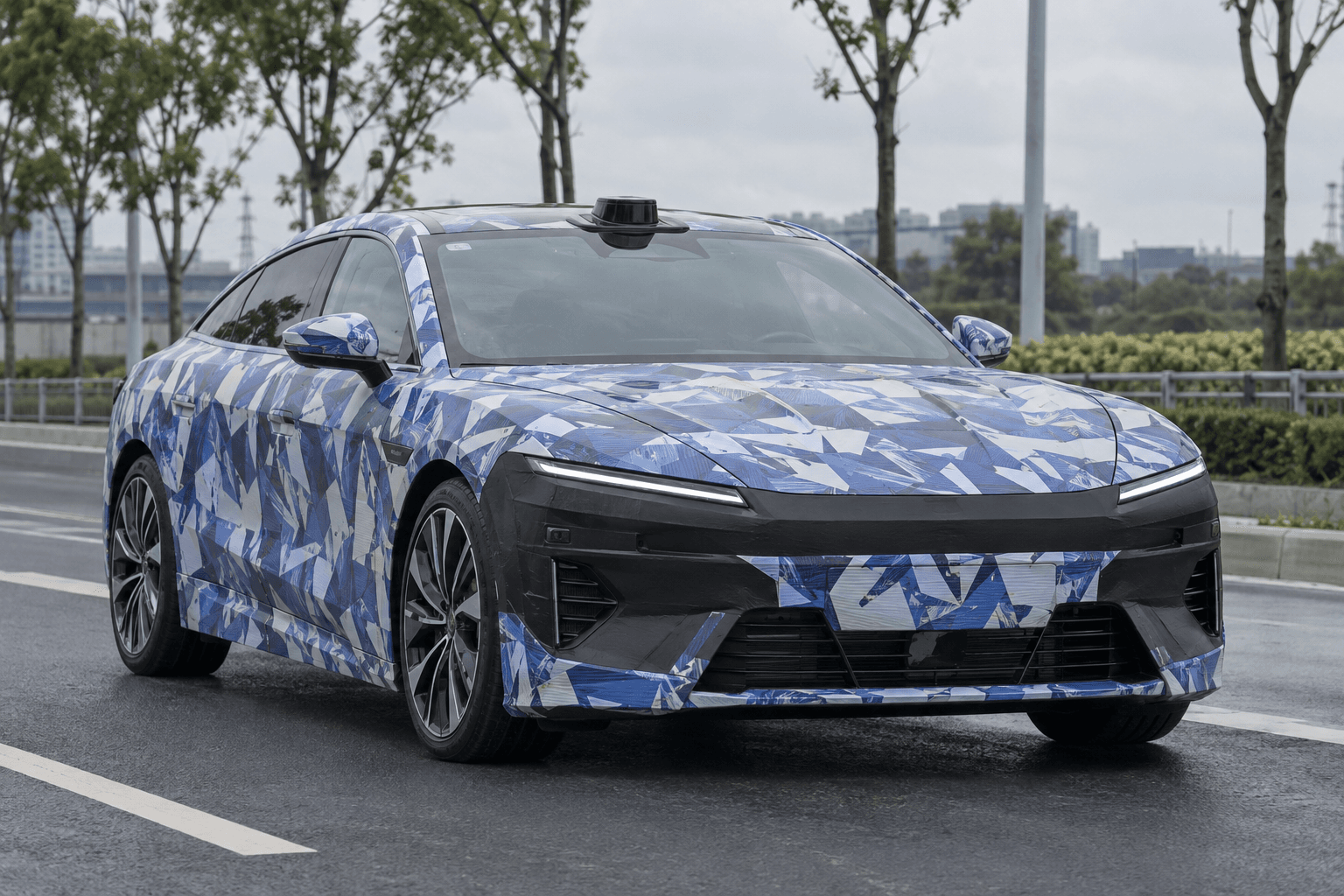
BYD is apparently working on the next generation of its large Han sedan. In recent images from China, the prototype is still covered in camouflage, but its basic shape, full-width taillight, and an evolution of the brand’s signature Dragon Face front end are already visible.
The sensor array on the roof is particularly interesting. It features a single LiDAR unit, indicating a more advanced driver-assistance system. However, it has not yet been officially confirmed whether this is indeed the model’s third generation.
BYD Reorganizes Its Han Lineup
The upcoming Han is expected to serve as the entry point to the growing model family. BYD will position the Han L above it, while the larger BYD Da Han, with a claimed range of more than 1,000 km, is set to become the flagship.
This would allow the standard Han to retain its current role as a relatively accessible luxury sedan. An entry price of approximately 200,000 yuan is currently expected in China. However, a domestic-market price cannot be directly applied to Germany, Austria, or Switzerland because of taxes, transportation, homologation, and equipment differences.
LiDAR Points to DiPilot 300
The single LiDAR unit on the roof matches the DiPilot 300 driver-assistance system, which BYD also markets as God’s Eye B. LiDAR uses laser pulses to map the surrounding environment and can complement cameras and radar when detecting vehicles, lane boundaries, and obstacles.
However, this does not automatically make the Han a fully autonomous car. In addition to the sensors, the software, approval of the respective functions, and the legal framework in the target market are crucial. It also remains unclear whether higher trim levels will receive additional side-mounted LiDAR sensors.
Roof-mounted LiDAR would primarily indicate more capable driver-assistance features, not unrestricted autonomous driving.
By comparison, BYD’s higher-tier DiPilot 600 uses a total of three LiDAR units. Which version will actually be offered in the new Han is likely to depend on the trim level and powertrain.
Blade Battery and Flash Charging Expected
The next Han is once again expected to be offered as both a fully electric car and a plug-in hybrid. Both versions are expected to feature the second generation of the Blade Battery and BYD’s Flash Charging technology. Official performance figures, battery capacities, and ranges are not yet available.
Flash Charging is designed to deliver high charging power across a broad range, reducing time spent at compatible fast-charging stations. The announced BYD Seal 06 with nine-minute charging demonstrates how far BYD may already be able to take this technology. However, it requires sufficiently powerful charging infrastructure, which is currently available only in isolated locations in Europe.
High DC charging power would be particularly unusual for a plug-in hybrid and could be highly relevant in everyday use. A PHEV battery that can be recharged quickly could increase the share of electric driving, provided drivers regularly plug the vehicle into a charging station.
Two Levels of Active Suspension Possible
DiSus-C and DiSus-A are apparently being considered for the suspension. DiSus-C actively controls the dampers and can adapt the setup to the road and driving situation. DiSus-A adds air suspension, also allowing changes to the vehicle’s ride height and body position.
In everyday use, this technology promises a broader balance between comfort and controlled handling. Lowering the body on the highway could also improve aerodynamics, while increased ground clearance would be useful on poor roads.
Familiar Interior Control Layout
In the cockpit, BYD appears to be sticking with its current design approach. Visible features include a light-colored, minimalist interior, a centrally mounted infotainment display, and a row of physical buttons on the center console.
The combination of a touchscreen and physical controls is likely to be more convenient in everyday use than moving every function to the display. The screen size and operating system remain unknown.
New BYD Han at a Glance
| Feature | Next Generation | Current Han in China |
|---|---|---|
| Positioning | Entry point to the Han family | Large electrified sedan |
| Powertrains | Electric and plug-in hybrid expected | Electric and plug-in hybrid |
| Battery | Second-generation Blade Battery expected | Blade Battery |
| Charging technology | Flash Charging expected | Depends on the version |
| Driver-assistance system | DiPilot 300 with LiDAR expected | Depends on the trim level |
| Price in China | Approximately 200,000 yuan expected | 168,800 to 225,800 yuan |
| Dimensions | Not yet known | 4,995 mm long, 1,910 mm wide, 1,495 mm high |
| Wheelbase | Not yet known | 2,920 mm |
The Generational Change Comes at the Right Time
The current Han recorded 2,997 deliveries in its home market of China in August 2026. Sales have declined noticeably since the beginning of the year. In addition to intense competition, expiring incentives and the rapid pace of technological development in the Chinese market are likely contributing factors.
A generational change featuring a modern battery, faster charging, and more capable driver-assistance technology could therefore give the Han fresh momentum. With models such as the Seal 06 with LiDAR and DiSus-C, BYD is already demonstrating which technologies are expected to reach more affordable model lines in the future.
The new BYD Han has not yet been confirmed for Europe. If BYD brings the sedan to the DACH region—Germany, Austria, and Switzerland—key factors alongside price would include adapted charging-route planning, local approval of driver-assistance features, and access to a competitive fast-charging network.