BYD Reaches Its Next Production Milestone in Thailand
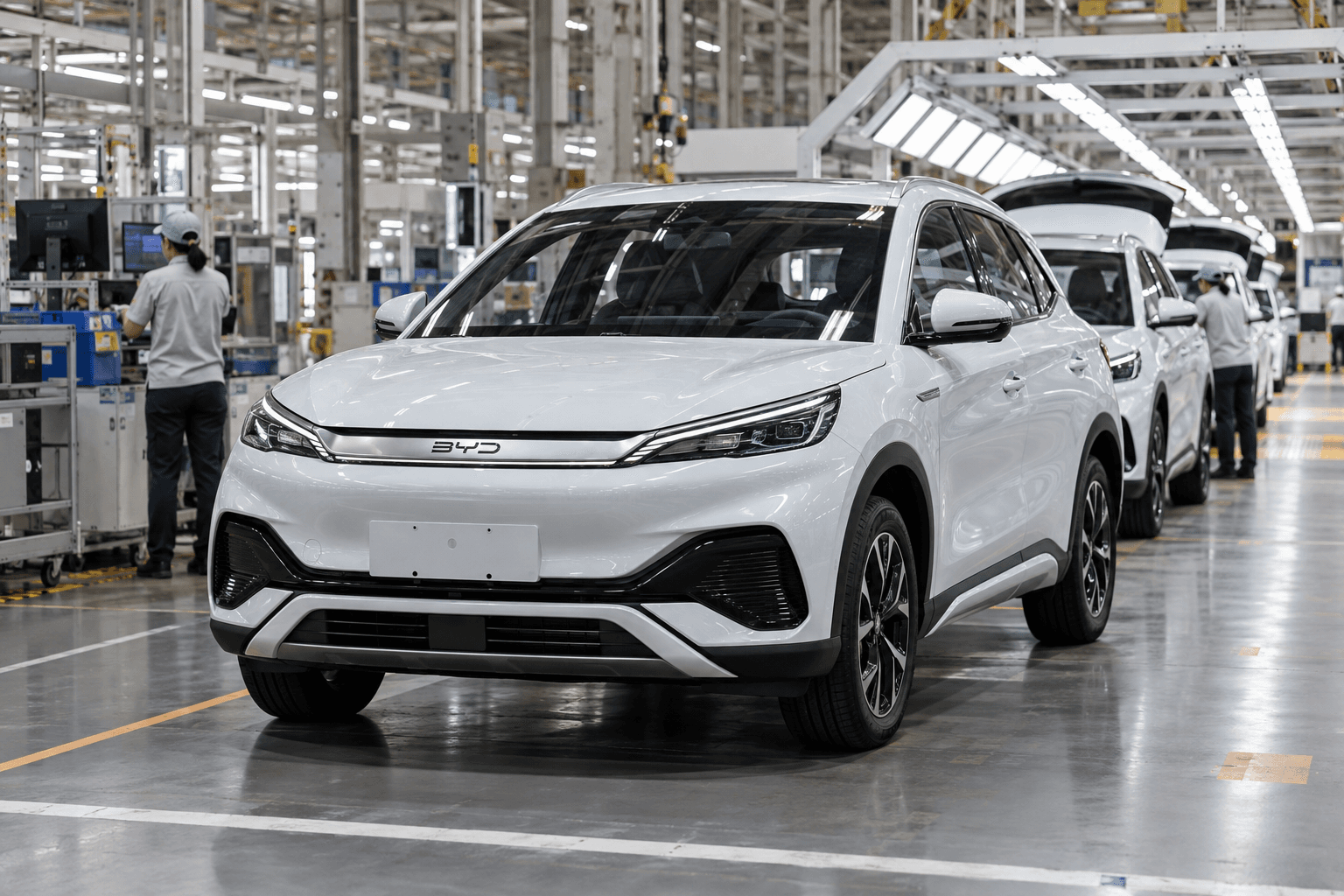
The 100,000th vehicle rolled off the production line at BYD’s plant in Thailand’s Rayong province on September 21, 2026. The milestone car was a white BYD Atto 3, the model with which the brand also entered the Thai market in 2022.
The factory has only been producing vehicles since July 2024. This means BYD took around 26 months to reach six figures. It is an important milestone because Rayong is the first passenger-car production facility outside China to be fully controlled by BYD.
The Thailand plant has long since become more than a local assembly facility. It is developing into a strategic production and export hub for BYD.
How Production in Rayong Has Developed
The factory is designed for a theoretical annual capacity of 150,000 vehicles. The production milestones achieved so far illustrate the site’s gradual ramp-up, but do not yet allow any reliable conclusions to be drawn about its current capacity utilization.
| Date | Production milestone |
|---|---|
| July 2024 | Production begins |
| November 2024 | 10,000 vehicles |
| November 2025 | 70,000 vehicles |
| September 2026 | 100,000 vehicles |
BYD groups its production under the term New Energy Vehicles. This includes both fully electric cars and plug-in hybrids. That explains why several vehicles featuring DM-i hybrid technology are built in Rayong alongside battery-electric models.
Five BYD Models Are Built in Thailand
Five locally produced models now have Thai certificates of origin. The range extends from compact electric cars to plug-in hybrid SUVs.
| Model | Powertrain |
|---|---|
| BYD Dolphin | Electric |
| BYD Atto 3 | Electric |
| BYD Seal 5 DM-i | Plug-in hybrid |
| BYD Sealion 5 DM-i | Plug-in hybrid |
| BYD Sealion 6 DM-i | Plug-in hybrid |
Local involvement is also growing. Around 95% of employees are from Thailand, up from approximately 93% in July. According to BYD, it has created more than 5,000 jobs in the country, while around half of its procurement is already handled through local suppliers.
Thailand Is Becoming an Export Hub for Europe
Thailand is BYD’s most important market in the Asia-Pacific region. By July 2026, more than 130,000 cars, including imported vehicles, had been delivered there. However, the plant supplies not only the domestic market and other ASEAN member states.
In August 2025, BYD shipped more than 900 Dolphins from Thailand to Europe for the first time. The destination countries included Germany, Belgium and the United Kingdom. This also makes the plant relevant to the DACH region—Germany, Austria and Switzerland—even though separate export figures for Austria and Switzerland are not yet available.
Production outside China can help BYD diversify its supply chains and reduce its dependence on individual markets. However, it does not automatically provide protection from all tariffs or trade requirements, as rules of origin and the specific design of European regulations are among the decisive factors.
Localization Is Becoming a Competitive Advantage for BYD
The high proportion of Thai employees and growing local procurement show that BYD is building more than a simple final-assembly operation in Rayong. Local suppliers → shorter transport routes, more resilient supply chains and, in the long term, greater flexibility over production costs.
Having built 100,000 vehicles, the plant has clearly moved beyond its industrial ramp-up phase. The key questions now are how quickly BYD will utilize the available capacity and which additional models are planned for export from Thailand.