VW in Zwickau: No Decision, but a Clear Mandate
During a visit to Volkswagen’s Zwickau plant, Group CEO Oliver Blume outlined the outlook for the site in Saxony. The key point: VW currently sees no robust prospect of competitively viable capacity utilization at several plants in the 2030s. Emden, Hanover, Zwickau and Neckarsulm were named.
Important context: No decision has been made to close any plants. Blume described closures as “always the last and most expensive solution.” Rather than making harsh short-term decisions, the Group is initially establishing a structured window in which to develop options.
Six to Twelve Months for Specific Options, with Competitiveness Deciding the Outcome
The brands are to work with the plants over the next six to twelve months to develop specific “option frameworks.” The aim is to establish viable prospects for all affected sites rather than focusing on a single plant.
Regarding Zwickau, Blume used wording that cuts both ways: The site would receive “the same opportunity as every other plant in Europe.” Ultimately, competitiveness would determine the outcome. In practice, that means costs, productivity, complexity and the question of which vehicles or industrial functions can realistically be assigned to the site.
Praise for Zwickau: Lower Costs, Better Processes and New Projects
Blume explicitly emphasized that Zwickau’s workforce had already delivered: Costs had been reduced, processes improved and the agreed workforce restructuring advanced according to plan. He also cited the latest vehicle launches as evidence of the site’s capabilities.
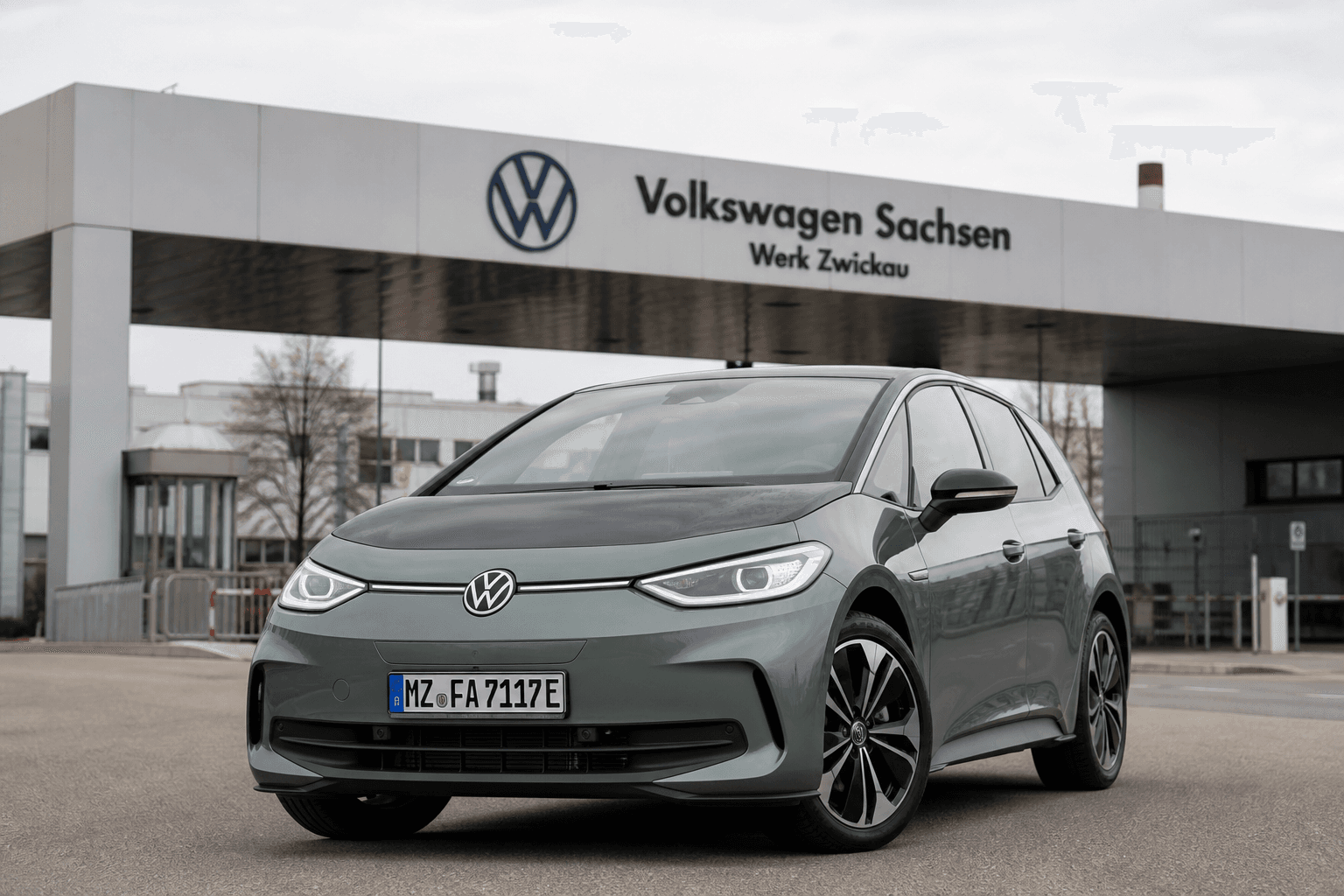
Zwickau produces several models that are also in strong demand across the DACH region—Germany, Austria and Switzerland—including the VW ID.3 and the Audi Q4. The plant also builds the Cupra Born, which likewise plays a clear role in the compact segment.
Blume also pointed to the planned Circular Economy Hub. This approach typically involves reusing components and materials more systematically and establishing closed-loop systems, which can reduce costs and dependencies over the long term. Such an additional industrial pillar can be crucial for a site when vehicle production volumes fluctuate.
Integration into Volkswagen AG: Blume Acknowledges Delays
Another issue is the plant’s delayed integration into Volkswagen AG. Blume was self-critical and said he understood the disappointment. The problem did not lie with the site, and he personally stood behind efforts to move the integration forward.
For the workforce, this is more than symbolic. Structural issues of this kind often affect how quickly investments, programs or new work packages are approved—and therefore how reliably the next few years can be planned.
Cost Gap with Other Plants Remains the Tough Issue
Despite the improvements, Blume said the internal comparison remains difficult. He stated that labor costs in Zwickau are currently more than twice as high as at comparable European sites. Other plants also have lower factory costs.
He said this was not an accusation but the reality against which a site must be measured. For VW, this is particularly relevant in a market facing increasing price pressure from new competitors, faster product cycles and an increasingly global platform business.
Job Cuts: Focus on Indirect Functions, Management to Shrink by 25%
Regarding the announced job cuts, Blume said they would primarily affect areas outside direct vehicle production. These include Group-level positions, central functions, development and sales. In addition, management is to lose one-quarter of its positions.
Blume said the frequently reported figure of around 50,000 jobs worldwide was not a target but a theoretical calculation based on cost comparisons. Volkswagen’s costs are currently around 30% above the average for comparable companies. The message: The aim is not to become smaller, but to become more efficient and thereby retain the financial capacity to act.
Voluntary Measures: Attrition, Phased Retirement and Restrictive Hiring
VW intends to continue relying on voluntary measures to reduce its workforce. These include retirements, mutually agreed arrangements, natural attrition and a restrictive hiring policy. Phased retirement—a German arrangement that allows older employees to reduce working hours ahead of retirement—is also to be opened to additional age groups, with details to be discussed with employee representatives.
About half of the current adjustment requirement applies to Germany, while the other half is spread internationally across approximately 170 companies. This makes one thing clear: Although public debate frequently focuses on German plants, the restructuring is much broader in scope.
Why VW Is Scrutinizing Costs So Closely Right Now
Blume cited tariffs, new competitors and geopolitical risks among the reasons. These affect not only VW but the entire automotive industry, particularly in Europe, where CO2 regulations, energy prices and market dynamics converge.
Blume also pointed to the operating margin of 3.8%, which is in line with the competitive environment but insufficient to finance the future “under its own steam.” For EVs, this means that scale, manufacturing and platform costs, and demand must be brought into a balance that enables investment in the next generations. Anyone looking for an overview of the electric compact SUVs and alternatives currently available on the German market can also consult our overview of electric compact SUVs in Germany in 2026.
For Zwickau and other sites, this amounts to a transparent competition, combined with the task of presenting specific, viable industrial options over the coming months.