Tesla Software 2026.26.6.5: Summer Update Meets FSD (Supervised) 14.3.8
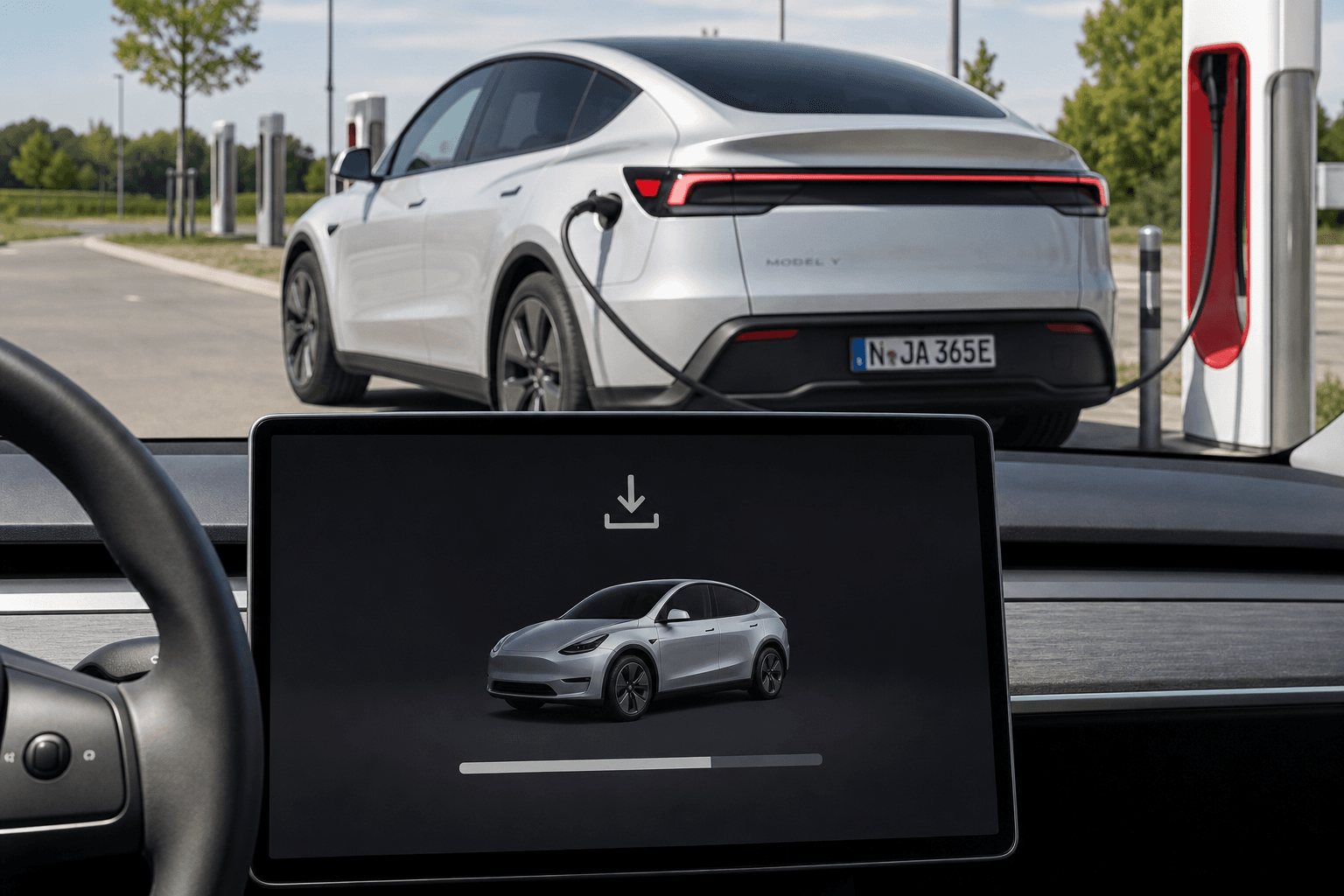
Tesla is rolling out software version 2026.26.6.5. The update combines the 2026 Summer Update with new features related to Full Self-Driving (Supervised), with Tesla making a clear distinction between hardware generations this time: FSD (Supervised) v14.3.8 is intended for HW4, while FSD (Supervised) v14.1 Lite specifically targets HW3—primarily the Model 3 and Model Y.
Important for Germany, Austria, and Switzerland—the DACH region: FSD features are heavily restricted in Europe by regulations and software enablement. Many of these points are therefore primarily relevant as a preview of the technology, while individual Summer Update features relating to the UI, navigation, media, and convenience may already reach vehicles here, depending on the model.
How FSD (Supervised) v14.3.8 Technically Improves HW4
For v14.3.8, Tesla lists several steps aimed directly at faster and more robust decision-making. The focus on training and runtime is particularly noteworthy: According to the release notes, Tesla has further developed the reinforcement-learning training stage and revised the vision encoder to better understand rare situations and poor visibility.
The biggest performance boost sounds like genuine platform-level work: Tesla describes a reimplementation of the AI compiler and runtime based on MLIR, which is expected to enable around 20% faster response times. In everyday driving, this would primarily help when the system has to quickly weigh several options, such as at complex intersections or when another vehicle suddenly cuts in.
Specific Driving Behavior Updates: Lane Positioning, Parking, and Edge Cases
In the release notes, Tesla also lists a series of driving behavior corrections. These include less unnecessary “lane biasing”—an undesirable tendency to favor one side of a lane—less close following, and more decisive behavior when selecting a parking space and parking.
Of particular interest for safety logic, Tesla mentions improvements in handling emergency vehicles, school buses, and rare right-of-way conflicts. Small animals are also explicitly mentioned, with targeted training on difficult examples intended to improve proactive safety.
Driver Monitoring: More Sensitive, but Ideally More Accurate Too
Driver monitoring is also said to have been improved, including more precise gaze tracking, better handling of glasses, and more stable detection in changing light. As FSD and driver-assistance features become more capable, the quality of this monitoring is crucial to reducing false alarms and detecting genuine inattention more quickly.
FSD (Supervised) v14.1 Lite for HW3: “Distillation” Instead of Stagnation
The second major topic is FSD (Supervised) v14.1 Lite for HW3. Tesla describes the approach as “distillation”: The “intelligence” from the HW4 V14 stack serves as the teacher model, allowing HW3 to learn from these patterns. In practice, this means Tesla is trying to bring more recent improvements to older hardware without requiring HW3 to run exactly the same large models.
Tesla cites better responses and more predictive behavior during navigation, merging, road splits, interactions with pedestrians and traffic lights, and when other vehicles cut in. Comfort is also expected to improve, with fewer unnecessary slowdowns, smoother steering, and more stable lane centering.
New on HW3: Parking, Exiting Parking Spaces, and Reversing
One major functional leap in the notes is that this package gives HW3 the ability to park, exit parking spaces, and reverse. How much of this is actually enabled in each location will depend heavily on the market and regulatory approvals. Nevertheless, the direction is clear: Tesla does not want the feature gap between HW3 and HW4 to become unnecessarily large.
“Start Self-Driving from Park” and New Arrival Options
For HW3 in the Model 3 and Model Y, Tesla also describes “Start Self-Driving from Park.” If the driver requirements are met—including seat position, seat belt use, an unobstructed cabin camera, and other conditions—a button appears that allows FSD (Supervised) to start directly from a standstill. There is also an optional setting called Brake Confirm, which either requires a brief press of the brake pedal for confirmation or allows the system to apply the brakes itself before setting off.
Under “Arrival Options,” Tesla is adding destination arrival modes such as parking lot, street, driveway, and “Pull Over” for drop-off-style situations. Notably, preferences are expected to be saved for each destination. This could save time in everyday use by allowing the car to complete journeys to recurring destinations such as the office, school, or sports facilities more consistently.
Speed Profiles: Driving Style Becomes Easier to Adjust
A new approach to Speed Profiles is also described for HW3. Instead of constantly adjusting the exact offset from the speed limit, the selected profile will play a greater role in determining the vehicle’s behavior. A new, particularly conservative profile called SLOTH drives more slowly and chooses lanes more defensively than “CHILL.”
According to the notes, the right-hand scroll wheel on the steering wheel will also be used more extensively as a direct control for the speed profile. This is a clear UX improvement: less micromanagement and more of a “choose a driving style and let the car drive” approach.
Summer Update: Navigation, Range Display, and Grok
Independently of FSD, 2026.26.6.5 includes the Summer Update with several features likely to be more relevant to many Tesla drivers in the DACH region than FSD itself.
Estimated Range Takes Greater Account of Battery Aging
For selected Model 3 and Model Y configurations, the estimated range will take additional battery-aging characteristics into account in the future. This could help make the everyday range display appear less “optimistic” and better aligned with your actual usage profile.
Preferred Routes and Automatic Navigation
With “Preferred Routes,” the navigation system prioritizes routes you have driven frequently in the past. Online routing must be enabled. There is also “Automatic Navigation,” which can suggest destinations and automatically plan routes based on your routine, such as regular stops on the way to work.
Tesla emphasizes that location data is processed anonymously and is not intended to be linked to the vehicle. In practice, the feature is particularly useful if you often follow the same daily routine and want the car to anticipate your needs more quickly.
Grok Commands: More Voice Functions, but Not Everywhere
Depending on the vehicle hardware—especially AMD in newer models—Tesla is expanding the Grok integration to include making calls, playing music, adjusting the climate controls, and searching settings. “Hey Grok” is also mentioned, along with a note that Premium Connectivity or Wi-Fi may be required depending on usage.
Other Visible Changes: Visualizations, Speed Cameras, and Caraoke
The update also introduces several UI and convenience improvements. These include adjustable driving visualization zoom, icons for speed cameras along the route—with Premium Connectivity required—and Caraoke with scoring, including a QR-code function on the rear display in compatible vehicles.
For Tesla fans who interact extensively with the interface, these are often precisely the “small” improvements they cannot imagine living without after two days of use.
Which Tesla Models Are Generally Affected?
For FSD v14.3.8 on HW4, Tesla lists the Model S, Model 3, Model X, Model Y, and Cybertruck. For FSD v14.1 Lite on HW3, the Model 3 and Model Y are listed. However, which features actually reach your vehicle depends not only on its hardware but also on the region, configuration, and software enablement.
| Feature Group | Hardware According to the Notes | Models According to the Notes | Everyday Benefits (Briefly) |
|---|---|---|---|
| FSD (Supervised) v14.3.8 | HW4 | S, 3, X, Y, Cybertruck | Faster responses, more robust vision, and better handling of edge cases |
| FSD (Supervised) v14.1 Lite | HW3 | 3, Y | More V14 improvements for older hardware, including parking functions according to the notes |
| Preferred Routes, Automatic Navigation | Intel or AMD, depending on the feature | S, 3, X, Y, Cybertruck | Navigation learns routines and preferred routes |
| Estimated Range with Aging Factors | Selected configurations | 3, Y | Range display is intended to be closer to real-world results |
What It Means for Germany, Austria, and Switzerland
FSD (Supervised) is available much more widely in North America than in Europe. However, Tesla is clearly developing large, reusable building blocks: better vision, a faster runtime, a clearer UI, and navigation that understands habits. These components are also relevant to European driver-assistance features and the overall driving experience, even if FSD is not available here in the same form.
If you are particularly interested in Tesla models, you can find our overviews of the Tesla Model Y and Tesla Model 3. And if you want a deeper look at Tesla’s hardware and AI approach, our article on Tesla’s HW4 and “distilled” FSD models is also a useful companion piece.