Tesla Semi enters production with technical refinements
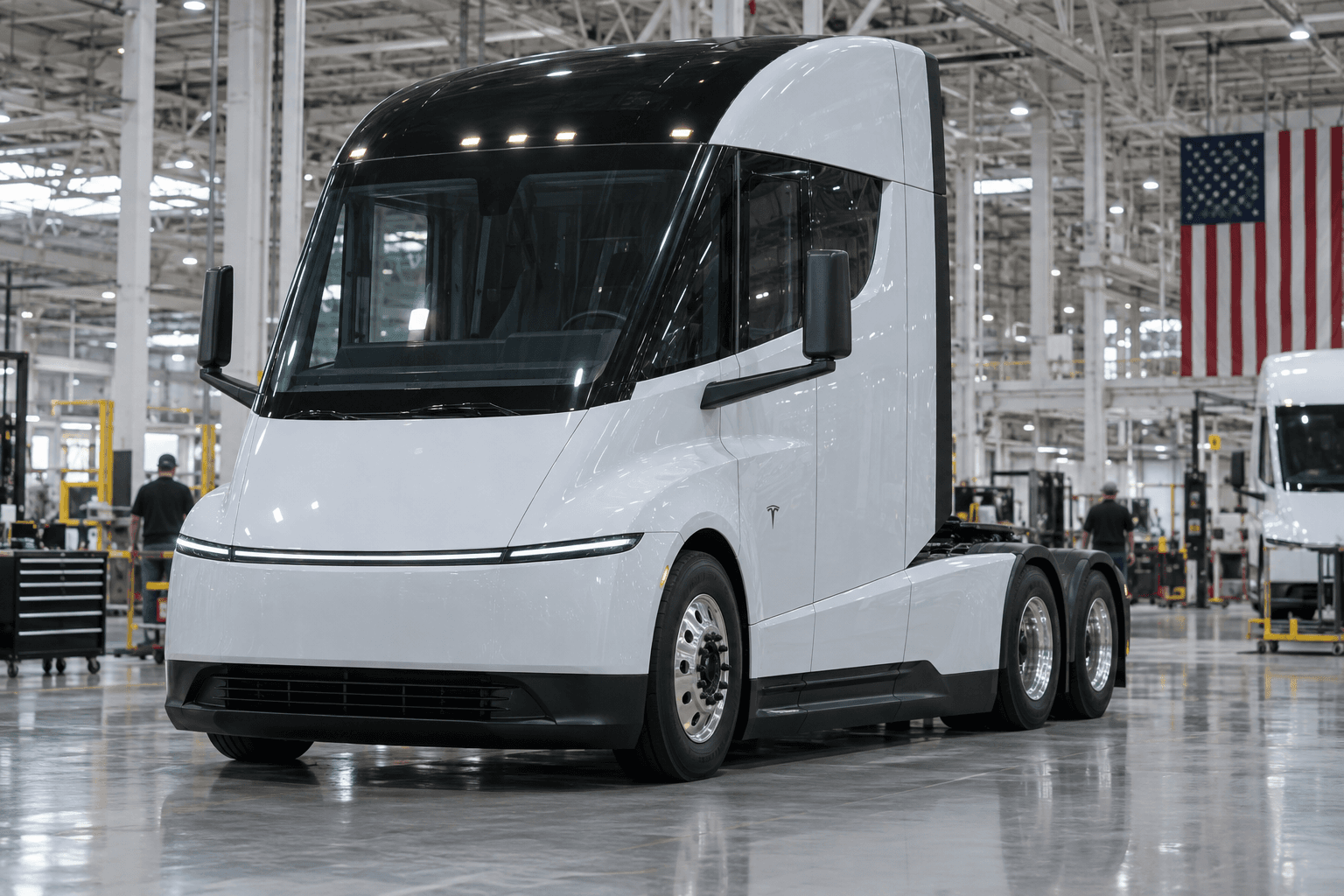
Tesla has released new details about the production version of the Semi. The electric truck is expected to operate around 3% more efficiently than earlier prototypes while also being simpler and less expensive to manufacture.
Production is ramping up in Nevada. Tesla is primarily targeting the North American market, where the Semi competes in the heavy-duty Class 8 category. Specific details regarding its market launch, type approval, and pricing in Germany, Austria, and Switzerland are still unavailable.
A full load slows the Semi down less
Without a trailer, the Tesla Semi is expected to accelerate to around 100 km/h in approximately 12.5 seconds. With a fully loaded trailer, Tesla quotes around 24 seconds. According to Tesla, a comparable diesel truck may need approximately 60 seconds.
| Configuration | Acceleration to around 100 km/h |
|---|---|
| Without trailer | approximately 12.5 seconds |
| With fully loaded trailer | approximately 24 seconds |
| Comparable diesel truck, fully loaded | approximately 60 seconds |
In everyday use, sprint times matter less than merging quickly, pulling away on inclines, and keeping pace with traffic. A powerful electric drivetrain can save time and reduce driver workload in these situations, provided traction and energy consumption are managed effectively.
548 kWh battery and improved aerodynamics
The Standard Range version receives a battery with 548 kWh of capacity. Tesla says that despite its significantly greater mass and frontal area, the Semi requires only around seven times as much energy as a Tesla Model Y. However, the company did not provide a specific energy consumption figure for the production version.
To improve efficiency, Tesla has revised the airflow around the front, among other measures. A new opening in the bumper is intended to improve airflow. According to the manufacturer, the Semi achieves particularly low aerodynamic drag, which is said to be even lower than that of the Bugatti Chiron.
The battery enclosure has also been revised. Its more angular design is intended to retain heat more effectively at low temperatures. This can reduce the need for active battery heating → leaving more energy available for propulsion.
The key advances are not limited to performance and range, but also include efficiency, repair costs, and scalable manufacturing.
Powder coating replaces conventional paintwork
Rather than painting the Semi’s body panels conventionally, Tesla applies a powder coating. The company already uses a similar process for its stationary Megapack energy storage systems.
Eliminating a conventional paint shop saves space in the factory and can reduce investment costs and production complexity. The Semi will initially be offered in white, with additional colors set to follow later for fleet customers.
This approach makes sense for operators of large fleets. Durable surfaces and predictable costs often matter more to them than an extensive selection of elaborate paint finishes.
Three-piece bumper could reduce repair costs
On the production version, the front bumper consists of three separate sections. This means the entire component does not necessarily have to be replaced after minor damage. Particularly for high-mileage commercial vehicles, such a design can reduce downtime and repair costs.
The centrally positioned driver’s seat has been retained. It provides a good view of the road ahead but differs significantly from conventional European truck cabs. The heated fabric seats also feature ventilation, while the cab is said to provide sufficient standing room for people up to approximately 1.98 m tall.
Important questions remain unanswered for Europe
The new details show that Tesla is not optimizing the Semi solely for maximum performance. Many of the changes concern manufacturing, cold-weather efficiency, maintenance, and repairability—the very factors that determine total cost of ownership for fleet operators.
It nevertheless remains unclear whether the Semi will come to Europe in this form. Dimensions, axle-load limits, charging infrastructure, and regulatory requirements differ from those in the North American market. Only reliable energy consumption, range, and charging-time data from production vehicles will show how competitive Tesla’s electric truck really is in everyday long-haul operations.