Tesla Assesses Optimus Supply Chain
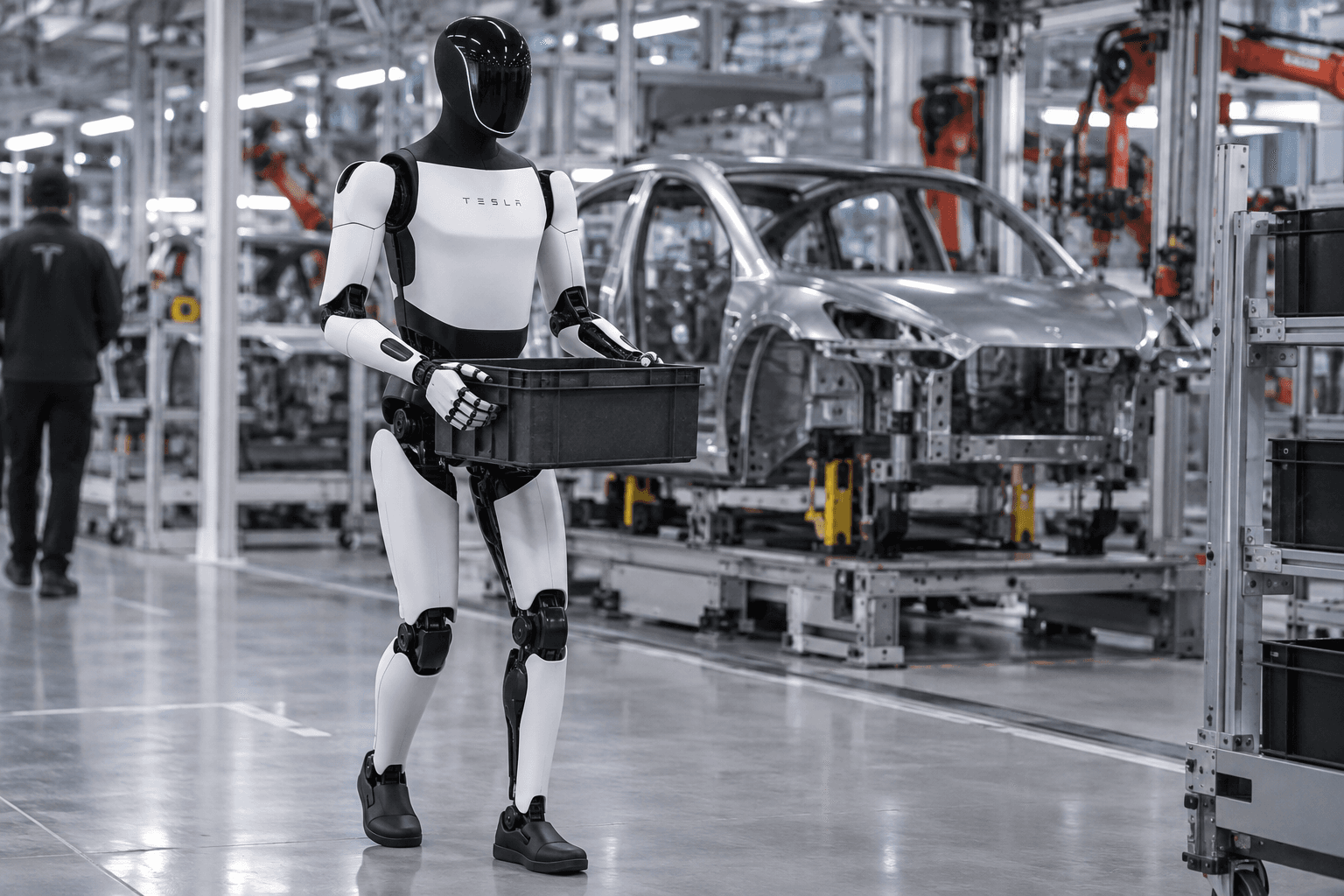
Tesla is reportedly making significant progress toward the industrialization of its Optimus humanoid robot. A company team is said to be assessing several suppliers in China’s Yangtze River Delta for production quality, capacity, and compliance with technical standards.
The companies named include Tuopu Group, Sanhua Intelligent Controls, and Joyson Electronics. They already supply components for Tesla’s vehicle business and are expected to produce joint modules, actuators, and precision components for Optimus in the future.
According to media reports, several of the companies under review have already received orders. This would make the audits less of a conventional supplier selection process and more of a final quality check before production ramps up.
What Tesla Is Checking at Its Suppliers
The inspections are expected to cover factories in Ningbo, Hangzhou, Shanghai, and other locations in the region. The key question is whether the respective production lines can meet Tesla’s requirements for quality, repeatability, and delivery reliability.
Tesla reportedly applied automotive industry standards during an earlier round of inspections. These include short production cycles, a high yield of defect-free parts, transparent per-unit costs, and oversight of downstream suppliers.
Optimus must do more than simply work. Tesla must be able to build thousands of complex robots with consistent quality and predictable costs.
That is precisely where the real challenge lies. A humanoid robot has numerous moving joints, sensors, and electromechanical drives. Small deviations in individual components can affect the robot’s entire range of motion.
Third-Generation Optimus Set for Mass Production
According to the report, the third generation of Optimus is intended for mass production. It is expected to be the first version designed from the outset for higher volumes and to feature substantial improvements to its hands and joint actuators.
The hands in particular are considered technically demanding. They must be precise enough to handle a variety of objects while also remaining robust, affordable, and reasonably easy to maintain.
| Area | Current Plan |
|---|---|
| Initial tasks | Material transport and simple assembly work |
| Key components | Actuators, joint modules, and precision structures |
| Supplier region | Yangtze River Delta, including Ningbo, Hangzhou, and Shanghai |
| First production site | Tesla’s Fremont factory |
| Additional production | Planned line at Gigafactory Texas |
Fremont Could Build Up to One Million Robots
Tesla is said to have converted a former production area for the Model S and Model X in Fremont into an Optimus production line. A planned annual capacity of one million units has been discussed.
However, a capacity figure is not the same as a production forecast. Whether Tesla actually reaches this scale will depend on stable supply chains, sufficiently high manufacturing yields, and robotics software that works reliably in real-world conditions.
A second line in Texas is reportedly designed to eventually produce up to ten million robots per year. Production is currently expected to begin around summer 2027, although schedules may still shift for such a new product.
First Real-World Deployment Likely to Be in Tesla Factories
The first Optimus robots are expected to handle internal industrial tasks. Moving materials, supplying components, and performing simple, repetitive assembly steps are easier to control than deployment in private homes.
This approach offers Tesla a major advantage: The company can test the hardware and software under real-world conditions without immediately having to sell a fully mature household robot. More operating hours in its own factories → more data for motion planning, reliability, and maintenance.
Optimus is also closely linked to Tesla’s AI strategy. Statements about Optimus, FSD, and future hardware show that Tesla increasingly views vehicles and robotics as a shared platform for real-world artificial intelligence.
China Is Becoming a Decisive Factor for Optimus
Tesla’s decision to rely on established Chinese automotive suppliers is understandable. The region offers extensive manufacturing capabilities, short distances between specialized companies, and considerable experience with electric drives, power electronics, and precision mechanics.
At the same time, competition there is growing. Several Chinese automakers and technology companies are developing their own humanoid robots and can also draw on capable local supply chains.
For Germany, Austria, and Switzerland, this latest step does not indicate an imminent market launch. It is nevertheless significant: If the suppliers pass the audits and component production begins, Optimus would make the transition from a publicly demonstrated prototype to an industrially manufactured Tesla product for the first time.