FSD Lite v14.1: When Large Obstacles Suddenly Seem “Invisible”
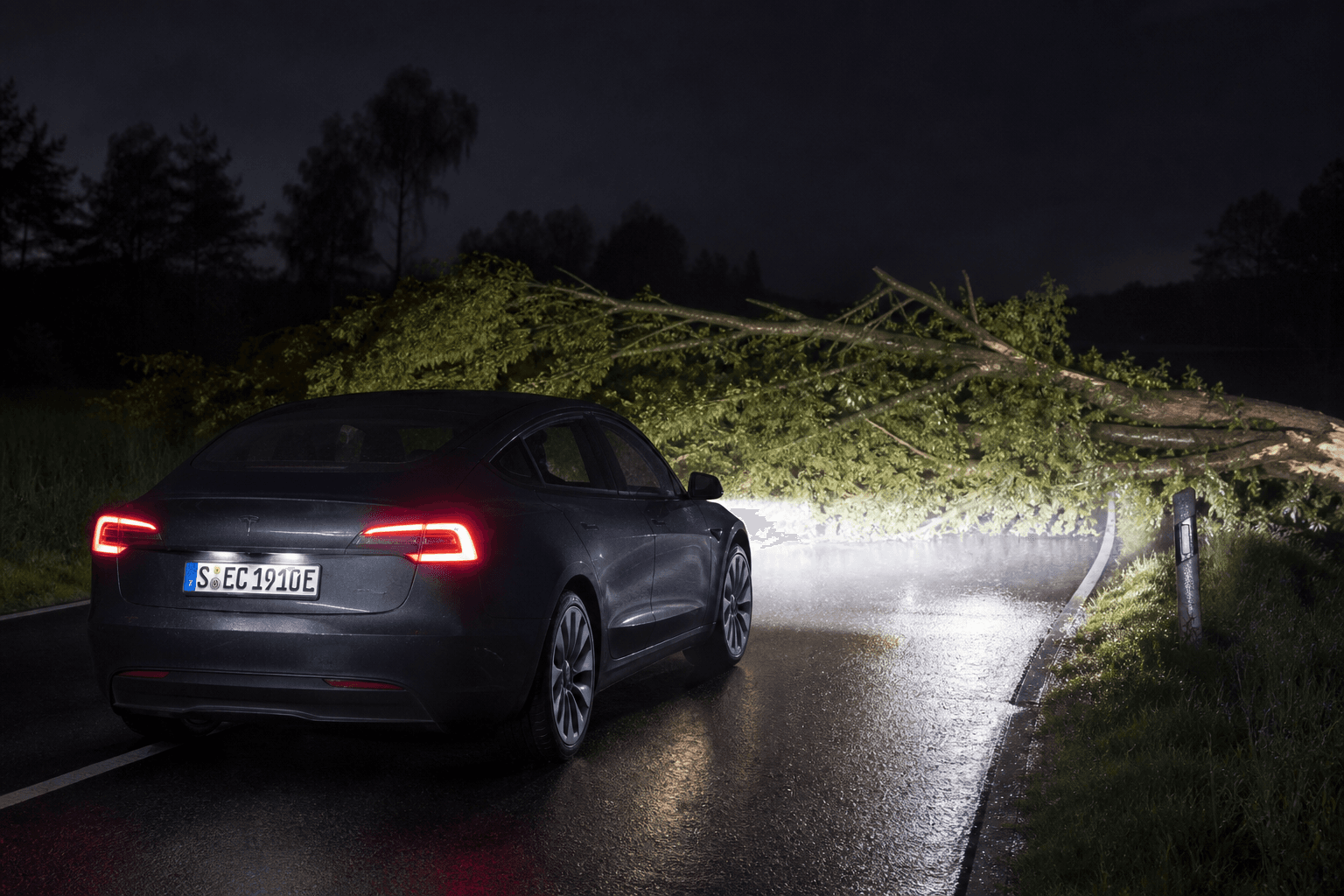
Two videos are currently circulating on social media in which Tesla’s FSD Lite v14.1 apparently fails to respond in time to obstacles on the road. One involves a fallen tree at night, while the other shows a thick log in the roadway. In both situations, the drivers intervene: in one case, the car is manually brought to a stop in time; in the other clip, the driver claims the car made contact with the log.
Important context: Tesla’s system is still called Full Self-Driving (Supervised). This is not merely a marketing qualifier, but a clear usage requirement: drivers must keep their hands and attention ready to take over immediately at all times. It was precisely this driver supervision that prevented worse outcomes here.
What Exactly Is “FSD Lite,” and Why Does It Mainly Affect Older Teslas?
FSD Lite is a version of the FSD software designed specifically for vehicles equipped with Tesla Hardware 3 (HW3). HW3 was installed from 2019 onward and has significantly fewer computing and memory resources than the newer Hardware 4 (HW4), which began playing a larger role in vehicles from around 2023. With FSD Lite, Tesla is attempting to bring as much of the newer platform’s functionality and behavior as possible to the older hardware.
The central conflict is that autonomous driving today is extremely demanding in terms of AI and computing power. Less performance often means smaller or more heavily compressed models, fewer reserves for challenging scenes and potentially greater sensitivity to edge cases such as darkness, changing shadows, wet roads or unusual objects.
HW3 vs. HW4: Why the Platform Makes a Difference
| Criterion | Tesla HW3 | Tesla HW4 |
|---|---|---|
| Introduction | from 2019 | from 2023 (wider availability) |
| Camera resolution (reported) | 1.2 megapixels | 5 megapixels |
| RAM (reported) | 8 GB | 16 GB per chip |
More RAM and better camera data are not merely “nice to have” in vision-based systems; they have a direct impact on perception by enabling finer details, more stable classification and greater flexibility to run multiple AI models in parallel or at higher input resolutions.
Why Trees, Branches and Logs Can Be Particularly Difficult
Large but “atypical” obstacles such as fallen trees are a classic challenge for driver-assistance systems. The issue is less their size than the combination of shape, structure and context. A tree is not a standardized object like a car or traffic cone and, depending on the viewing angle, may appear to be part of the “background.”
At night, image quality declines further, particularly with high-contrast light sources such as headlights or oncoming traffic, or when leaves and branches do not form clear edges. A system that relies primarily on camera vision therefore needs highly robust models to distinguish reliably between a “clear road” and a “blocked road.”
Reports of Other FSD Lite Weaknesses: Overheating and Inaccurate Lane Guidance
In addition to the current clips, other user reports about FSD Lite can also be found online. These include FSD hardware overheating and situations in which lane tracking appears imprecise. Such feedback is not automatically representative, but it does reveal a pattern: on HW3, Tesla appears to be operating closer to the platform’s limits.
Tesla itself has already discussed the HW3 issue publicly. CEO Elon Musk has previously stated that, in the long term, HW3 will not meet all the requirements for “true” autonomous driving. This is relevant to buyers and existing owners because it affects expectations regarding future FSD capabilities and upgrade paths.
What This Means for Drivers in the DACH Region
For Germany, Austria and Switzerland—the DACH region—the practical takeaway is quite clear: If you use FSD features, supervision is always required, especially at night and on rural roads. Fallen branches, logs or construction debris are precisely the kind of “edge cases” that occur more frequently in real life than training data may reflect.
If you drive a vehicle with HW3, it is also worth monitoring updates carefully and initially testing new versions in straightforward situations. More “capability” on older hardware is fundamentally good news, but it may also mean that the safety margin becomes narrower when the platform is operating at its limit.
FSD remains a driver-assistance system that requires an attentive driver. The situations shown are a reminder of why “Supervised” is not merely a footnote in practice.
How This Fits Into Tesla’s Product Strategy: Scalability Meets Reality
Tesla ultimately wants to bring its autonomous-driving software to as many vehicles as possible. That is precisely why FSD Lite is strategically important, as a large portion of the fleet is still equipped with HW3. At the same time, clips like these demonstrate that porting modern AI stacks to older computers is technically challenging and can visibly reach its limits in certain scenarios.
For the Tesla ecosystem, this does not automatically mean a “step backward.” Rather, development takes place iteratively, and individual builds may have weaknesses that are significantly improved again in later releases. What matters is that drivers realistically assess the system’s limitations and that Tesla addresses such cases promptly.
Related Analysis on Our Blog
- How Tesla’s FSD approach is changing on Hardware 4: Tesla HW4 Apparently Runs “Slimmed-Down” FSD Models
- If you are interested in Tesla software updates for everyday driving: Tesla Model 3 Update 2026
- Technical background on charging architectures (because “hardware limits” do not exist only in driving): 800V vs. 400V Compared