Cybertruck Gets Optimized Camera Housings
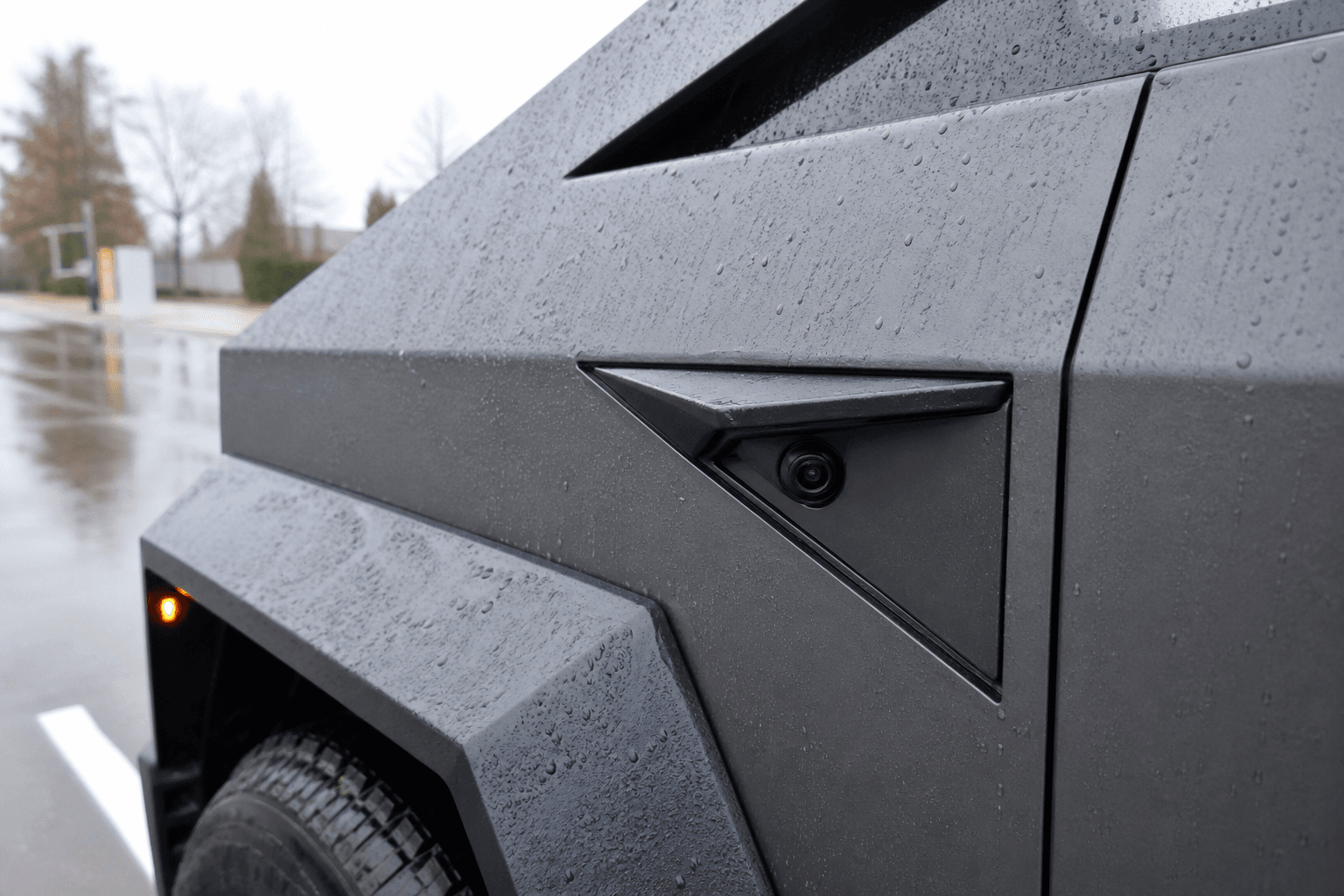
Tesla is redesigning the Cybertruck’s side repeater cameras. Newly shaped plastic housings use airflow while driving to divert rainwater and kicked-up road grime away from the camera lenses.
The change may appear minor, but it is highly relevant to Tesla’s camera-based driver-assistance system. A clear lens provides more reliable image data in bad weather, while droplets or dirt can impair contrast and outlines.
Instead of installing an additional washer nozzle, Tesla is letting the shape of the camera housing do some of the work.
How the Passive Aerodynamics Work
The previous camera module sat largely flush within a triangular recess in the black wheel-arch trim. By contrast, the new version features molded air channels and a vertical fin directly beside the lens.
These edges alter the airflow along the front fender. Airflow hits the fin → water droplets and spray are deflected sideways before they can collect on the camera glass.
| Feature | Previous Housing | New Version |
|---|---|---|
| Shape | Largely flush and smooth | With channels and a vertical fin |
| Water management | No targeted drainage | Airflow is intended to deflect droplets |
| Additional components | No washer nozzle | No washer nozzle required |
| Technical principle | Conventional cover | Passive aerodynamics |
Why Tesla Is Opting for a Simple Solution
An active camera-cleaning system requires nozzles, lines, fluid and potentially additional valves. This increases the number of components and creates more potential maintenance points. The aerodynamic solution, by contrast, can be integrated directly into a plastic part.
The Cybertruck’s front camera already has its own cleaning system. Tesla has so far omitted this additional hardware from the side cameras. Whether the new geometry works as reliably under all conditions remains to be seen, particularly in heavy rain, slush and salty road spray.
For systems such as Tesla FSD and its associated camera technology, keeping the view as clear as possible is especially important. However, the housing can only reduce new contamination. Airflow cannot reliably remove residue that has already dried on the lens or ice.
Typical Tesla: Changes During Production
Tesla does not necessarily bundle technical improvements into traditional model years. Validated components can be introduced into ongoing production as soon as existing inventory has been used up. As a result, vehicles that look identical may have different details depending on when they were produced.
For the Cybertruck, this approach is not limited to visible components. Recent changes also include underbody panels made from carbon-fiber-reinforced composite material, replacing the aluminum parts used previously and intended to improve durability away from paved roads.
For the DACH Market, It Remains a Technology to Watch for Now
The Cybertruck is not officially offered in the DACH region—Germany, Austria and Switzerland. Reasons include its dimensions, weight and the challenges of obtaining European type approval. Accordingly, the latest price adjustment affects the North American market, where the starting price for dual-motor versions recently rose by $5,000 to $74,990.
Nevertheless, the camera solution is relevant beyond the Cybertruck. If the passive airflow design proves effective in everyday use, Tesla could apply a similar principle to other vehicles in the future. Particularly on a high-volume model such as the Tesla Model Y, even a small improvement in camera visibility could have a significant practical impact.