Tesla Cybercab to Support Consoles, Musk Mentions PlayStation and Xbox
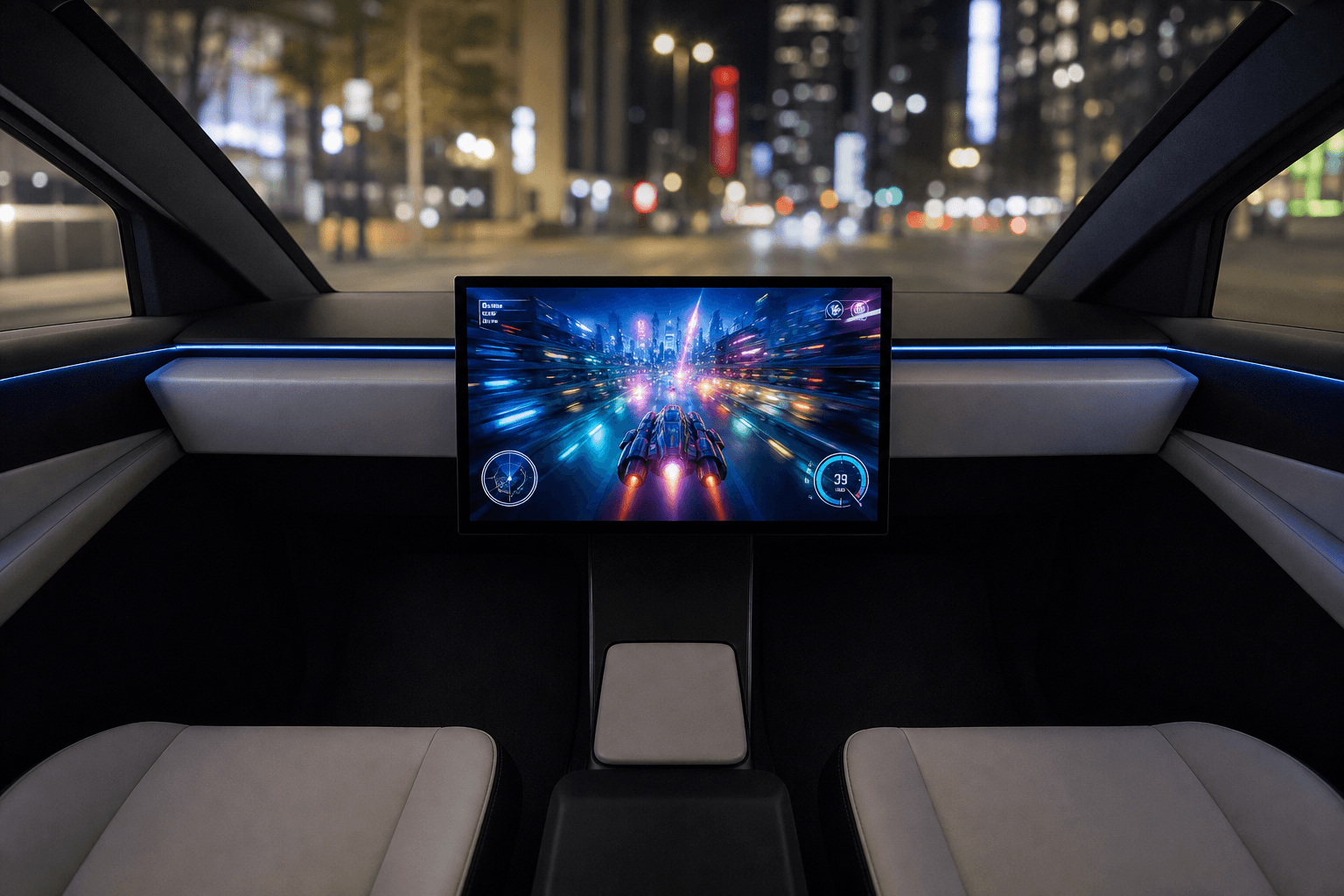
When a vehicle travels without a steering wheel or pedals, time on the road becomes free time. That is exactly what Tesla is targeting with the Cybercab: Its interior centers on a large 22-inch central display, complemented by streaming, gaming apps and, potentially, new connectivity options in the future.
Elon Musk has now gone a step further publicly, announcing that it should eventually be possible to connect a PlayStation or Xbox to the Cybercab. While this was initially just a brief statement, it raises an interesting technical question: Is he referring to controllers, or to an actual video connection for external devices?
Controllers Already Work Today; Video Inputs Would Be the Interesting Part
Game controllers can generally already be used in Tesla vehicles. Wired controllers can work via the vehicle’s USB-C ports, and wireless pairing may also be possible depending on the setup. That alone would hardly warrant saying this capability will arrive “in the future.”
The subtext is therefore more important: For a PlayStation or Xbox to be genuinely useful, the screen would typically need a video input. Two plausible options would be a dedicated HDMI port or DisplayPort via USB-C (USB-C Alt Mode). The latter would be particularly practical for everyday use, as many devices already output video via USB-C.
What Tesla Would Need to Provide Technically
- A video input in the vehicle (HDMI or DisplayPort via USB-C)
- Seamless source switching on the 22-inch display
- Audio routing through the vehicle (speakers or headphones)
- Optional: USB power so handhelds and laptops can charge during use
Real-World Impact: Handhelds, Switch and Laptops Are More Realistic Than a Console
Someone carrying an entire home console into a robotaxi is likely to remain the exception. Portable devices that many people already carry in their backpacks are far more likely: handheld PCs such as the Steam Deck or ROG Ally, a Nintendo Switch or a work laptop.
For these devices, the 22-inch screen would offer real added value by temporarily turning the Cybercab into a mobile monitor. This would not be limited to gaming, but could also include streaming users’ own content or working productively while the vehicle drives autonomously.
Starlink in the Cybercab: Crucial for Cloud Gaming and Multiplayer
The idea also fits Tesla’s announced connectivity push: Cybercabs are expected to be equipped with Starlink in the future to provide more stable internet with potentially lower latency. This is more relevant for cloud gaming, large downloads or multiplayer than basic in-vehicle entertainment apps.
The practical implementation will remain important: Whether external devices will actually be allowed to use the vehicle’s connection is a question of software, security and user experience. But the vision is clear: Autonomous driving is intended to free up time, and Tesla wants to fill that time in the Cybercab with infotainment and connectivity.
Assessment: An Announcement Is Not Yet a Feature, but the Direction Is Clear
For now, Musk’s statement is an announcement, not a confirmed specification. It remains to be seen whether Tesla ultimately installs an HDMI port, enables DisplayPort over USB-C or merely simplifies controller support. Nevertheless, the proposal shows how Tesla envisions robotaxi use: not as a “taxi without a driver,” but as a new environment for media and productivity.