Smart #2 Appears as a Camouflaged Electric Two-Seater
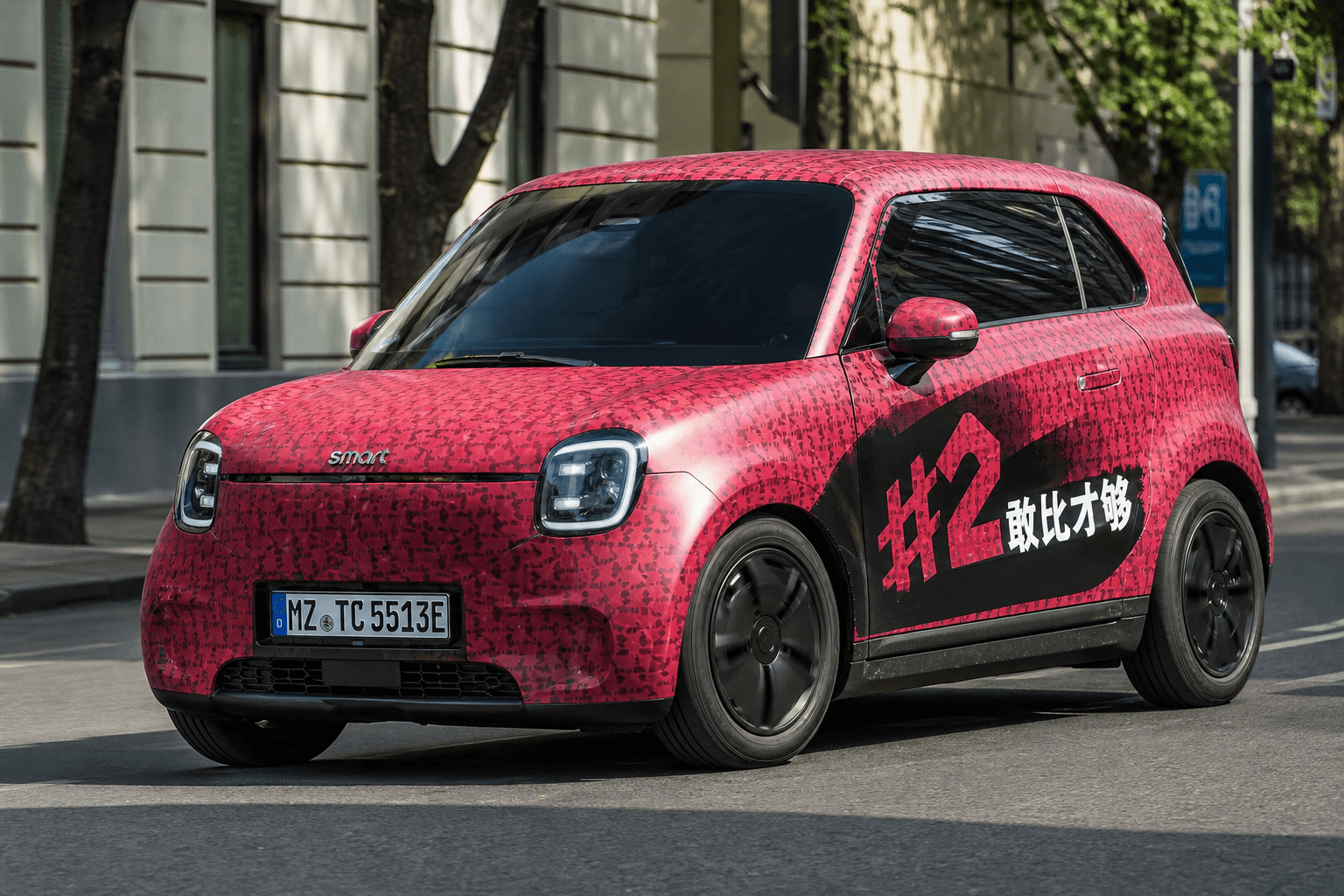
Smart is working on a return to the segment that originally made the brand famous. New images show the upcoming Smart #2 as a camouflaged prototype on public roads. Despite the wrap, it is already clear just how compact the new electric car is likely to be.
The model is intended to carry the idea of the former Fortwo into the next generation while offering significantly more modern technology. Initial specifications point to a premium electric microcar developed specifically for congested cities. Specific indications of the Smart #2’s comeback as an electric two-seater had already emerged previously.
Just 2.75 Metres Long, Yet Still Practical?
With a reported length of just 2.75 metres, the Smart #2 would be by far the smallest model in the current line-up. By comparison, the Smart #1 is well over four metres long and competes as a compact crossover.
The short vehicle length is particularly appealing for major cities in Germany, Austria and Switzerland. Tight parking spaces, narrow streets and densely built-up city centres are precisely the environments in which a modern two-seater can make the most of its advantages. The key question will be how much space Smart can create for luggage and occupants within such a small footprint.
| Feature | Current information |
|---|---|
| Powertrain | Fully electric |
| Seating layout | Expected to have two seats |
| Length | Around 2.75 metres |
| Battery | Around 30 kWh, not yet officially confirmed |
| Range | More than 300 km possible, test cycle not specified |
| Positioning | Premium microcar |
| Design premiere | Planned for 2026 |
| Market launch | Expected in 2027 |
30-kWh Battery Could Deliver More Than 300 km
A battery with a capacity of around 30 kWh is being discussed for the Smart #2. This could potentially provide a range of more than 300 km. As Smart has not yet disclosed either the usable battery capacity or the applicable test cycle, this figure should be regarded as a preliminary indication.
For a vehicle of this size, the figure would nevertheless be plausible if its weight, aerodynamics and powertrain are all consistently optimised for efficiency. A small frontal area and low weight → lower energy consumption in urban traffic. On fast motorway journeys, however, the real-world range is likely to fall much more sharply.
The crucial improvement over the former Fortwo EQ would not be maximum power, but a significantly greater electric driving range.
An official range of more than 300 km could allow many commuters to drive for several days without stopping to charge. At the same time, a 30-kWh battery would remain compact enough to keep weight, costs and charging times under control.
A Price of Around €20,000 Would Make a Statement
Smart reportedly intends to position the #2 as a premium microcar, yet a price close to €20,000 is being discussed. That would be ambitious, as high-quality materials, modern driver-assistance systems and a contemporary software platform increase costs even for small vehicles.
It remains unclear whether this amount would apply to the base version, reflect potential discounts or be offered only in certain markets. For the German-speaking DACH market—Germany, Austria and Switzerland—equipment, warranty coverage and charging power will also be crucial. Only once official prices are announced will it be possible to assess whether the #2 will become a genuine high-volume model or a deliberately exclusive urban EV.
Smart Embraces the Retro Trend
The #2 joins a growing group of electric reinterpretations of familiar small cars. Renault has already followed this approach with the electric Renault 5, while other manufacturers are also developing modern models with historic names or familiar concepts.
Smart is taking a particularly credible approach: an extremely short two-seater fits the brand’s heritage better than the larger SUV models introduced recently. At the same time, the new #2 is being developed within the Mercedes and Geely ecosystem, giving Smart access to modern EV platforms, software and international production structures.
Premiere in 2026, Market Launch Expected in 2027
The final design is due to be unveiled in 2026. The Smart #2 is expected to appear on roads from 2027. The fact that prototypes are already being driven in public and the model is also being visibly promoted in China suggests that development is at an advanced stage.
However, important questions will remain unanswered until the premiere. These include charging power, motor output, luggage capacity and the exact European price. The basic concept already appears convincing: the Smart #2 could reclaim the urban niche left behind by the Fortwo when its production ended.