Lotus plans new supercar for 2028, hybrid rather than plug-in
Lotus is preparing a new supercar for 2028 under the codename Type 135. It is expected to be produced alongside the Emira in Hethel, England. According to current plans, there will be two powertrain options: a hybrid V8 and a V6 version.
The direction is clear: Lotus does not want to abandon its lightweight-engineering DNA, while electrification will help it meet increasingly stringent emissions regulations worldwide. Crucially, Lotus is explicitly opting for a conventional hybrid system rather than a plug-in hybrid. That means a smaller battery, less weight and less complexity, with a stronger focus on driving dynamics rather than practical electric range.
Target weight of 1.5 metric tons despite 800 volts and a V8 will be challenging
Lotus has set a target weight of around 1.5 metric tons for the hybrid V8 version. That is ambitious in this performance class, especially when accommodating an 800-volt architecture and an electrified powertrain. Lotus itself describes this particular combination as a technical challenge.
Management says the key will be an extremely light electric motor using technology derived from Formula 1 and weighing just 20 kg. The issue is not only the motor’s weight, but the overall package: a light electric motor allows for a smaller cooling system, requires less structural reinforcement and makes component packaging easier. Ultimately, what matters is whether the car retains its balance and agility instead of feeling like an overweight “power statement.”
Why a hybrid rather than a plug-in can make sense for a supercar
A plug-in hybrid generally comes with a significantly larger battery. While that provides electric range, it also adds weight and requires more complex thermal management. For a car focused purely on performance, a compact hybrid powertrain may offer the better compromise: more punch under acceleration and greater efficiency under partial load, without making the car feel sluggish in corners.
Power, transmission and positioning: between the Emira and Evija
Lotus has set a bold performance target: total system output is expected to exceed 736 kW. This will be paired with an eight-speed dual-clutch transmission designed to handle high torque while remaining as light as possible. The aim is to create a supercar that remains emotional and engaging to drive, but is technologically far more advanced than the Emira.
Lotus is positioning the Type 135 as a model that will bridge the gap between the Emira, its mid-engine sports car, and the all-electric Evija hypercar. The car will therefore also serve as a bridge within the product portfolio, combining classic sports-car character with modern electrification and high system output.
Design and seating layout: inspired by the electric Theory 1 concept
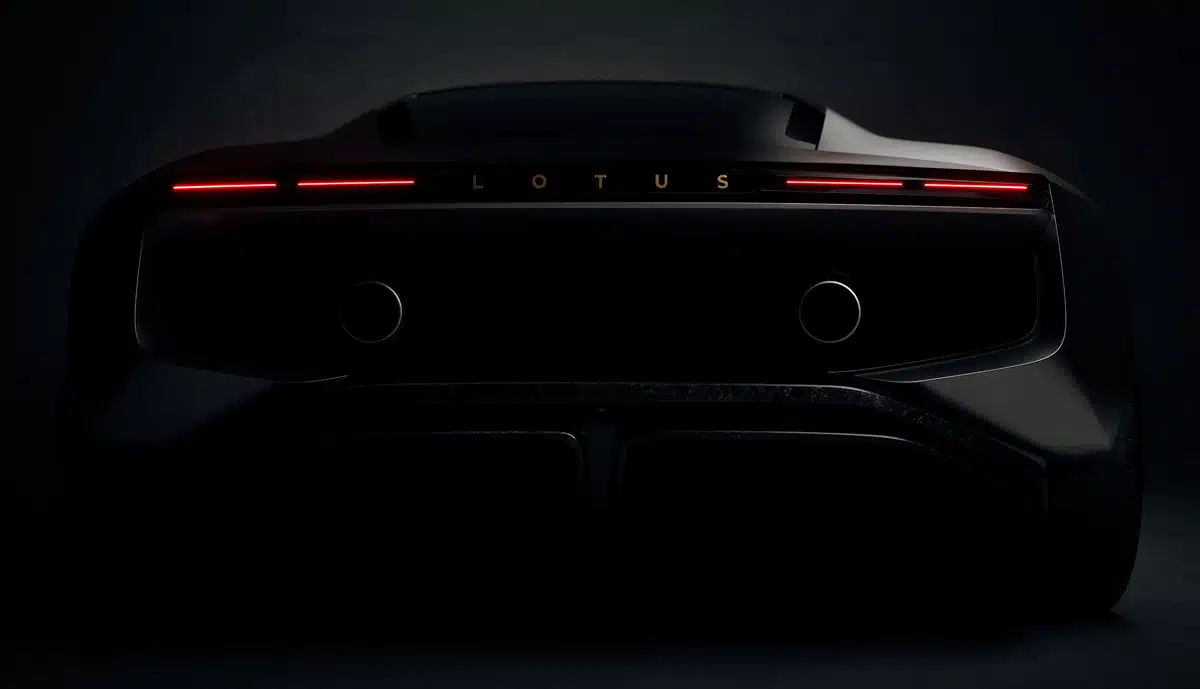
The new supercar’s styling is expected to draw on the Theory 1 electric concept unveiled in 2024. Lotus has already released a teaser that primarily hints at the rear design. Another intriguing possibility is a three-seat layout with the driver positioned in the center. This could reduce the development work required for left- and right-hand-drive versions.
Change of strategy at Lotus: a broader range of powertrains
The Emira was originally intended to be Lotus’s “last combustion-engine car.” In practice, however, all-electric models in the premium and luxury segments have not scaled as quickly in every market as manufacturers initially hoped. Lotus has already responded by beginning to diversify its lineup, including partially electrified versions.
For the DACH market—Germany, Austria and Switzerland—this is primarily a sign that even heritage brands are taking an increasingly pragmatic approach to powertrains. That is not necessarily bad news for performance enthusiasts, provided weight, thermal management and throttle response are properly optimized. At the same time, it remains to be seen how Lotus will combine a modern 800-volt electrical system with lightweight engineering in a way that makes the finished car truly feel like a Lotus.
What this means for EV enthusiasts
Those coming from the EV world may be quick to view the word “hybrid” with skepticism. Nevertheless, the technology is interesting: 800 volts, an extremely light electric motor and high system output show how extensively components developed for electric vehicles are now being incorporated into high-performance powertrains. And the better manufacturers become at controlling weight, the lower the risk that electrification will ultimately amount to nothing more than “extra weight for extra power.”