Electric cars reach a 32.4% market share
Germany’s electric car market reached a new annual high in August 2026. Of a total of 212,563 newly registered passenger cars, 68,930 vehicles were fully electric. This corresponds to a BEV share of 32.4%.
In July, the share was still 29.3%, even though the absolute number of electric cars registered was higher at 78,609. The difference illustrates how strongly the market share depends on the overall volume of new cars in a given month.
Compared with August 2025, new electric car registrations increased by 75.1%. The incentive program launched in May is likely supporting the market, although the registration data alone cannot establish a direct link. So far, just under 52,500 incentive applications have been approved, including around 25,600 last month.
Almost one in three cars newly registered in Germany in August 2026 was fully electric.
Skoda Elroq retains the top spot
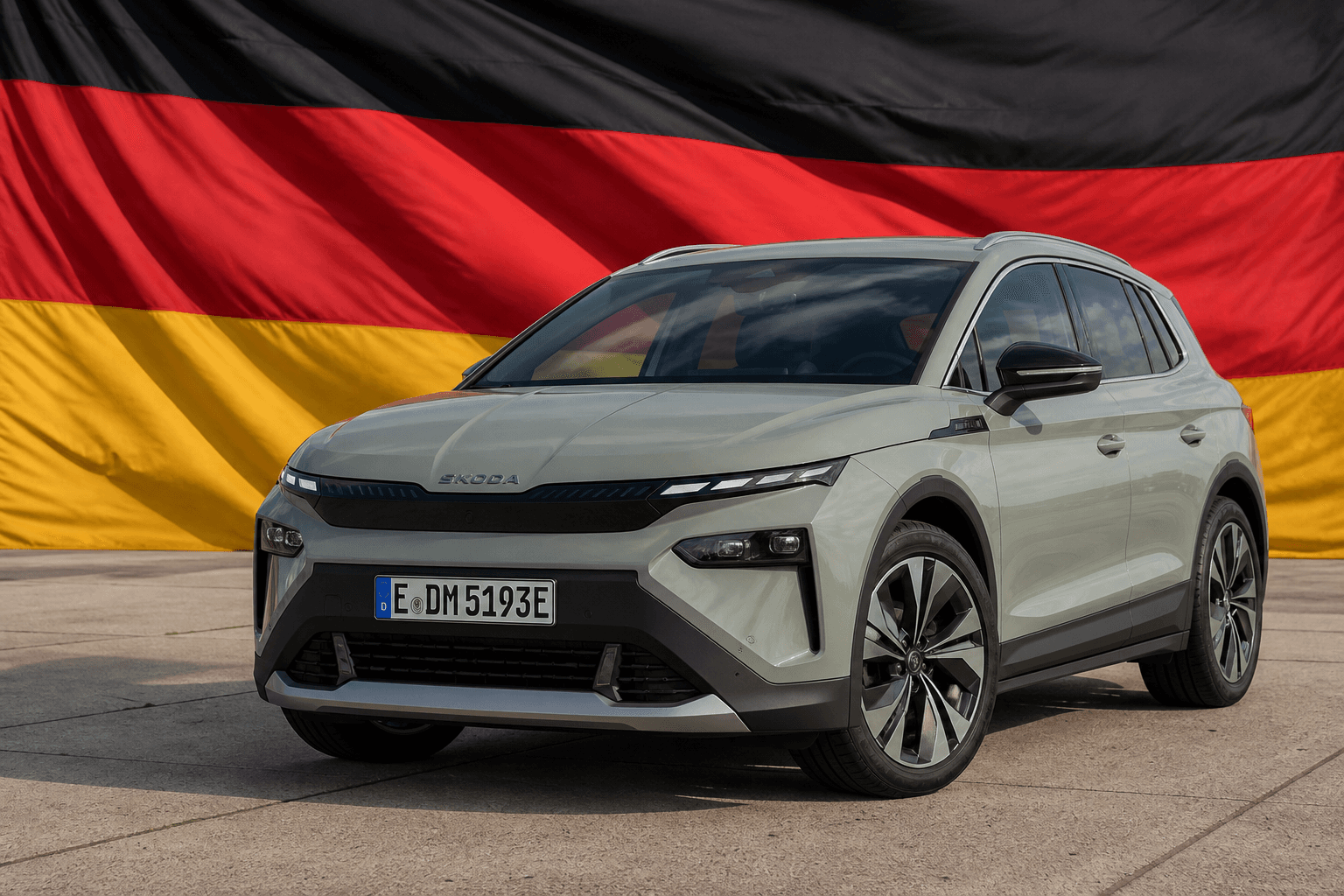
The Skoda Elroq remains Germany’s most registered electric car. With 3,038 new registrations, the compact SUV was well ahead of the BMW iX1 and VW ID.7.
Although the Elroq recorded 503 fewer registrations than in July, several direct competitors posted steeper declines, allowing it to retain first place.
| Rank | Model | New registrations in August |
|---|---|---|
| 1 | Skoda Elroq | 3,038 |
| 2 | BMW iX1 | 2,449 |
| 3 | VW ID.7 | 2,236 |
| 4 | VW ID.4 and ID.5 | 2,189 |
| 5 | Electric Mercedes-Benz GLC | 2,164 |
| 6 | Skoda Enyaq | 2,140 |
| 7 | Audi A6 e-tron | 1,749 |
| 7 | Mercedes-Benz CLA | 1,749 |
| 9 | Audi Q6 e-tron | 1,738 |
| 10 | Citroën ë-C3 | 1,722 |
BMW iX1 and electric GLC gain ground
The BMW iX1 moved up to second place. After ranking fifth in June and fourth in July, the compact electric SUV is continuing its upward trend.
The most notable climber was the electric Mercedes-Benz GLC. Its registrations increased by around 47% compared with July, taking the model directly from 16th to fifth place. The ongoing production ramp-up is therefore increasingly translating into customer deliveries.
There was an unusual tie for seventh place: the Audi A6 e-tron and Mercedes-Benz CLA each recorded exactly 1,749 new registrations. The Audi Q6 e-tron and Citroën ë-C3 followed close behind.
VW ID.3 and Cupra Born decline significantly
The VW ID.3 fell from 2,220 to 1,467 new registrations, dropping from seventh to 14th place. The ongoing model transition is also likely to have played a role, so one weaker month does not yet provide reliable evidence of a drop in demand.
The electric Mini models, which are counted together, recorded 1,351 registrations and ranked 19th. The Cupra Born declined even more sharply, finishing only 22nd with 1,005 vehicles.
By contrast, the new Cupra Raval only narrowly missed the top 10. With 1,663 new registrations, it already reached 11th place, continuing its strong market debut.
Tesla Model 3 ranks ahead of Model Y
The Tesla Model 3 ranked 12th with 1,605 new registrations. The Tesla Model Y followed with 1,426 units after recording just 299 new registrations in July.
These fluctuations are consistent with Tesla’s delivery cycle. Vehicles are often shipped in batches and delivered toward the end of a quarter, which can make individual monthly figures comparatively volatile. Cumulative performance is therefore more meaningful when assessing demand.
Elroq also leads the year-to-date rankings
From January through August 2026, the Skoda Elroq recorded 26,717 new registrations. Its lead over the second-placed VW ID.3 has already reached 4,790 vehicles.
| Rank | Model | January through August 2026 |
|---|---|---|
| 1 | Skoda Elroq | 26,717 |
| 2 | VW ID.3 | 21,927 |
| 3 | Skoda Enyaq | 21,492 |
| 4 | Tesla Model Y | 21,426 |
| 5 | VW ID.7 | 20,141 |
| 6 | VW ID.4 and ID.5 | 15,789 |
| 7 | BMW iX1 | 15,510 |
| 8 | Mercedes-Benz CLA | 15,295 |
| 9 | Audi A6 e-tron | 13,561 |
| 10 | Audi Q6 e-tron | 12,324 |
The Skoda Enyaq narrowly displaced the Tesla Model Y from third place. However, just 66 vehicles separate the two models, meaning the order could change again as early as next month.
Volkswagen Group dominates the top 10
Seven of the ten most successful electric cars so far this year come from Volkswagen Group. Its position is particularly strong in compact SUVs and midsize models, precisely the segments with high demand among private buyers and company-car fleets.
At the same time, BMW and Mercedes are gaining ground. The iX1 is establishing itself among the leaders, while the CLA and electric GLC show that new premium platforms can quickly achieve significant sales volumes.
The German results cannot be applied directly to Austria and Switzerland. Differences in taxes, incentive programs, company-car rules and vehicle allocations can result in a very different model ranking in those countries. However, the strong Elroq and Volkswagen Group’s broad lineup are also likely to provide momentum across the rest of the DACH region, meaning Germany, Austria and Switzerland.