Rivian Launches Its Biggest Software Update Yet
With RivianOS 2, Rivian is fundamentally overhauling the vehicle software in its electric cars. The update, version 2026.31, is being rolled out gradually to compatible R1 and R2 vehicles and is intended to bring all current vehicles onto a shared software platform for the first time.
Until now, the systems in the first-generation R1, the updated R1, and the new R2 had diverged technically. In the future, a shared platform will make it easier to develop, test, and distribute new features via over-the-air updates.
A shared software platform does not mean that every Rivian model will receive exactly the same features and graphics.
Unreal Engine 5 Remains Limited to Newer Hardware
The computing power of each vehicle generation continues to impose limits. The R2 and second-generation R1 use Unreal Engine 5 to render the vehicle and its surroundings as detailed 3D graphics in real time.
For the first-generation R1, however, Rivian is sticking with Unreal Engine 4. This is intended to keep the interface running smoothly on older hardware rather than forcing the latest graphics technology at the expense of responsiveness.
| Vehicle platform | Graphics system | AI processing |
|---|---|---|
| R1, first generation | Unreal Engine 4 | Advanced cloud-based voice features |
| R1, second generation | Unreal Engine 5 | Local and cloud-based processing |
| R2 | Unreal Engine 5 | Local and cloud-based processing |
New Interface With More Flexible Controls
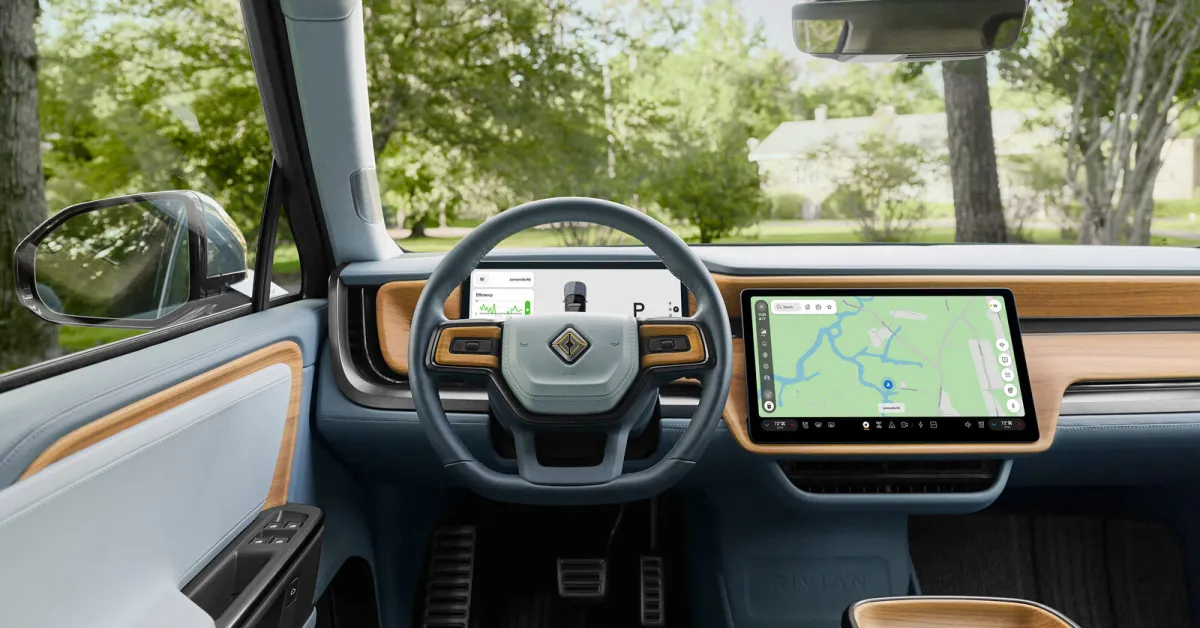
The redesigned interface is the most noticeable change. Shortcuts and the media player can now be positioned on either side of the display, while a vertical status bar keeps important vehicle functions permanently within reach.
The settings menu has also been rebuilt. The interface, which Rivian calls Settings 2, displays context-sensitive options and offers universal search. This reduces the number of submenus users need to navigate, particularly for functions that must be found quickly while driving.
Navigation Provides Real-Time Event Alerts
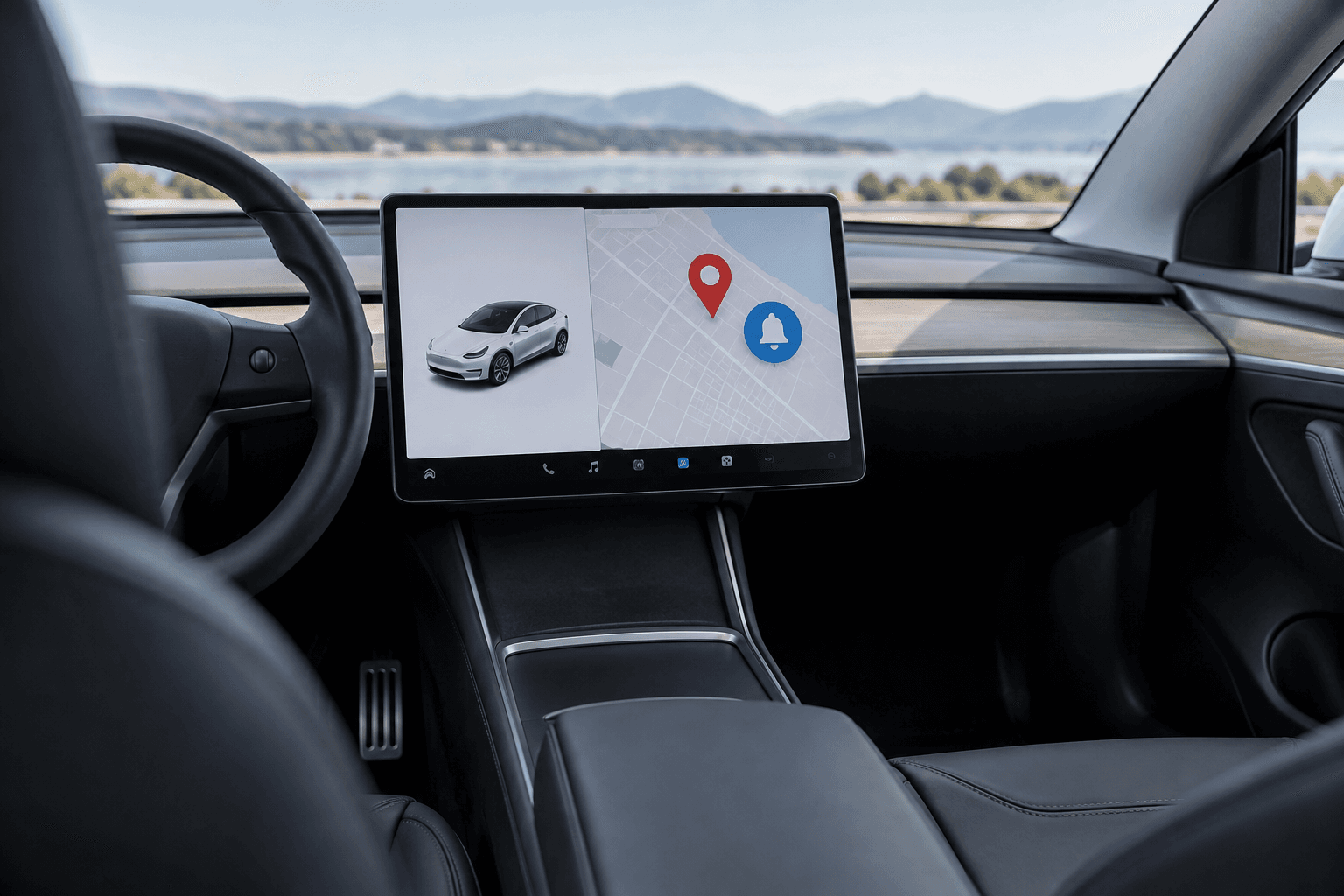
The navigation system now receives real-time reports about police presence and speed checks. Rivian integrates information from Google Maps for this purpose, including data supplied by authorities, third-party providers, and the community.
For the DACH region—Germany, Austria, and Switzerland—the applicable laws in each country are crucial. In Germany, drivers are not permitted to use speed-camera warning functions while driving, while Austria and Switzerland have their own regulations. Technical availability therefore does not automatically mean that Rivian can offer every alert unchanged in every country.
Weather and Mobile Trip Planning Cost Extra
Two new features require a Connect+ subscription. The new weather app displays current conditions, air quality, and a 10-day forecast. Mobile Live Trips allows drivers to access, start, and update an active route through the Rivian app.
In the US, Connect+ costs US$14.99 per month or US$149.99 per year. No prices or specific availability for Germany, Austria, and Switzerland can yet be inferred from this, especially since Rivian currently focuses its passenger vehicles primarily on the North American market.
Unified Intelligence Connects the Car and the Cloud
Under the name Rivian Unified Intelligence, the manufacturer is expanding its AI platform. It also provides the foundation for the voice assistant, which can control vehicle functions directly using a wake word.
In the R2 and second-generation R1, some time-sensitive tasks are processed directly in the vehicle. This shortens response times and reduces dependence on a stable cellular connection. More complex requests can still be handled via cloud services.
Rivian is also adding new privacy options. Users can disable the wake word, restrict location sharing, and specify which data is stored in their personal driver profile.
Why the Shared Platform Matters So Much
RivianOS 2 will make it easier for the manufacturer to develop features across multiple model lines. Ideally, a bug will need to be fixed only once in the central platform → updates can reach different models faster and more consistently.
With the Model 3 and other model lines, Tesla demonstrated early on how significantly centralized vehicle software can improve the user experience over many years. Recent developments involving Tesla FSD and the HW4 platform also illustrate how closely software and vehicle hardware are now intertwined.
With RivianOS 2, Rivian is taking a similar approach without ignoring the differences between hardware generations. This is strategically important, particularly ahead of the production ramp-up of the more affordable R2: The high-volume model is set to run on a scalable platform from the outset, while existing R1 drivers will continue to receive updates.