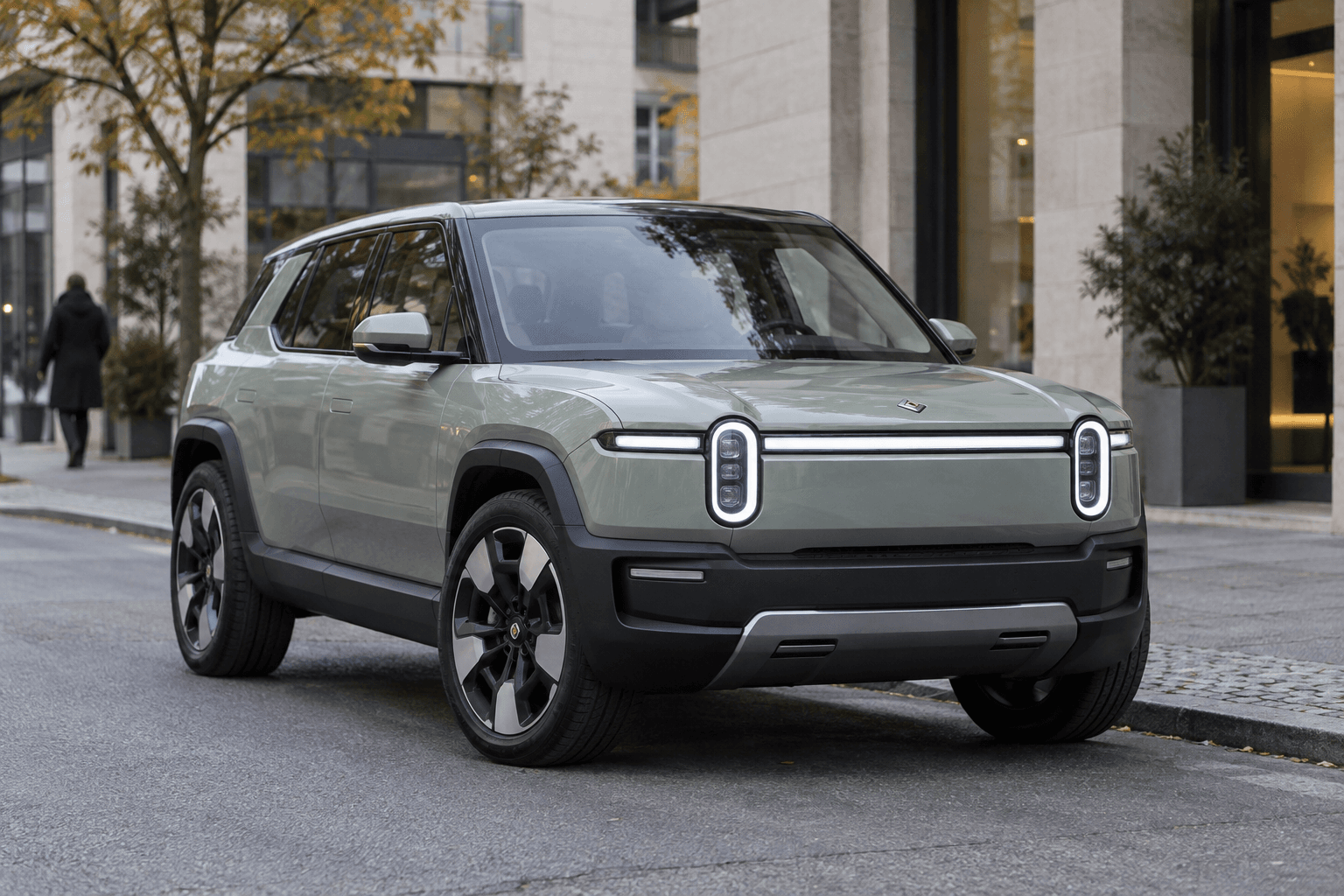
Rivian is planning an entire model family for Europe
Rivian plans to significantly expand its lineup at the more affordable end of the market in the coming years. The R2 is initially expected to spearhead the brand’s entry into Europe, followed by the more compact R3. Additional, even more affordable electric cars—the R4 and R5—are already being planned.
The direction is clear: smaller vehicles, lower prices and higher production volumes. However, Rivian has not yet announced specific dates or European prices. The R4 and R5 in particular are therefore long-term projects, not imminent market launches.
Rivian aims to evolve from a manufacturer of large premium electric vehicles into a broader brand offering more affordable models.
R2 and R3 are expected to lead the way
The R2 is positioned as a midsize electric SUV and, for the first time, puts Rivian closer to high-volume models such as the Tesla Model Y. This segment is particularly relevant in Europe, where compact and midsize SUVs account for a significant share of the market.
Below it will sit the R3, which has already been unveiled. Its angular hatchback shape, short body and upright rear evoke classic European compact cars, while the brand’s signature oval lights preserve Rivian’s design language. This could make the R3 better suited to European cities and parking garages than the brand’s existing large models.
| Model | Positioning | Current status |
|---|---|---|
| Rivian R2 | Midsize electric SUV | Expected to lead Rivian’s European launch |
| Rivian R3 | Compact electric crossover | Design unveiled, market launch planned after the R2 |
| Rivian R4 and R5 | Even more affordable model lines | Early planning on a new platform |
R4 and R5 require a new platform
Simply scaling down its existing technology does not appear to be sufficient for the R4 and R5. Rivian is planning a new platform designed to enable lower production costs and smaller vehicle formats. Only an architecture consistently engineered for high production volumes can substantially reduce the entry price.
This is technically demanding because more affordable vehicles need more than just a smaller battery. The electronics, control units, wiring harnesses, body structure and manufacturing processes must also be designed for cost efficiency. Rivian could benefit from its strongly software-focused architecture in this respect.
European prices remain speculative
So far, Rivian has only confirmed that prices are expected to fall significantly with the upcoming models. This is not yet enough to provide a reliable forecast for Germany, Austria or Switzerland. Transport costs, tariffs, VAT, equipment and potential local production will all have a considerable impact on the final price.
Based on the model hierarchy, an R3 priced below the Model Y would be plausible. Whether that would automatically mean a starting price below €40,000 remains unclear. Even lower prices are conceivable for the R4 and R5, but without technical specifications or a production plan, figures of €30,000 to €35,000 are purely speculative.
Rivian will also face a rapidly expanding range of competitors in Europe. Our overview of compact electric SUVs in Germany shows how crowded this segment already is. By the time the R3 or R4 becomes available, prices and driving ranges are likely to face even greater competitive pressure.
The VW partnership makes Rivian particularly relevant
Rivian has gained additional significance through its collaboration with the Volkswagen Group. The partnership centers on software and a modern electronic architecture that is also expected to be used in vehicles from Volkswagen Group brands in the future. This makes Rivian interesting not only as a vehicle manufacturer but also as a technology partner.
For Rivian, the partnership could spread development costs across higher volumes. Volkswagen, meanwhile, gains access to a leaner, software-oriented vehicle architecture. Lower hardware and development costs could support Rivian’s path toward more affordable models, but they do not guarantee low retail prices.
Great potential, but considerable development work remains
At present, the R3 appears to be Rivian’s most exciting model for Europe. It combines a distinctive design with dimensions that are better suited to the European market. However, driving range, charging performance, the service network and price will be decisive.
The R4 and R5 primarily demonstrate how Rivian intends to grow over the long term. Before they become electric cars customers can buy, the new platform must be developed, industrialized and used for large-scale production. The strategy is sound, but the timeline remains ambitious.