Rivian Tests Technology for the Next Voltage Class
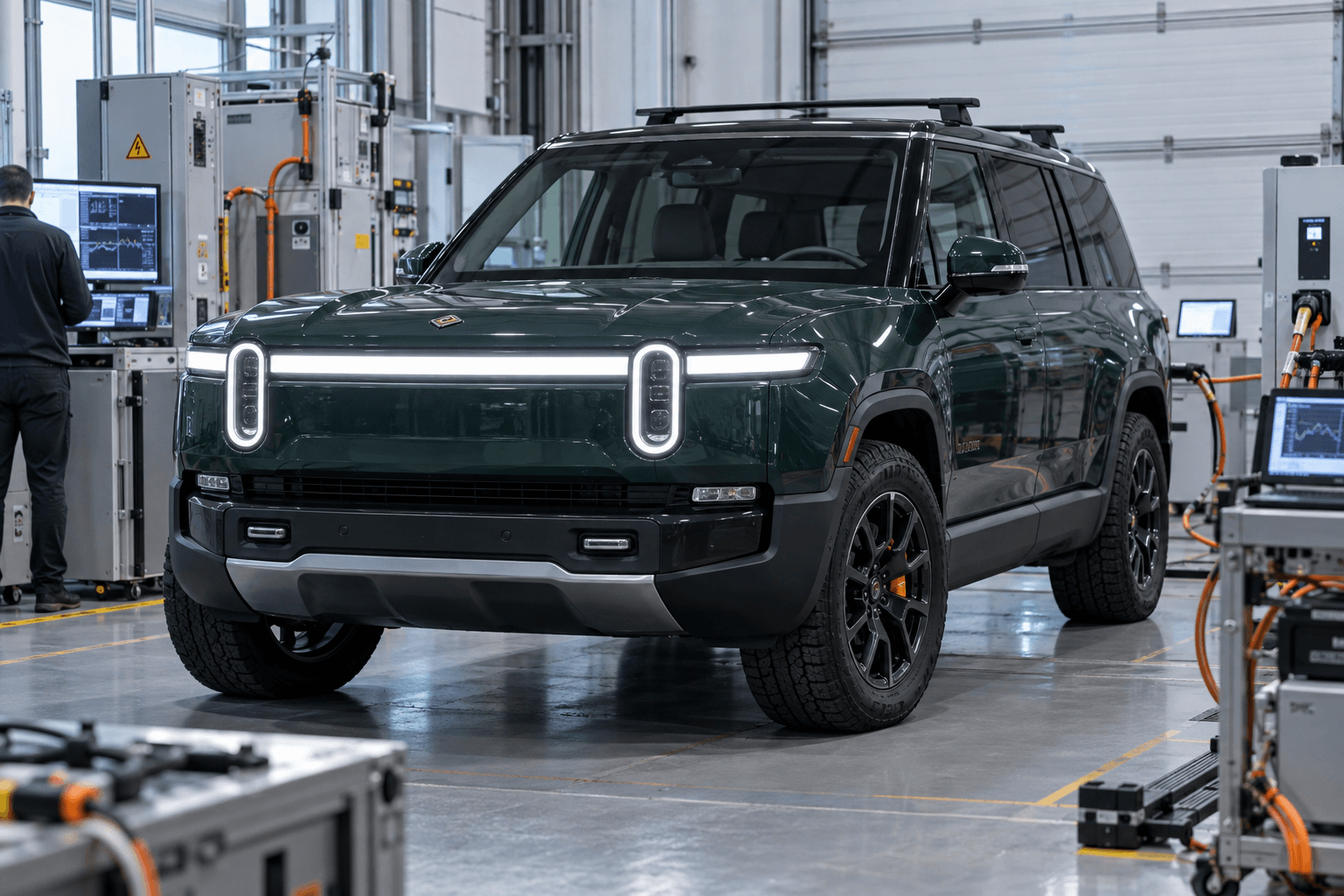
Rivian is apparently laying the groundwork for a future transition from 400 volts to the more powerful 800-volt class. An internship listing for January through August 2027 mentions the construction of a powertrain laboratory where future platforms will be tested at up to 900 V.
Battery systems operating at 400 and 900 V are also mentioned at the joint technology venture between Rivian and Volkswagen. This is a clear indication of the direction of development, but it is not yet an official product announcement with a firm launch date.
Above all, the new information shows one thing: Rivian and Volkswagen want to prepare their electronics for different voltage classes at an early stage.
Why 900 V Usually Falls Within the 800-Volt Class
The terms 400 volts and 800 volts describe voltage classes, not a constant, precisely defined battery voltage. Depending on cell chemistry, state of charge, and configuration, the actual voltage can vary considerably. In practice, a test system rated for 900 V therefore belongs to the widely recognized 800-volt architecture.
The main technical advantage is lower current at the same power level. Less current means lower heat losses and allows thinner cables or significantly higher charging power. Our comparison of 800 and 400 volts provides a detailed overview.
| Voltage class | Typical advantage | Typical application |
|---|---|---|
| 400 volts | Lower-cost components and established technology | Small cars, compact models, and many mass-market vehicles |
| 800 volts | Higher charging power at a lower current | High-performance electric cars designed for long-distance travel |
| Up to around 900 V | Wider operating range for modern 800-volt systems | New platforms and particularly powerful battery systems |
400 Volts Remains a Sensible Choice for Affordable Electric Cars
A higher system voltage does not automatically make an electric car better. Charging power, battery cooling, cell chemistry, and the charging curve are at least as important. Vehicles with 400-volt technology can also charge quickly in everyday use if the overall system is properly optimized.
For small and budget-focused models, costs also favor 400 volts. High-voltage components, power electronics, and charging technology for 800 volts are more complex. Volkswagen’s planned electric small car based on the ID. Every1 is therefore also expected to retain a 400-volt system initially.
Volkswagen Wants to Use 800 Volts More Widely
The higher voltage is already a reality within the Volkswagen Group, but so far mainly in more expensive model lines. The PPE platform from Audi and Porsche uses 800-volt technology, including in the Audi Q6 e-tron and the electric Porsche Macan.
The future SSP platform is intended to bring the technology to significantly more vehicle classes. An electric Golf is considered a possible early SSP model for 2029 or 2030. However, platform planning and the timeline could still change before production begins.
It is important to distinguish between the electronic architecture and the high-voltage platform. Rivian and Volkswagen are jointly developing control units, computing architectures, and software, among other things. This foundation can be designed for both 400 and 800 volts without every vehicle using it automatically receiving the higher battery voltage.
What the Transition Could Mean for Rivian
Rivian’s current technology predominantly uses 400 volts. The initially planned version of the more compact R2 is also designed for this voltage class. Preparing suitable test facilities could relate to a later model-year update, a more powerful variant, or the next vehicle generation.
For Rivian’s large batteries, 800-volt technology would be particularly appealing. High charging power at a lower current could shorten charging stops and reduce thermal stress. However, the complete charging curve remains crucial, as a high peak voltage alone does not guarantee a fast charging stop.
No Production Launch Confirmed Yet
Job listings provide valuable insight into technical preparations, but they are not a binding product roadmap. At present, they indicate that Rivian and Volkswagen intend to develop and test systems operating at up to around 900 V. It remains unclear which vehicle will receive the technology first.
The direction is nevertheless plausible: 400 volts remains economically attractive for affordable models, while 800 volts is increasingly moving into the mass-market segment. Rivian and Volkswagen are apparently preparing to support both approaches with a shared, flexible electronic architecture.