Spain to Become a New Pillar of Renault’s EV Production
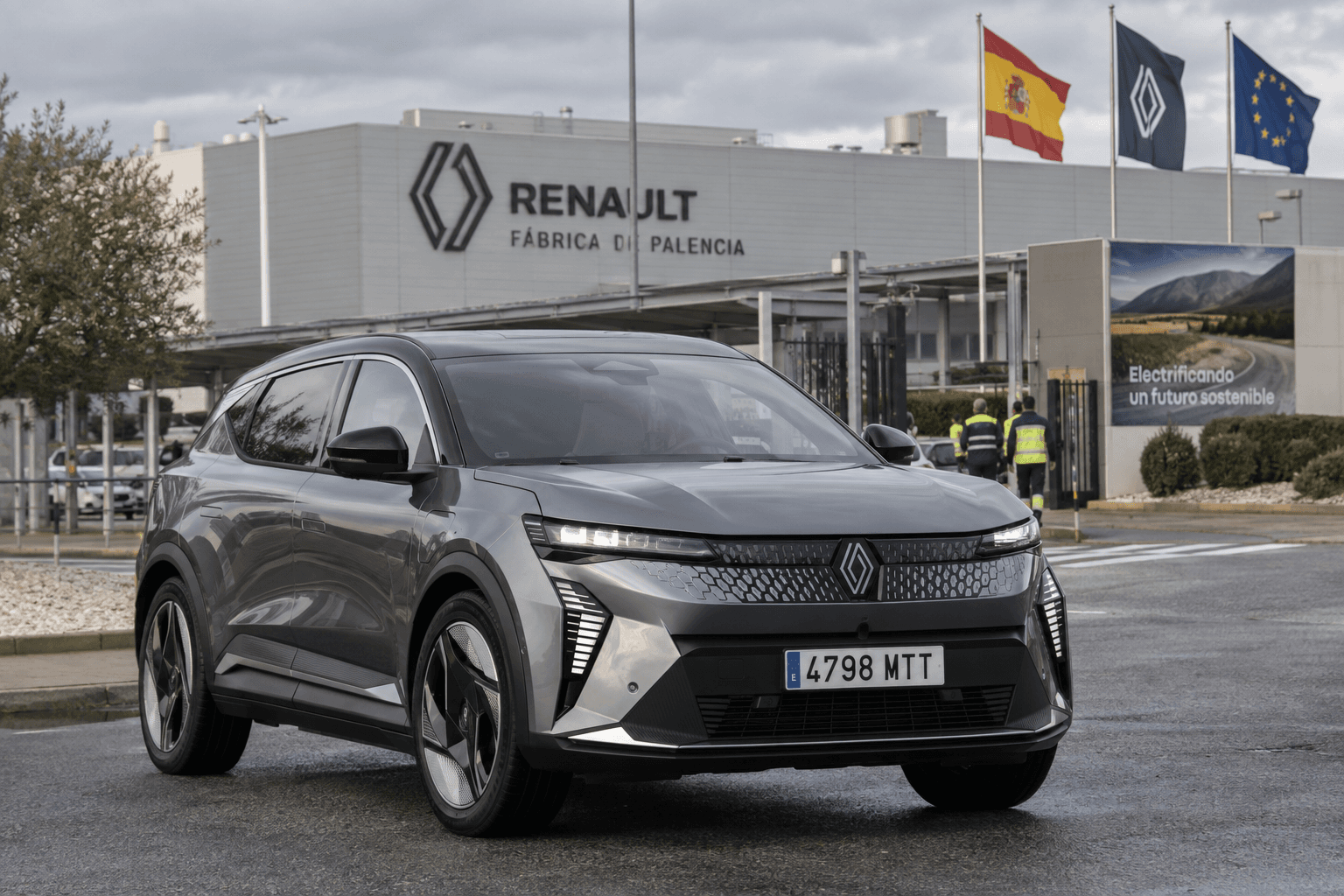
Renault is expanding its European electric car production and investing a total of €600 million in its Spanish sites in Valladolid and Palencia by 2030. Both plants are to be converted for five new models, including two all-electric vehicles in the C-segment.
This will allow Renault to spread its EV production more widely across Europe in the future. Until now, the group has concentrated a large share of its electric models at French plants, while Spain has primarily played an important role in conventional and electrified powertrains.
| Area | Plan |
|---|---|
| Investment volume | €600 million by 2030 |
| Sites | Valladolid and Palencia |
| New models | Five, including two C-segment electric cars |
| EV platform | RGEV Medium 2.0 with 800-volt architecture |
| Batteries | New battery assembly line in Valladolid |
| Employment | 6,000 jobs secured through a collective bargaining agreement until 2028 |
New 800-Volt Platform for Several Vehicle Classes
The two electric cars will be based on the new RGEV Medium 2.0 platform. It is designed for vehicles ranging from the B+ to the D-segment and is intended to support different body styles such as sedans, SUVs, and vans.
The switch to an 800-volt architecture is particularly significant. With a suitable battery and charging infrastructure, a higher system voltage can enable greater charging power and lower current levels. The practical differences are explained in our comparison of 800 volts versus 400 volts in electric cars.
With RGEV Medium 2.0, Renault is creating a flexible technical foundation for long-range electric cars and range-extender models.
Renault is targeting up to 750 km of WLTP range for all-electric vehicles. Range-extender versions are expected to achieve a total range of up to 1,400 km. The manufacturer also cites fast-charging times of around ten minutes but has not yet specified the charging window to which this figure applies.
Battery Assembly Is Not Cell Production
A new battery assembly line will also be built at the Valladolid body plant. It is expected to assemble externally supplied battery cells or modules into ready-to-use packs and prepare them for installation in the vehicles. This does not constitute an announcement of in-house cell production.
Local assembly is nevertheless important for day-to-day production. Shorter transport routes and closer integration with vehicle manufacturing can reduce costs and make the supply chain more resilient.
Which Models Could Be Built in Palencia
Renault has not yet officially named the future model lines. Earlier information from industry sources pointed to a second generation of the Scénic E-Tech Electric, an electric successor to the Rafale, and a Scénic variant with a range extender.
For now, this allocation remains unconfirmed. The only confirmed details are two C-segment electric cars and the use of the new platform. Until the models are officially announced, specific names should therefore be regarded as provisional.
Renault Spreads EV Production More Widely
The group’s series production of electric vehicles was long heavily concentrated in France. Models built in Douai include the Mégane E-Tech Electric, Scénic E-Tech Electric, Renault 5 E-Tech Electric, and Alpine A290. The electric Kangoo and Renault 4 E-Tech Electric are produced in Maubeuge.
The production network is also growing outside France. The new Twingo E-Tech Electric is set to be manufactured in Novo Mesto, Slovenia. At the same time, Renault is working on more affordable battery concepts, such as the Renault 5 with a 37-kWh LFP battery.
Public Funding Supports the Conversion
The €600 million will come from the Renault Group’s own funds as well as national and regional funding programs. The project is supported by the Spanish government and the regional government of Castile and León.
For Spain, the investment means more than two additional EV models. It strengthens the plants as they compete for new platforms while also safeguarding industrial expertise in battery integration and high-voltage technology. A collective bargaining agreement running until 2028 is also intended to secure 6,000 jobs at Renault’s Spanish sites.
The decision is also relevant to the European market. Renault is creating additional capacity for mass-market electric models and reducing its dependence on individual production regions. Whether the announced ranges and charging times prove convincing in production vehicles will ultimately depend on battery size, charging curve, efficiency, and price.