MG targets growth with multiple powertrains in 2026
MG wants to be more than an EV-only brand in Germany. Battery-electric models remain an important part of its lineup, while full hybrids and plug-in hybrids are intended to reach customers for whom a fully electric car does not yet fit into everyday life.
This is less a retreat from electric mobility than a strategy for faster growth. By offering multiple powertrains, MG can serve more segments and gradually introduce customers to electric driving.
MG sees powertrain diversity as a way to open doors, while electric cars will continue to play a key role in its model lineup over the long term.
The target is more than 30,000 sales
MG aims to sell more than 30,000 vehicles in Germany in 2026. After selling 16,152 units in the first half of the year, the brand believes it is on track, provided demand and availability remain stable in the second half.
The powertrain mix so far shows that electrification continues to dominate at MG despite its broader portfolio. In the first half of 2026, almost 90% of the vehicles sold had at least one electric powertrain component.
| Metric | Result |
|---|---|
| MG sales target in Germany for 2026 | More than 30,000 vehicles |
| Sales in the first half of 2026 | 16,152 vehicles |
| Fully electric share in 2025 | Around 34% |
| Fully electric share in the first half of 2026 | Around 21% |
| Share of electrified powertrains in the first half of 2026 | Almost 90% |
| Dealerships in Germany | Around 185 |
The decline in the share of fully electric cars in the first half of 2026 should be viewed in the context of the model transition. New high-volume models such as the MG4 EV Urban will not be fully reflected in registration figures until later in the year.
MG4 EV Urban expected to drive volume
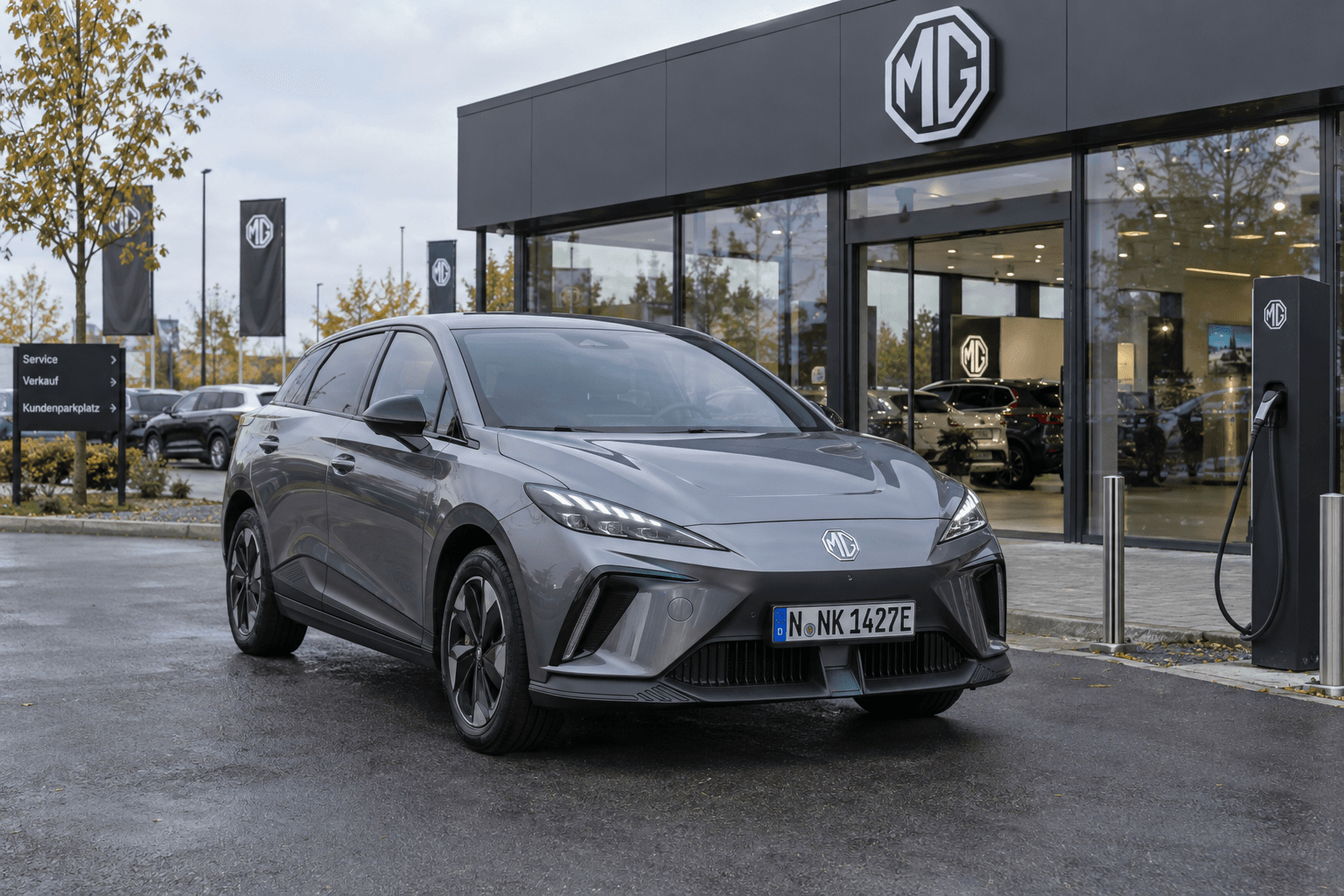
MG has clearly defined the roles within its electric model range. The Cyberster primarily serves as an emotional halo car, while the MG4 EV Urban is intended to appeal to a much broader audience.
| Model | Powertrain | Role in the portfolio |
|---|---|---|
| MG4 EV Urban | Electric | Value-focused volume model for urban and everyday driving |
| MGS5 EV | Electric | Compact SUV for a high-demand market segment |
| MGS6 EV | Electric | Larger SUV expanding the electric portfolio |
| MG Cyberster | Electric | Electric roadster and halo car |
| MG IM5 and MG IM6 | Electric | Technologically advanced models focused on performance and comfort |
| MGS9 PHEV | Plug-in hybrid | Seven-seater with up to 100 km of electric range |
The MGS5 EV is particularly important because electric compact SUVs in Germany are among the most fiercely contested vehicle classes. A low starting price alone is not enough in this segment; charging performance, range, interior space, and software must also impress.
The MGS9 PHEV expands the lineup in a different direction. Its electric range of up to 100 km could allow many everyday journeys to be completed without using the combustion engine, provided it is charged regularly. Without consistent charging, however, a plug-in hybrid loses a significant part of its efficiency advantage.
Price remains important, but should not be everything
MG is strongly associated with value for money in Germany. Promotions such as the limited-time MG EV bonus for several electric cars reinforce this perception.
However, the brand wants to avoid being seen solely as a discount brand. Interior quality, design, service, and the 7-year warranty are intended to turn an attractive price into a compelling overall package over the long term.
Dealer network expands on a broader basis
MG’s German network currently comprises around 185 dealerships. Another 30 partners are expected to be added to close regional gaps and make test drives and workshop services more accessible.
This physical presence is crucial, particularly for a relatively young import brand. A dense dealer network builds trust, simplifies maintenance and repairs, and gives customers a dedicated point of contact if questions arise about software, charging, or the warranty.
Car subscriptions lower the barrier to entry
Alongside purchases, financing, and leasing, MG also offers car subscriptions. These generally cover insurance, maintenance, and registration through a fixed monthly payment, while the vehicle can be returned at the end of the agreed period.
This is appealing to EV newcomers because it allows them to test electric mobility for longer than a short test drive. Factors such as home charging, winter range, and personal energy consumption can only be realistically assessed in everyday use. It can also replace conventional EV range anxiety with practical experience.
At the same time, the user does not bear the residual-value risk. This can be particularly persuasive for electric cars, as many buyers are uncertain about how technological progress and used-car prices will develop in the coming years.
What the strategy means for MG
With its broad powertrain mix, MG can reach more customers in the short term than it could with an all-electric portfolio. Full hybrids and plug-in hybrids serve as a bridge, while new electric cars form the brand’s technological and strategic focus.
Whether MG achieves its target of more than 30,000 vehicles is likely to depend primarily on the ramp-up of the MG4 EV Urban, demand for its SUV models, and the quality of its growing dealer network. If this combination succeeds, MG could significantly strengthen its position in the German market without abandoning its EV identity.