Mercedes Tests ProLogium’s Gen4 Solid-State Cells
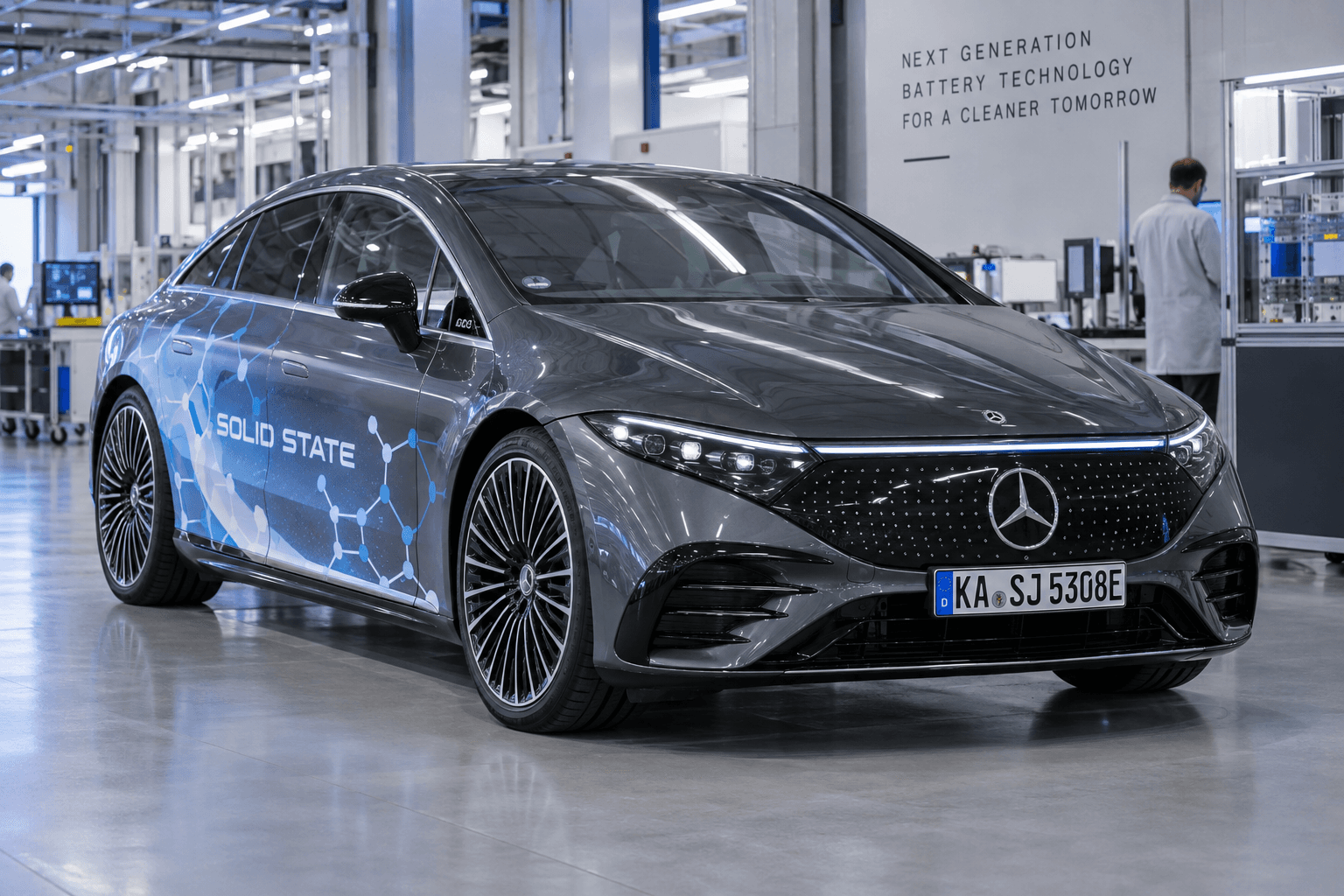
Mercedes-Benz is deepening its partnership with Taiwanese battery developer ProLogium. A new agreement gives the automaker priority access to the Gen4 solid-state cells, which will now undergo electrical, thermal, and safety testing.
The tests will be conducted at specialized external institutes and testing facilities. An important distinction: Priority access for testing is not yet an exclusive supply agreement and confirms neither a specific production model nor a binding production start date.
What the Gen4 Battery Promises Technically
ProLogium’s Gen4 platform uses a nonflammable inorganic electrolyte, a ceramic separator, and additional safety mechanisms. The architecture is intended to support high charging rates, strong power output, and better performance at low temperatures.
The manufacturer claims a gravimetric energy density of up to 400 Wh/kg for the new cell generation. The cells are also said to charge from 5% to 80% in 6.4 minutes.
| Metric | Figure | Context |
|---|---|---|
| Gen4 energy density | Up to 400 Wh/kg | Manufacturer’s cell-level figure |
| Gen4 charging time | 5% to 80% in 6.4 minutes | Not directly transferable to a production vehicle |
| Gen3.5 large-format cell | 381 Wh/kg at 185.4 Ah | Confirmed by an external TÜV test, conducted by a German technical inspection organization |
| Dunkirk plant | Initially 4 GWh per year | Capacity is to be reached gradually by 2030 |
| Planned final capacity | Up to 44 GWh per year | Long-term production target |
The crucial distinction is between the cell figure and the finished battery pack. The housing, cooling system, wiring, and battery management system add weight and reduce the energy density of the complete pack. The stated charging time also depends on temperature, the charging curve, cell aging, and the available charging power.
Cell-level energy density of 400 Wh/kg could enable significantly lighter batteries or greater range, but it is not yet a substitute for reliable testing in a production vehicle.
Partnership Has Been Underway Since 2016
Mercedes and ProLogium have been working together for around ten years. During that time, they have investigated various lithium-ceramic concepts, including pouch cells, prismatic cells, and a bipolar cell architecture.
ProLogium opened a GWh-scale factory in Taiwan in May 2024. According to the company, its Gen3.5 lithium-ceramic cell is now in mass production there. This step is significant because industrial-scale manufacturing with consistent quality and competitive costs is one of the biggest hurdles facing solid-state batteries.
A second gigafactory is being built in Dunkirk, France. The first phase is expected to gradually reach annual capacity of 4 GWh, with up to 44 GWh planned in the long term. This would give ProLogium a significant European production base for the first time.
Mercedes Is Pursuing Multiple Battery Technologies
ProLogium is not Mercedes’ only solid-state battery partner. The manufacturer is testing another technology together with Factorial Energy. A modified Mercedes EQS equipped with 106 solid-state cells has already covered more than 1,200 km without stopping to recharge.
This parallel strategy reduces development risk. Different cell concepts may have different strengths in terms of energy density, service life, fast-charging capability, and production costs. This means Mercedes does not have to commit to a single supplier at an early stage.
The goal remains to launch its first production electric car with a solid-state battery by 2030. Other manufacturers are also working toward earlier deployment, including BYD with a Yangwang solid-state battery prototype announced for 2027. It remains unclear which technology will be the first to become available in larger volumes at competitive prices.
Why This Step Matters to EV Drivers
Higher energy density gives manufacturers two options: the same range with a smaller, lighter battery, or greater range with a battery of a similar size. Lower weight can also improve energy consumption, handling, and material efficiency.
ProLogium’s current progress is therefore technically exciting, but it is not yet a near-term product promise. Between a validated individual cell and a durable, affordable vehicle battery lie pack development, crash protection, winter testing, and the establishment of stable high-volume production. Nevertheless, the figure of 381 Wh/kg already achieved shows that the technology is increasingly moving out of the laboratory and toward industrialization, as also demonstrated by recent progress in small-scale solid-state battery production.