Amazon brings the eActros 600 to German roads
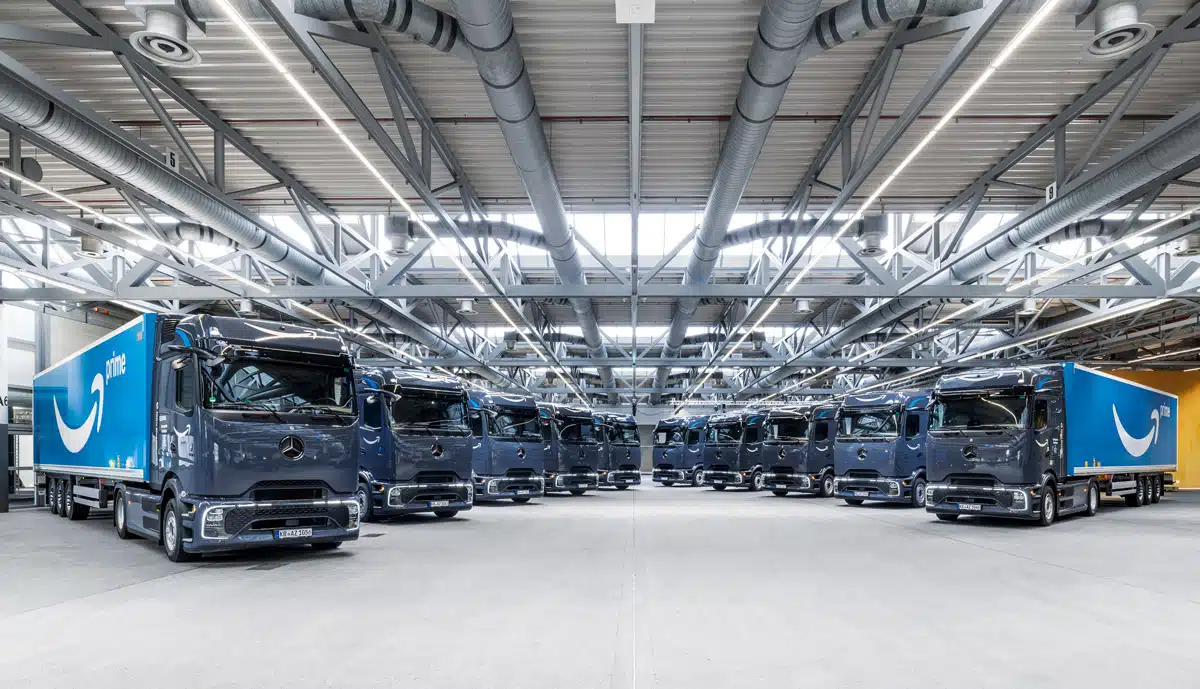
Amazon has taken delivery of the first 27 Mercedes eActros 600 trucks for use in Germany. By the end of the year, more than 50 of the battery-electric long-haul trucks are expected to be operating in the company’s German logistics network.
The vehicles will primarily handle transportation on the so-called middle mile. This involves moving goods between logistics centers and urban distribution hubs before smaller delivery vehicles complete the final leg to customers’ doors.
With the eActros 600, Amazon is now extending electrification to longer and particularly energy-intensive transport routes.
More than 200 electric trucks ordered
The German portion of the fleet is part of a major order for more than 200 eActros 600 trucks that Amazon placed with Mercedes-Benz Trucks in early 2025. It is the retail group’s largest order for battery-electric trucks to date.
The United Kingdom is the primary market covered by this order, with deliveries having begun there in late 2025. Germany is now following as another key logistics market. No specific number has yet been announced for Austria and Switzerland under this order.
621 kWh battery and up to 560 km of range
The eActros 600 has been in series production at the Mercedes-Benz plant in Wörth since late 2024. Its three LFP battery packs each have a capacity of 207 kWh, providing a combined installed capacity of 621 kWh.
More than 95% of the installed capacity is expected to be usable. This equates to over 590 kWh of available energy and is particularly relevant for predictable logistics routes, where the truck needs to travel for as long as possible between charging windows.
| Specification | Mercedes eActros 600 |
|---|---|
| Battery | 3 LFP packs with a combined capacity of 621 kWh |
| Usable capacity | More than 95% |
| Real-world range | Around 500 km at a gross combination weight of 40 metric tons |
| Maximum stated range | Up to 560 km in the most energy-efficient configuration |
| Technical gross combination weight | Up to 44 metric tons |
| Payload in the EU | Approximately 22 metric tons with a standard semitrailer |
| Amazon’s charging target | 10% to 80% in around 70 minutes |
Under real-world conditions with a gross combination weight of 40 metric tons, Mercedes states a range of around 500 km without intermediate charging. Up to 560 km should be possible with the most efficient configuration. In everyday operation, however, weather, speed, topography and load remain key factors.
Dedicated truck charging points are becoming a key factor
Large batteries alone will not solve the challenges of long-haul transportation. Amazon is therefore installing hundreds of charging stations for electric trucks at European sites. The planned systems are intended to charge the eActros 600 from 10% to 80% in approximately 70 minutes.
For a battery of this size, that requires charging power of several hundred kilowatts to be available over an extended period. A stable charging curve that fits within mandatory breaks and operational downtime is more important than a brief peak value.
Amazon is investing more than €1 billion in the further electrification and decarbonization of its European transportation network. More than €400 million of this amount is allocated to Germany.
Why the middle mile is particularly suitable
Transportation between logistics centers often follows recurring routes and ends at company-operated sites. This makes charging points, time slots and energy requirements easier to plan than for changing long-haul destinations. Fixed route plus depot charging → less reliance on publicly available fast chargers for trucks.
With a range of around 500 km, the eActros 600 can complete many of these routes without an intermediate stop. High-power charging en route will still be needed for greater daily distances, meaning that the expansion of charging infrastructure will directly determine the economic viability of these vehicles.
A signal for European heavy-duty transportation
Measured against Amazon’s overall transportation volume, more than 50 electric trucks do not yet represent a complete transition. Nevertheless, the fleet is large enough to gather reliable real-world data on energy consumption, charging schedules, maintenance and operating times.
For Germany, Austria and Switzerland, the project demonstrates above all that battery-electric transportation with 40-metric-ton trucks is increasingly moving from pilot projects into regular logistics operations. Mercedes-Benz Trucks is supplying the vehicles, while Amazon is building the necessary charging infrastructure in parallel. This combination is likely to be crucial to the continued electrification of road freight transportation.