New electric cars could revive Maserati
Maserati is reportedly working on a comprehensive electric vehicle strategy with partners from China. An industry report mentions two planned models: a midsize-to-large electric SUV and a large electric grand tourer. However, the partnership has not yet been officially confirmed.
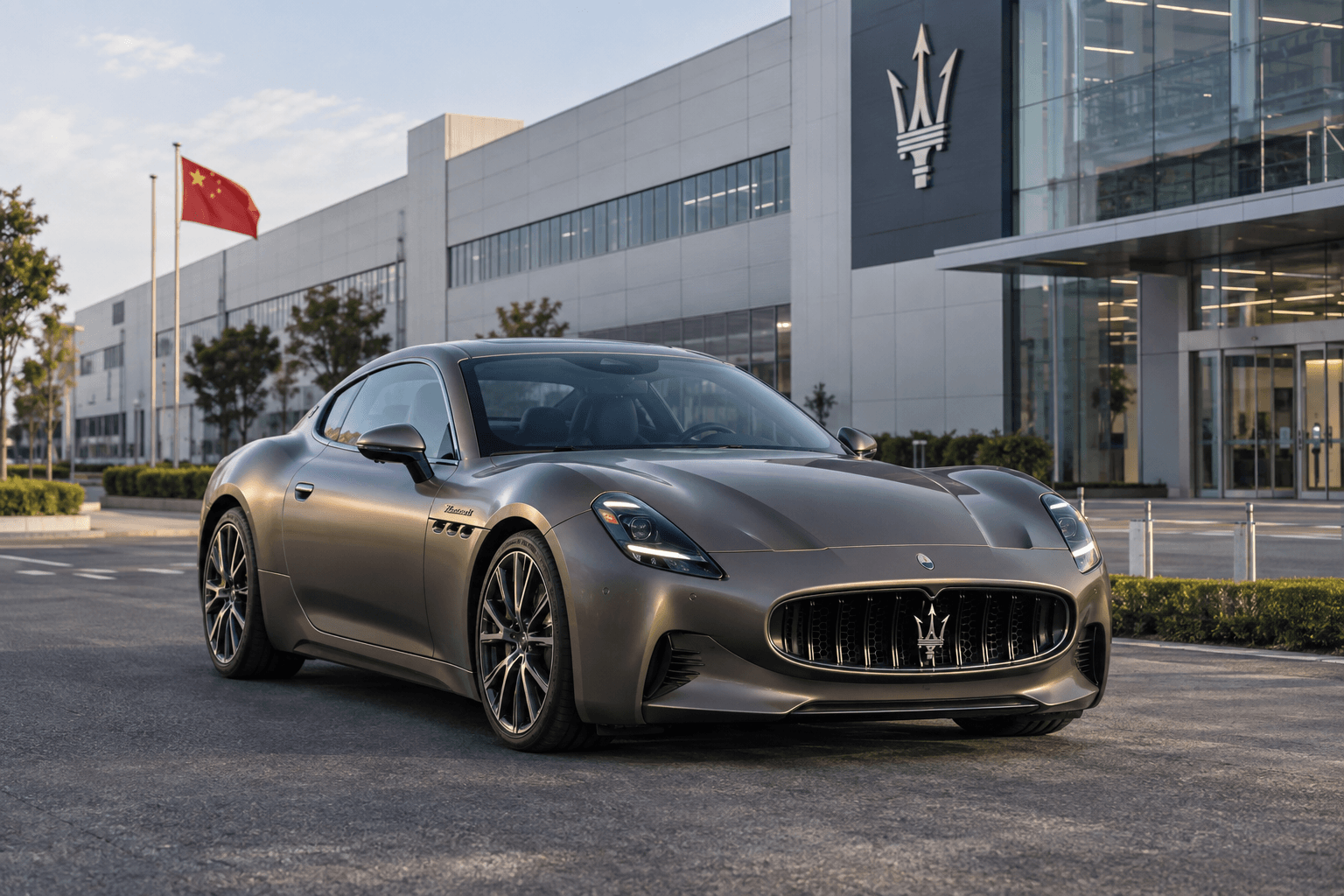
The SUV is expected to expand the range above or alongside the Grecale Folgore. The electric GT, meanwhile, would directly build on the Italian brand’s sporting identity and could draw on the experience gained with the GranTurismo Folgore.
Internally, the electric GT is currently said to be the preferred first model from the potential partnership.
Huawei, JAC and Maserati would divide the responsibilities
The planned model would go well beyond a conventional supplier relationship. Huawei, JAC and Maserati would each take responsibility for a key part of the development, production or marketing process.
| Partner | Planned role |
|---|---|
| Huawei | Digital cockpit, Qiankun ADS driver assistance and electric powertrain technology |
| JAC | Vehicle development and industrial production at its Hefei plant |
| Maserati | Design, chassis tuning, luxury interior and international sales |
Huawei would reportedly contribute technology from its HIMA ecosystem. This includes connected infotainment systems and advanced driver-assistance features. For Europe, however, the hardware and software would have to be adapted to homologation requirements, data protection rules and regional mapping services.
Two brands for different markets
The planned dual marketing strategy is particularly notable. In China, the vehicles could be offered under Maextro, the luxury brand jointly developed by Huawei and JAC. In international markets, however, they are expected to carry the Maserati badge.
This could allow Maserati to benefit from Chinese economies of scale without abandoning its well-known brand in Europe. At the same time, it creates a demanding challenge: the design, material quality and driving characteristics must feel unmistakably like a Maserati, even if much of the technical foundation comes from China.
A new electric GT would enter a highly competitive segment. Established rivals include the Porsche Taycan and the Audi e-tron GT. Modern software alone is not enough in this class; charging performance, long-distance comfort and brand-specific tuning are equally important.
Body shells from China, final assembly in Italy
According to the report, production would use a semi-knocked-down (SKD) process. Body shells would be manufactured at JAC’s Hefei plant and then transported to Italy. There, the interior, chassis and other brand-specific components would be completed.
This model could reduce costs while retaining a significant share of value creation in Italy. It could also help Maserati make better use of existing resources in Modena and Cassino. Whether and to what extent both locations would be involved remains unclear.
Germany among the potential launch markets
Germany, France, Italy and the Middle East are named as the first international target markets. For the DACH region—Germany, Austria and Switzerland—it would be particularly important for Maserati to offer a competitive fast-charging system, a reliable service network and long-term software support.
The partnership with Huawei and JAC could provide a significant boost in infotainment, driver-assistance systems and development speed. Chinese platforms now offer high levels of integration and short model cycles. Luxury brand plus Chinese technology → faster development, provided Maserati retains sufficient control over quality and brand character.
Economic pressure is high
The plans come at a difficult time. Maserati’s worldwide deliveries are reported to have fallen below 8,000 vehicles in 2025. Compared with the 2017 peak, this would represent a decline of around 80%.
An adjusted operating loss of €198 million has also been reported for 2025. The operating margin is said to have been negative 27.3%. The Stellantis Group is therefore looking for industrial partnerships that could renew Maserati without having to sell the brand.
A plausible strategy with unanswered questions
An alliance with Huawei and JAC would not be an ordinary model change, but a far-reaching strategic realignment. Maserati could save development time, adopt modern electronics and benefit from more efficient manufacturing. In return, JAC and Huawei would gain access to a globally recognized luxury brand and its sales network.
The crucial question is how much influence Maserati would ultimately retain. Customers in this price category are not only buying range and displays, but also design, heritage and a distinctive driving experience. Until there is official confirmation, technical data or a timetable, the project remains a well-founded but still unconfirmed plan for the future.