JAC prepares the Sunray Pro for Europe
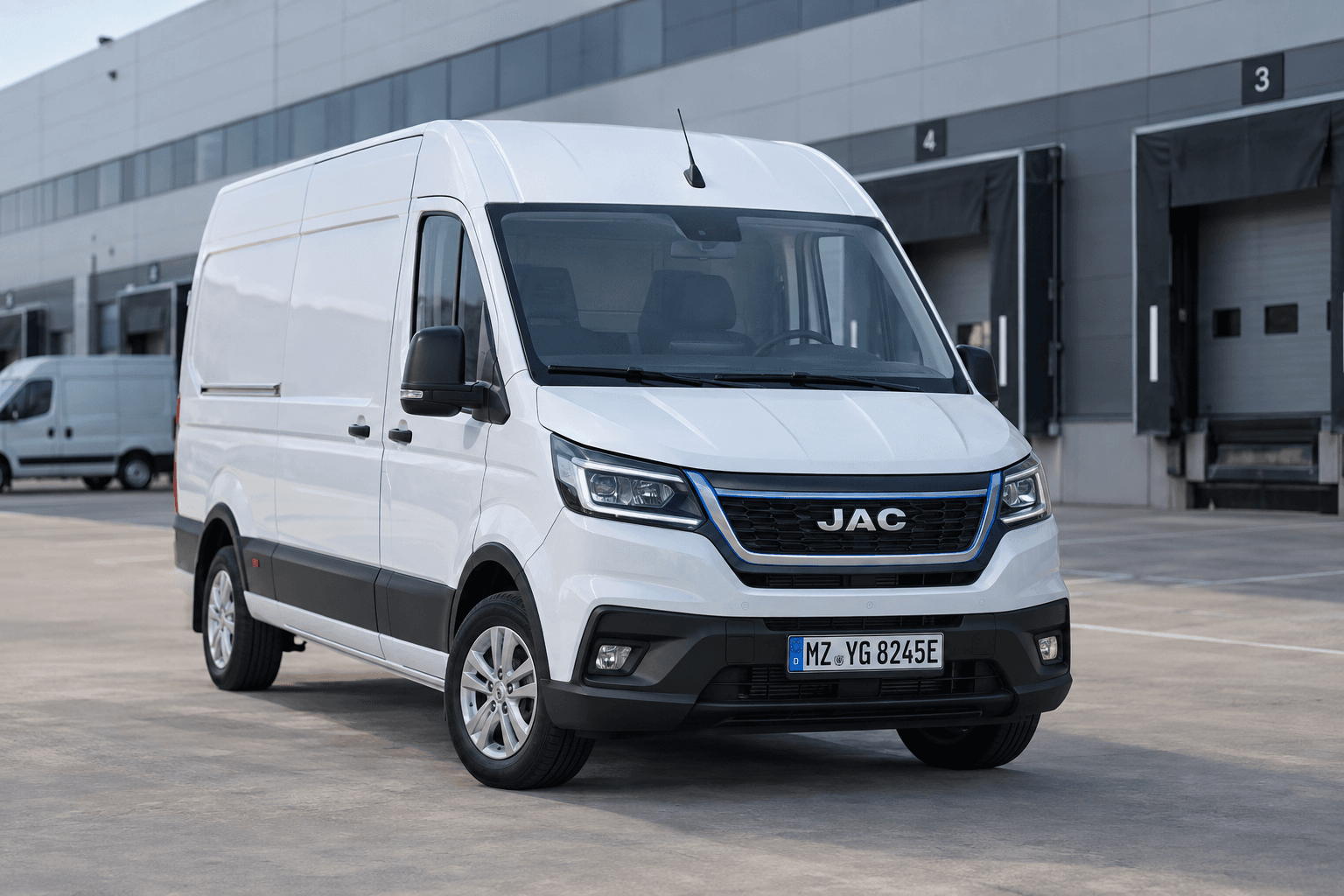
JAC Motors does not intend to compete in the European commercial vehicle market on technical specifications alone. Ahead of the sales launch, the Chinese manufacturer is already building a network of distributors, workshops, financing partners and body manufacturers. The first key product in this strategy is the fully electric JAC Sunray Pro.
The midsize electric van is scheduled to launch in the first half of 2027. Germany is part of the initial rollout. Selected fleet customers are expected to begin testing pre-production vehicles under real-world conditions as early as the fourth quarter of 2026.
JAC is not selling the Sunray Pro as a stand-alone vehicle, but as part of a complete solution for electric fleets.
Service and infrastructure are intended to make the difference
Electric vans are no longer a niche product in urban delivery operations. This makes it difficult for new brands to distinguish themselves from established competitors through range, cargo capacity or motor output alone. Fleets also value short workshop turnaround times, available spare parts, suitable body conversions and predictable financing costs.
JAC plans to combine these areas in a single offering. It is set to include financing, charging infrastructure, stationary energy storage, fleet management, maintenance and battery recycling. The aim is to give companies a single point of contact for as many stages of electrification as possible.
A European regional headquarters was established in Turin at the end of 2025. According to JAC, the company is now present in 13 European countries and works with eight distribution partners. The network comprises more than 50 sales locations and over 100 service points.
Sunray Pro combines a 1,300 kg payload with a 3.5-tonne rating
The Sunray Pro is based on a newly developed skateboard platform. The powertrain, chassis, thermal management and electronic controls are integrated into a modular architecture. A similar basic principle is also used by specialized platforms for an electric motorhome with a large battery.
JAC is planning five body variants in both left- and right-hand-drive configurations. Vehicle lengths of 5 and 5.4 meters will be available, along with three roof heights. Depending on the version, cargo capacity is expected to range from 7.3 to 11.25 cubic meters.
| Specification | JAC Sunray Pro, 5-meter version |
|---|---|
| Dimensions | 5,000 × 1,980 × 2,180 mm |
| Battery | 83.5 kWh CATL LFP |
| Combined range | 348 km WLTP |
| Urban range | 523 km WLTP |
| Peak output | 150 kW |
| Maximum torque | 330 Nm |
| Cargo capacity | 8.3 m³ |
| Payload | 1,300 kg |
| Gross vehicle weight rating | 3.5 tonnes |
| Top speed | 120 km/h |
With a curb weight of around 2.2 tonnes, the van retains a payload capacity of 1,300 kg. At the same time, the 3.5-tonne version can be driven with a standard passenger-car license. This is an important advantage for parcel services, tradespeople and municipal fleets because it eliminates the need for additional staff with a truck-driving license.
The loading sill is just 495 mm above the ground. In delivery operations, this can make frequent entry and exit as well as moving heavy parcels easier. In addition to the panel van, JAC plans chassis cabs, crew vans and passenger vans for applications such as refrigerated bodies, mobile workshops and patient transport.
LFP battery charges in around 29 minutes even in cold weather
The 83.5 kWh battery uses CATL LFP cells and features liquid cooling and active heating. According to the manufacturer, charging from 30% to 80% takes around 29 minutes. This time is expected to be achievable even at an ambient temperature of −10°C, provided that a suitable fast charger is available.
JAC quotes a maximum charging rate of 2C, which theoretically corresponds to around 167 kW based on the battery capacity. However, confirmed figures for maximum DC charging power and the charging curve of the European production version are not yet available. The crucial factor will be how long the van can sustain a high charging rate.
The Sunray Pro charges at 11 kW from an AC connection. A full charge is expected to take around 9.2 hours, making it well suited to fleets whose vehicles remain at the depot overnight. The announced battery warranty of eight years or 600,000 km is remarkably extensive for a commercial vehicle.
6 kW power outlet turns the van into a mobile workshop
An AC outlet supplies up to 6 kW to external devices. This allows the van to power tools, refrigeration equipment or other appliances. The planned ability to supply power while charging is particularly interesting, as working on site would not necessarily reduce the vehicle’s subsequent driving range.
Other equipment includes a heat pump, a 12.3-inch touchscreen, a 360-degree camera and 25 storage compartments in the cabin. An app can control functions including locking, preconditioning, charge scheduling and vehicle tracking. A driver-assistance package is intended to protect the driver, cargo and other road users.
JAC plans two electric trucks and a plug-in pickup
The Sunray Pro is just one of four models with which JAC intends to expand its European commercial vehicle business. It will be joined by the N42 EV and N90 EV light electric trucks as well as the T9 PHEV. The planned portfolio will therefore cover urban delivery services, heavier distribution tasks and the pickup market.
| Model | Powertrain and output | Battery | Range |
|---|---|---|---|
| Sunray Pro | Electric, up to 150 kW | 83.5 kWh LFP | 348 km WLTP combined |
| N42 EV | Electric, up to 105 kW | around 77 kWh | 190 km WLTP |
| N90 EV | Electric, up to 180 kW | 100 kWh LFP | around 182 km WLTP |
| T9 PHEV | Plug-in hybrid, 360 kW system output | 31.2 kWh | 100 km electric |
JAC is also using an aerodynamically optimized cab for its electric trucks. The manufacturer says this can increase range by just over 33 km. Such improvements can be relevant in fleet operations, but the actual cost benefits depend heavily on the route, load, energy price and body configuration.
As a plug-in hybrid, the T9 PHEV occupies a special position. It is expected to travel up to 100 km on electric power alone and combines a system output of 360 kW with 674 Nm of torque. A 3.3 kW power outlet and over-the-air software updates via the cellular connection are also part of the announced package.
Local production is an option, but has not been confirmed
In the long term, JAC is considering creating more value within Europe. The first step could be closer cooperation with European body manufacturers before local vehicle production follows. No location or specific timetable has yet been announced.
By 2028, the brand aims to cover all major European markets. In Spain, JAC already reports a 41% market share in the 7.5-tonne segment for the first half of 2026. Whether this success can be replicated in Germany, Austria and Switzerland will depend primarily on service quality, parts availability and competitive total operating costs.
An interesting approach for fleet customers
With a 1,300 kg payload, up to 523 km of urban range and a 6 kW power outlet, the Sunray Pro offers compelling specifications on paper for delivery services and tradespeople. The long battery warranty could also appeal to commercial buyers.
Before the market launch, however, JAC still needs to announce pricing, final charging power figures and the exact equipment for the DACH region—Germany, Austria and Switzerland. The Sunray Pro will also face growing competition, which will eventually include the larger Kia PV7 electric van. Establishing the European service offering ahead of the market launch is therefore not merely an extra, but the central requirement for a successful entry.