Nearly 100,000 km in a production-spec VW ID. Buzz
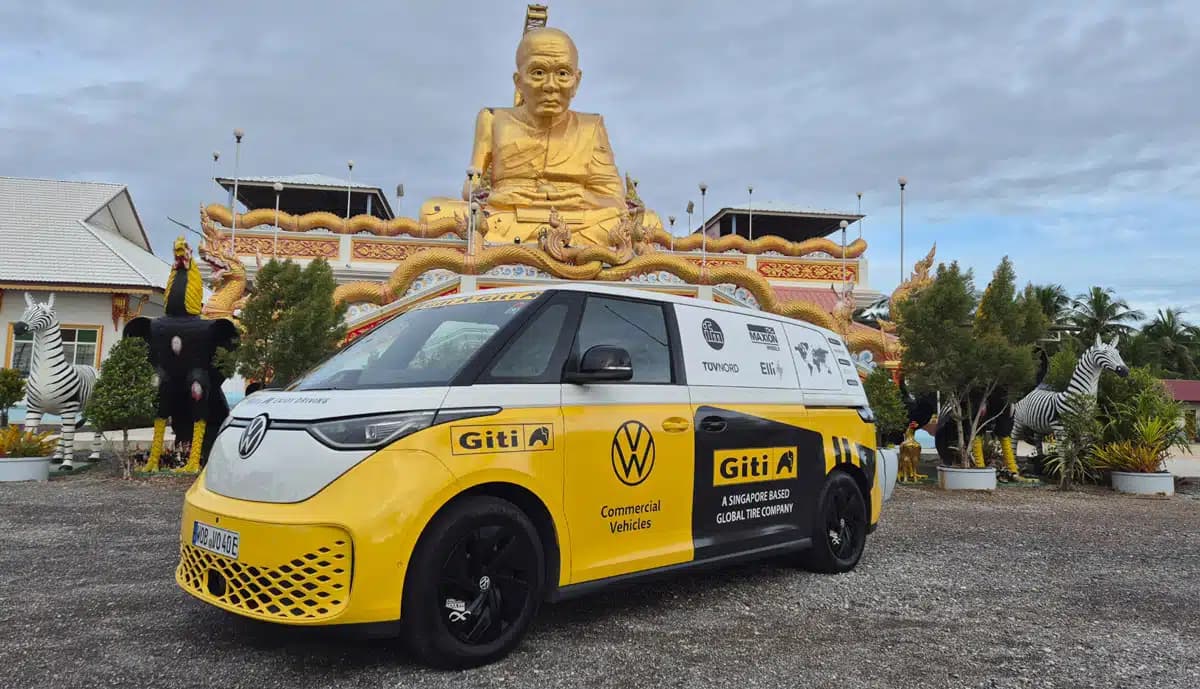
A fully electric VW ID. Buzz has completed an extraordinary long-distance test. The journey covered 99,767 km through 92 countries on six continents and earned an official Guinness World Record.
The drive was recognized for visiting the most countries during a continuous journey in a battery-electric vehicle. The technical record is particularly remarkable: According to the organizers, the vehicle did not suffer a single breakdown during the entire tour.
| Metric | Result |
|---|---|
| Distance traveled | 99,767 km |
| Duration | 445 days |
| Countries visited | 92 |
| Continents | 6 |
| Charging sessions | More than 300 |
| Ship transports | 16 |
| Battery health after the journey | 95.75% |
Production vehicle without a technical breakdown
The vehicle used was a production-spec, long-wheelbase ID. Buzz Pro. The fitted Giti tires were also standard production versions. The journey began in Hanover on July 1, 2025, and returned for IAA Transportation, the international commercial-vehicle trade show, on September 14, 2026.
During 16 legs, the vehicle was transported by container ship to cross oceans and sections without continuous road access. This does not diminish the record, as the deciding factor was a continuous journey through as many countries as possible, not a circumnavigation completed exclusively under the vehicle’s own power.
Nearly 100,000 km, extreme climate zones, and not a single technical breakdown make the tour a compelling endurance test for VW’s electric van.
95.75% battery health after the journey around the world
After the vehicle returned, TÜV Nord, a German technical inspection organization, tested the high-voltage battery and determined a state of health of 95.75%. Despite the high mileage, changing temperatures, and more than 300 charging sessions, the measured capacity loss was therefore just 4.25%.
However, the state of health does not automatically correspond to the remaining real-world driving range. Measurement methods, temperature, and battery management all affect the result. Nevertheless, the figure is compelling evidence that modern batteries can remain durable even under intensive use.
A VW ID.3 after 220,000 km had already presented a similar picture. Real-world data like this is more relevant to buyers than individual laboratory results because it shows how the battery and drivetrain actually develop over long distances.
Charging infrastructure still varies widely by region
The greatest challenge was apparently not the vehicle but access to electricity. In Zambia and Tanzania, public charging points were largely unavailable along the route. There, the ID. Buzz had to be charged under supervision at facilities connected to the national power grid.
Charging was significantly easier in South Africa, Morocco, and Rwanda. Saudi Arabia, Brazil, and Chile have also noticeably expanded their infrastructure. China, by contrast, proved to be a market where electric mobility and public charging are already firmly established in everyday life.
What the record means for drivers in Germany, Austria, and Switzerland
A journey around the world is not a typical use case and cannot be directly compared with commuting or vacation travel. It combines high mileage, different power grids, extreme climate zones, and widely varying charging conditions.
That is precisely why the journey provides an interesting real-world test. The ID. Buzz completed the route in production specification, while its battery continued to show a high state of health after nearly 100,000 km. The demands of everyday driving are normally significantly lower for drivers in Germany, Austria, and Switzerland.
The record does not prove that every journey in an electric car is possible everywhere without difficulties. It does show, however, that the vehicle technology itself is now robust enough to handle enormous distances. Where difficulties arose, they were primarily related to regional charging infrastructure rather than the electric drivetrain.