Toyota Hilux FCEV to launch in Europe in 2028
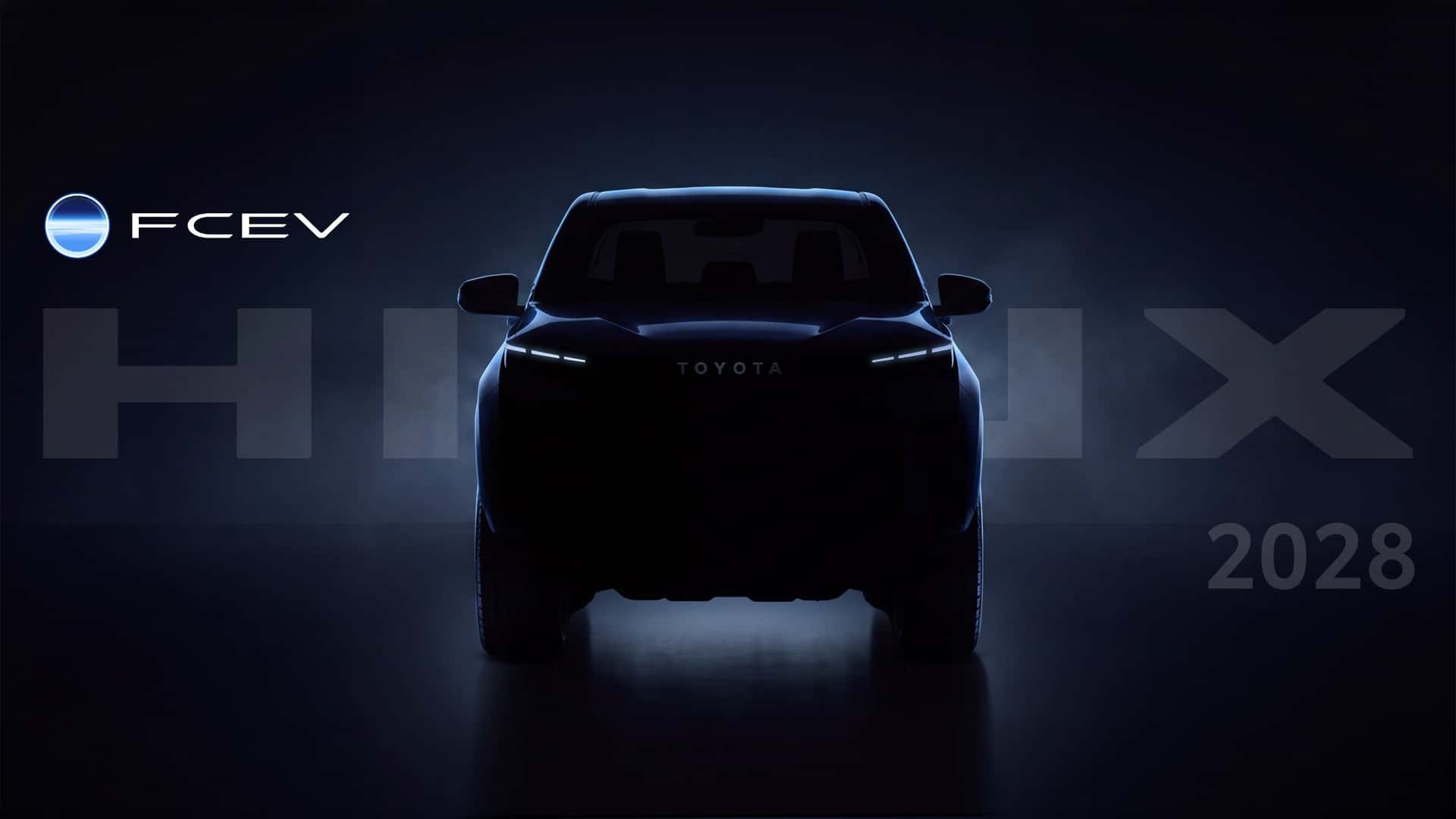
Toyota is adding a fuel-cell powertrain to the next Hilux generation. The Hilux FCEV is scheduled to launch in Europe in 2028, where it will be offered alongside a battery-electric version and a diesel model with mild-hybrid technology.
Toyota is targeting a range of around 400 km for the production model. Refueling is expected to take approximately five minutes, while the electric Hilux will need about 30 minutes to charge from 10% to 80%.
Higher towing capacity than the electric Hilux
The biggest practical advantage becomes apparent when towing heavy loads. Toyota is planning a towing capacity of 2,500 kg for the Hilux FCEV, while the battery-electric Hilux is expected to tow no more than 2,000 kg.
| Specification | Hilux FCEV | Electric Hilux |
|---|---|---|
| Range | around 400 km | around 257 km |
| Refueling/charging time | approximately 5 minutes | approximately 30 minutes from 10% to 80% |
| Towing capacity | 2,500 kg | 2,000 kg |
| Market launch | planned for 2028 | with the new Hilux generation |
These differences can be particularly relevant for a commercial vehicle. Frequent towing, heavy payloads and tight schedules put greater pressure on range and charging plans than normal passenger-car use. A short refueling stop plus higher towing capacity → on paper, the fuel cell is well suited to certain fleet operations.
How the hydrogen powertrain works
The powertrain is expected to be technically related to that of the Toyota Mirai. In the fuel cell, hydrogen reacts with oxygen to generate electrical energy for the drive motor. A lithium-ion battery provides a power buffer, stores energy recovered through regenerative braking and assists under heavy loads.
The test vehicles built so far had three hydrogen tanks mounted within the ladder frame and a battery beneath the cargo bed. They featured rear-wheel drive and had a calculated range of up to 600 km, although Toyota gives a significantly more conservative target of around 400 km for the production vehicle. It remains unclear whether an all-wheel-drive version will also be offered.
The first fuel-cell Hilux prototypes were built in 2022, followed by a fleet of ten test vehicles in 2024. The planned 2028 market launch shows that Toyota does not view the technology merely as an experimental platform. At the same time, the manufacturer is also advancing conventional electric cars, including the planned Toyota Corolla EV.
The refueling network remains the bottleneck
The technical specifications do not solve the central problem facing hydrogen vehicles. Only around 179 hydrogen refueling stations are operating across Europe and the United Kingdom. By comparison, the European Union has around 1.16 million public charging points for electric cars, although the counting methods and regions are not entirely comparable.
For private customers in the German-speaking DACH region—Germany, Austria and Switzerland—a Hilux FCEV could therefore quickly prove impractical. Anyone without a suitable refueling station along their usual routes will hardly benefit from the time saved when refueling. Battery-electric vehicles, by contrast, can be charged at home or at a company depot as well as at public charging points.
The Hilux FCEV is less a universal replacement for an electric vehicle than a specialist for predictable routes, heavy loads and fleets with a secure hydrogen supply.
Zero vehicle emissions, but not automatically carbon-neutral
During operation, the Hilux FCEV primarily emits water from its exhaust. Its overall carbon footprint, however, depends heavily on how the hydrogen is produced and transported. It makes the most sense when powered by hydrogen produced using renewable energy, which remains in limited supply and is energy-intensive to manufacture.
Ultimately, the operating environment will determine its usefulness. On fixed commercial routes with an on-site or reliably accessible refueling facility, the hydrogen-powered Hilux can play to its strengths. For widespread private use, the battery-electric Hilux and other electric pickups will remain easier to integrate into everyday life for the time being because of the far more extensive charging infrastructure.