Toyota supplies 300 kW system for Iveco S-eWay
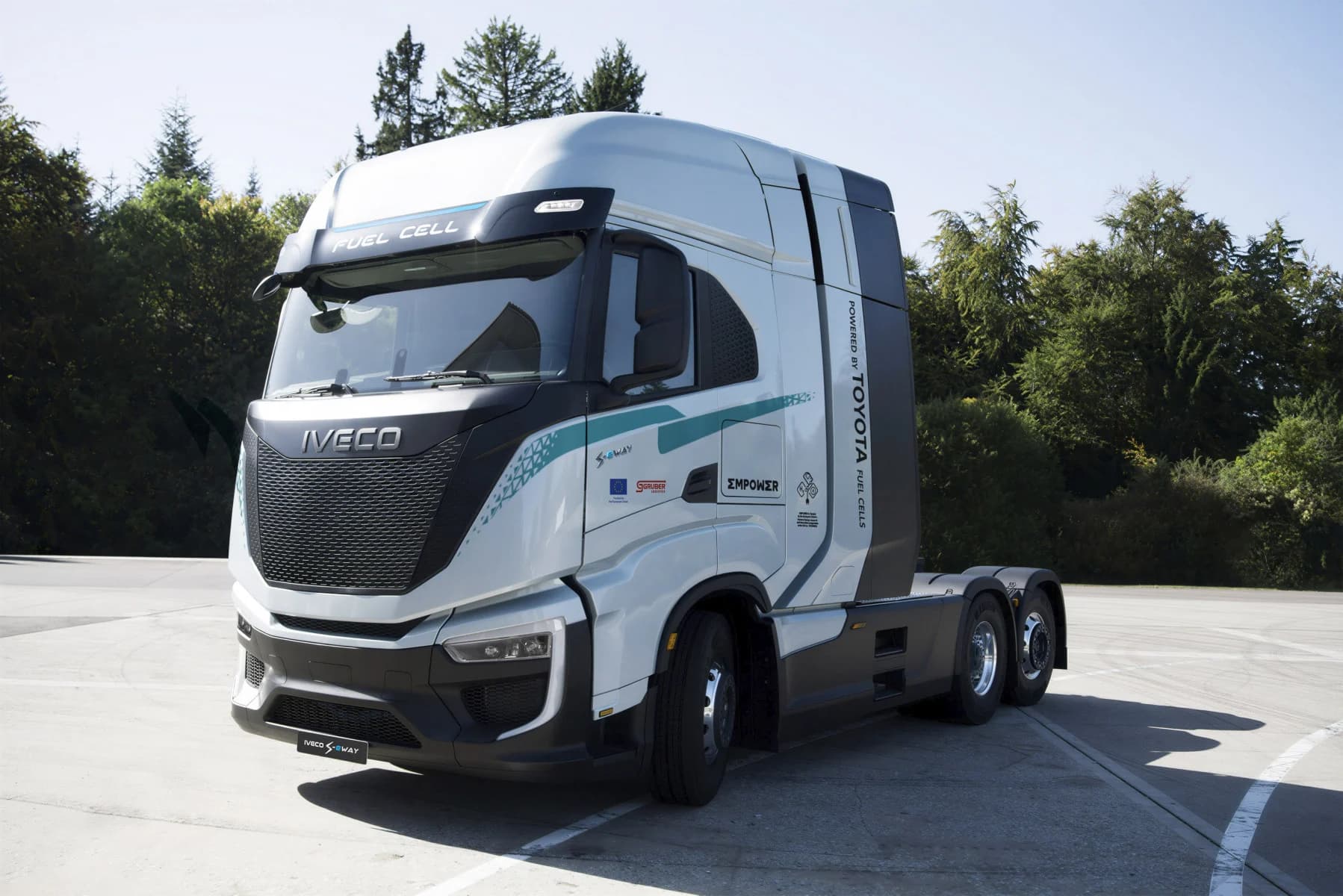
Iveco and Toyota are jointly developing a new heavy-duty fuel-cell truck. The vehicle is being developed as part of the EU-funded EMPOWER research project and is based on the Iveco S-eWay Fuel Cell. Toyota is contributing its third-generation fuel-cell technology, while Iveco is responsible for development, integration and testing.
The key figures indicate the project’s direction: long range, lower vehicle weight and a significantly smaller buffer battery. The project is therefore aimed primarily at demanding logistics operations where long distances and short downtimes are crucial.
| Metric | Iveco S-eWay Fuel Cell |
|---|---|
| Fuel-cell output | 300 kW |
| Planned range | more than 900 km |
| Target service life | more than 25,000 operating hours |
| Battery capacity | half that of its predecessor |
| Start of validation | fourth quarter of 2026 |
| Testing on public roads | first half of 2027 |
Smaller battery intended to reduce weight and complexity
A fuel-cell truck is fundamentally an electric vehicle. The fuel cell generates electricity from hydrogen while the truck is moving, while a battery handles power peaks and stores energy recovered through regenerative braking. The performance of the fuel-cell system is therefore not the only decisive factor; its interaction with the battery, electric motor and energy-management system is equally important.
This is precisely where Iveco is focusing its efforts. Compared with the previous generation, a revised vehicle architecture and a new operating strategy are intended to halve the required battery capacity. A smaller battery → less weight and potentially more flexibility for payload and installation, although the hydrogen tanks and fuel-cell system still require additional space.
At the same time, the developers aim to increase efficiency and reduce overall weight. Experience from the European H2Haul project is being incorporated into the new vehicle. In that project, Iveco had already deployed heavy-duty fuel-cell trucks using a system from another supplier.
With a target of more than 25,000 operating hours, durability in demanding everyday logistics operations is becoming a key focus alongside range.
Toyota expands its European truck business
The partnership with Iveco is part of Toyota’s broader commercial-vehicle strategy. Scania also plans to use the 300 kW system and test a total of 40 trucks equipped with it in real-world logistics operations from early 2027. Toyota also has partnerships with other European and Asian commercial-vehicle manufacturers.
Toyota is therefore increasingly positioning fuel cells in applications where they may be better able to leverage their technical advantages than in passenger cars. Heavy-duty long-haul vehicles require large amounts of energy, high daily mileage and the shortest possible refueling stops. Whether this translates into an economic advantage, however, will depend largely on hydrogen prices, the density of the refueling network and vehicle utilization.
What the Iveco truck means for the DACH region
For the DACH region—Germany, Austria and Switzerland—the project is technically relevant, but a market launch is not imminent. The partners must first demonstrate efficiency, durability and reliability under real-world conditions. The road tests planned from 2027 are also intended to provide data for possible series production at a later stage.
Battery-electric trucks generally retain an advantage in energy consumption because electricity is stored without the intermediate step of conversion to hydrogen. Fuel-cell trucks could nevertheless be attractive for fixed long-haul routes, high daily mileage or fleets with their own hydrogen supply. The decisive factor will be whether reliable infrastructure for renewably produced hydrogen is developed alongside the vehicles.
The new S-eWay Fuel Cell is therefore primarily an industrialization project. Iveco is contributing its experience with heavy-duty commercial vehicles, while Toyota is supplying an advanced fuel-cell system. If testing is successful, the project could produce an additional zero-emission powertrain option for particularly energy-intensive logistics applications.