Hyundai turns vehicle batteries into stationary storage systems
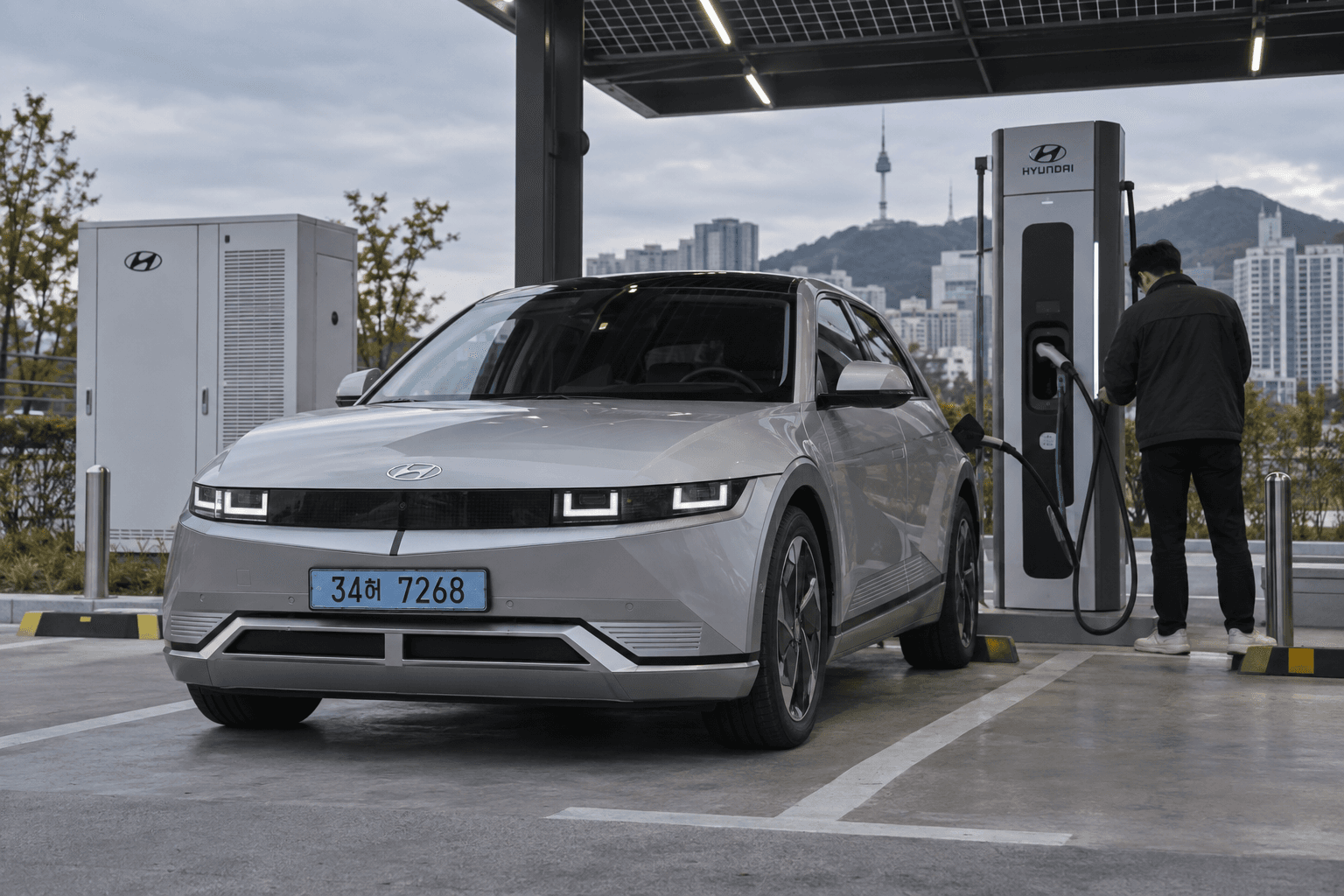
Hyundai and LG are testing a new use for retired high-voltage batteries. Batteries from electric cars based on the E-GMP platform are combined into a stationary energy storage system and connected directly to fast chargers.
The first installation in South Korea has a storage capacity of 200 kWh. For comparison, a current Hyundai Ioniq 5 can be equipped with a battery of up to 84 kWh. In purely mathematical terms, the pilot system is therefore equivalent to a few complete vehicle batteries, although the actual usable capacity depends on the condition of the used modules.
How the battery storage system at the fast charger works
The stationary storage system draws energy when electricity prices and the load on the grid are low. If several electric cars arrive to charge later, it can supply the stored energy in addition to the power available from the grid.
In simplified terms, the principle is: slow power draw from the grid → high output during fast charging. This means that the grid connection does not have to be permanently designed for the maximum output of the connected charging stations. This can make it easier to install high-powered charging points, particularly at locations with limited grid capacity.
| Metric | Hyundai pilot project |
|---|---|
| Location | South Korea |
| Storage capacity | 200 kWh |
| Battery source | Used batteries from the E-GMP platform |
| Application | Buffer storage for fast chargers |
| Objective | Reducing strain on the grid and using lower-cost charging periods |
Why retired EV batteries are still valuable
A battery is not necessarily defective simply because it is no longer ideally suited for use in a vehicle. Declining capacity, varying rates of degradation among individual modules or stricter range and performance requirements can result in a battery being removed from a car.
Weight and installation space are far less critical in a stationary storage system. Tested modules can often continue to store and release energy there for years. Only after this second phase of use do the raw materials they contain need to be recycled.
Second-life storage systems extend the useful life of a vehicle battery and postpone recycling until a later date.
How the storage system helps with everyday charging
A buffer storage system can absorb short-term power peaks and reduce costly peak loads. This can potentially lower the cost of operating a site, while allowing drivers to benefit from high charging power even with a lower-capacity grid connection.
It also makes it possible to purchase electricity specifically during lower-priced periods. When combined with solar power or other renewable energy sources, such a storage system could also retain locally generated energy for later charging sessions.
The concept complements other approaches that integrate vehicle batteries more flexibly into the energy system. Hyundai and Kia are also working on solutions for bidirectional charging and smart charging management, for example.
Second-life technology has demanding requirements
Used batteries cannot simply be installed in a stationary storage system without testing. Key factors include cell health, reliable cooling, fire safety and a battery management system that can safely control modules with different levels of degradation.
The cost of removal, transportation, diagnostics and integration must also make economic sense. New stationary LFP storage systems continue to become cheaper, which means second-life systems are not automatically the more affordable solution. However, Hyundai could benefit from standardized E-GMP batteries and direct access to vehicle data.
Potential for Germany, Austria and Switzerland
The project is initially being conducted in South Korea. A rollout in Germany, Austria or Switzerland has not yet been announced. Nevertheless, the approach is relevant to the DACH region—the German-speaking market comprising Germany, Austria and Switzerland—because high-capacity grid connections are expensive in many locations or require lengthy planning periods.
As the number of electric cars increases, so does the number of batteries that could be suitable for a second use. If Hyundai can demonstrate the technology’s reliability and economic viability, such storage systems could become particularly attractive for charging hubs, car dealerships, logistics sites and company parking facilities.