Hyundai Staria Electric is available to order, with 800 volts for everyday van use
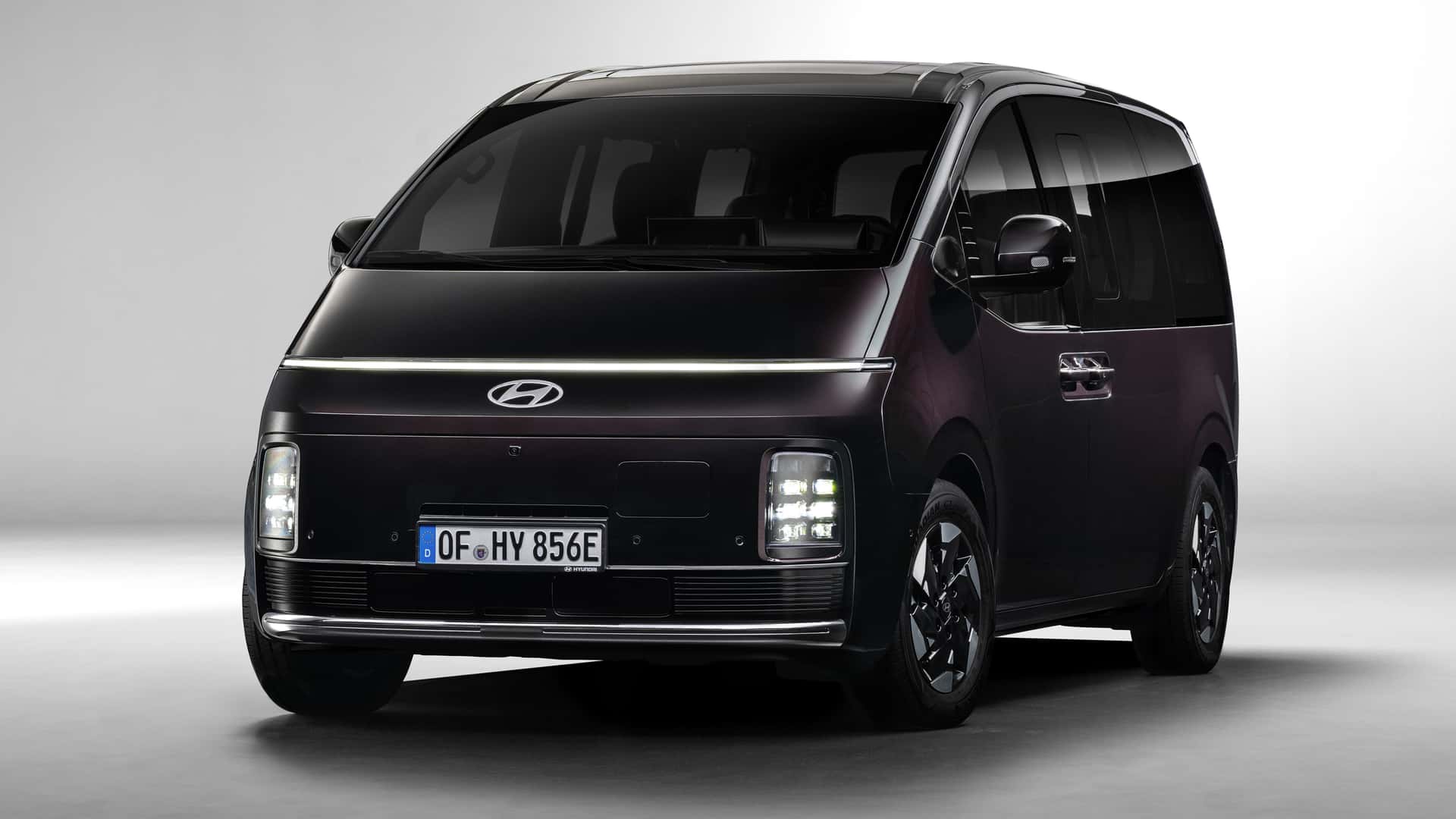
Hyundai has now officially added the Staria Electric to its configurator. Prices start at €57,450 for a 5.26 m van clearly designed for shuttle services, large families, and transportation. The technology is particularly interesting: Hyundai uses an 800-volt architecture, delivering charging times more commonly associated with passenger cars.
The model is built in Ulsan, South Korea. Visually, the Staria remains close to the familiar combustion-engine silhouette, although the electric version has a more enclosed front end.
Dimensions and charging design: Front charging port with heated flap
The front charging port is unusual in this vehicle class. It can actually be practical in everyday use, as it makes it easier to reach the charger at many fast-charging stations without maneuvering. To prevent the flap from freezing shut in its exposed position during winter, it can be heated.
| Dimension | Hyundai Staria Electric |
|---|---|
| Length | 5,253 mm |
| Width | 1,997 mm |
| Height | 1,990 mm |
| Wheelbase | 3,273 mm |
| Cargo capacity (9-seater) | 831 to 1,303 liters |
| Wheels | 17-inch |
Interior: 7 or 9 seats, ccNC infotainment, and OTA updates
Hyundai equips the cockpit with two 12.3-inch displays, although they are not positioned side by side as one continuous glass panel. The driver display sits high and close to the windshield, which may improve readability. The software is not Hyundai’s new Pleos system but ccNC, including over-the-air updates and optional features available through a store.
Crucially for many prospective buyers, the Staria remains exceptionally spacious, with a flat floor and long wheelbase. Three rows of seats are standard. Depending on the version, 7 or 9 seats are available, while the rear rows can be moved to vary passenger and cargo space. Hyundai also specifies a 24-liter frunk.
Powertrain, battery, and range: 160 kW at the front, up to 430 km WLTP
There is only one powertrain option: a 160 kW front motor producing 350 Nm. The battery has a capacity of 84 kWh (Hyundai does not explicitly state whether this is net capacity, which is realistically likely to be slightly lower). The WLTP range is up to 430 km.
| Specification | Hyundai Staria Electric |
|---|---|
| Powertrain | Front-wheel drive, 160 kW, 350 Nm |
| 0 to 100 km/h | 9.5 s |
| Top speed | 184 km/h |
| WLTP consumption | 21.8 kWh/100 km |
| Battery | 84 kWh |
| WLTP range | 430 km |
| Towing capacity (max.) | 2,000 kg |
| Payload (up to) | 750 kg |
The 2,000 kg towing capacity is a major statement for an electric vehicle of this size, for example when towing trailers for recreational or commercial use. Of course, a trailer or full load will noticeably reduce real-world range, but the Staria is well equipped to compensate with its charging performance.
Charging: 800 volts, up to 256 kW DC, and V2L inside and outside
The Staria supports 11 kW AC charging as standard. Things become more interesting at a fast charger: Hyundai quotes up to 256 kW DC. The manufacturer specifies around 20 minutes for a typical fast-charging session, which can make a real difference in everyday use for a van in this class when shuttle runs or family trips with short stops are planned.
The Staria also supports bidirectional charging (V2L), allowing its battery to power external devices, with connections outside and inside. This is useful for camping, events, or work: a charged vehicle battery means power is available for a cooler, tools, or an e-bike charger.
If you are interested in bidirectional charging more generally, our look at V2L in the Tesla Model Y is also worth reading, as it clearly shows how extensively the feature can be used in everyday life.
Pricing and equipment: Three trims, two seating configurations
Hyundai offers the Staria Electric in three trim levels. Importantly, Trend and Prime are available as 9-seaters, while the top Calligraphy trim is exclusively a 7-seater with a particularly comfortable second row.
| Version | Seats | Price |
|---|---|---|
| Trend | 9 | €57,450 |
| Prime | 9 | €63,650 |
| Calligraphy | 7 | €66,950 |
What is already included in the base model
The Trend already includes LED headlights, heated seats, front and rear parking sensors, a reversing camera, a heat pump plus battery heating, and wireless Apple CarPlay and Android Auto, among other features. This means the base vehicle is not sparsely equipped but clearly optimized for everyday use and efficiency.
Packages and highlights of the top version
Two packages are relevant for the Trend: an Assistance Package (including navigation, Highway Driving Assist 1.5, a 360-degree camera, a V2L adapter, and an interior power outlet) and a Premium Package (including power sliding doors on both sides and a power tailgate). These features are standard on the Prime, along with leather seats and ventilated front seats. A Panorama Package with glass roofs is optional.
With the Calligraphy trim, Hyundai is clearly targeting shuttle and comfort-focused customers: individual second-row seats with a relaxation function, higher-quality materials, a Bose sound system, and Digital Key. It also includes a "Passenger View and Talk" mode with camera and audio support for monitoring the rear passenger compartment.
Market positioning: An alternative to the VW ID. Buzz with its own character
In the DACH market—Germany, Austria, and Switzerland—the Staria Electric will inevitably be compared with the VW ID. Buzz. Hyundai competes less on maximum WLTP range and more on charging speed and standard practicality, including nine seats in the less expensive versions. Buyers primarily focused on efficient long-distance travel and the brand ecosystem will continue to consider the Buzz, while those who want fast charging and need to transport many people or a large amount of cargo will find the Staria a highly distinctive proposition.
Anyone exploring electric vans and minibuses should also keep the Kia PV5 in mind. Depending on the version, it serves a similar role but offers different packaging and targets a different audience.
The Hyundai Staria Electric brings 800-volt fast charging to a vehicle class where “lots of space,” rather than “short charging stops,” has often been the main selling point.