Larger battery addresses the Firefly’s biggest weakness
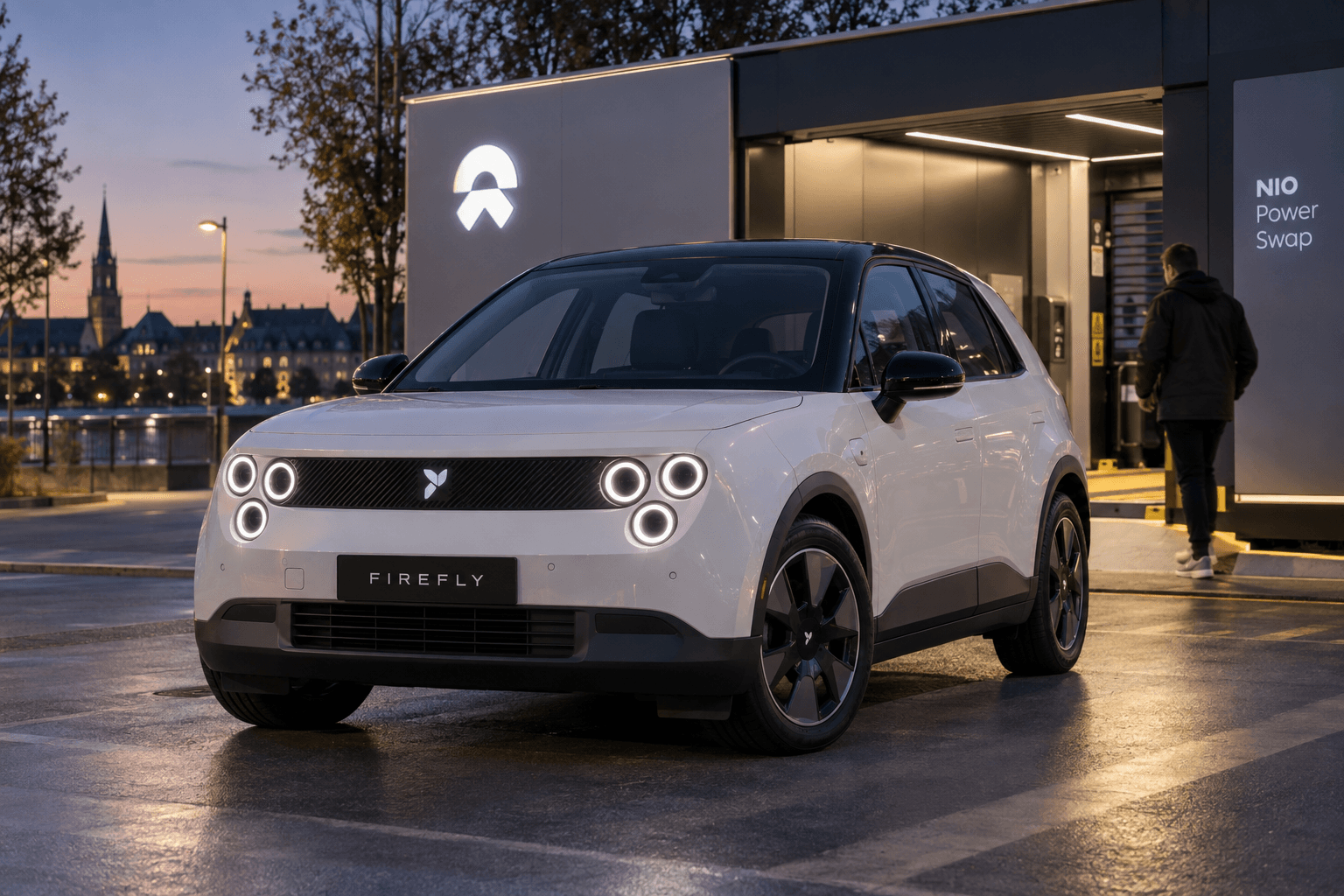
The Firefly is expected to become available with a 60 kWh battery. Compared with the current 40 kWh battery, capacity increases by 50%. This could give the small electric car a range of more than 400 km.
That would be an important step for the young brand within the Nio Group. The current battery size is well suited to city driving and commuting, but it places relatively tight limits on the Firefly on longer journeys. An additional 20 kWh of capacity → significantly fewer charging stops on the highway.
| Feature | Current battery | New battery |
|---|---|---|
| Capacity | 40 kWh | 60 kWh |
| Capacity increase | Baseline | 50% |
| Range | under 400 km | more than 400 km expected |
| Battery swapping | technically supported | technically supported |
Firefly closes in on Europe’s new small EVs
With a range of more than 400 km, the Firefly would compete on equal terms with upcoming small electric cars from Europe. These include the VW ID. Polo, which is already among the highly sought-after entry-level models from VW, Škoda and Cupra.
More affordable challengers from China are also increasing the pressure. The announced Geely E2 for Europe, for example, is aimed at a significantly lower price segment. A large battery alone will therefore not be enough for Firefly; the pricing also has to be right.
Price remains the crucial question
The Firefly currently costs around €30,000, depending on the market and terms. A version with a 60 kWh battery is likely to be more expensive, but an official price for Europe has not yet been announced. Despite its longer range, the model could therefore cost more than comparable small cars from established brands.
In the price-sensitive small-car segment, a difference of several thousand euros matters. In addition to its range and equipment, the Firefly will therefore also have to win buyers over with its compact dimensions, distinctive design and battery-swapping technology.
The 60 kWh battery makes the Firefly more suitable for long-distance driving, but price will be at least as important to its success in Europe.
Swappable battery opens up unusual possibilities
The Firefly is designed for automated battery swapping. At a compatible Power Swap Station, the battery is exchanged for a charged unit within a few minutes. On long journeys, this can be faster than conventional fast charging.
The standardized interface also raises hopes that older vehicles could later be fitted with a larger battery. From a technical perspective, switching from 40 to 60 kWh appears feasible in principle. However, it remains unclear whether Nio will actually offer such a permanent upgrade and how much it would cost.
In Europe, infrastructure also remains the limiting factor. The generation of swap stations required for the Firefly is not yet widely available. Until that changes, conventional charging will remain the norm for European drivers.
What still needs to be clarified before the European launch
- Price and market launch of the 60 kWh version
- Official WLTP range
- Compatibility with European swap stations
- Option to upgrade the battery of existing vehicles at a later date
On paper, the larger battery addresses one of the main criticisms of the Firefly. If range, price and the battery-swapping network are combined effectively, it could become a particularly flexible small electric car. Until confirmed specifications are available for Germany, Austria and Switzerland, however, details of the European version remain preliminary.