Mercedes reimagines the electric E-Class as a “proper” E-Class
Mercedes is visibly reorganizing its EV strategy: Instead of continuing the EQ names indefinitely, future EVs will once again be aligned more closely with the traditional model ranges. As part of this shift, the EQE is expected to be phased out, with its place taken by an electric E-Class. For buyers in Germany, Austria and Switzerland, this is primarily a signal that Mercedes wants to integrate EVs more clearly into its familiar portfolio, without requiring customers to navigate a parallel world of model names.
An electric C-Class is also being developed in parallel and, according to internal statements, is already set to benefit from the “E-Class feel.” This fits the overall direction: Comfort, low noise levels and long-distance capability are to remain the guiding principles, but with a new electric drivetrain platform.
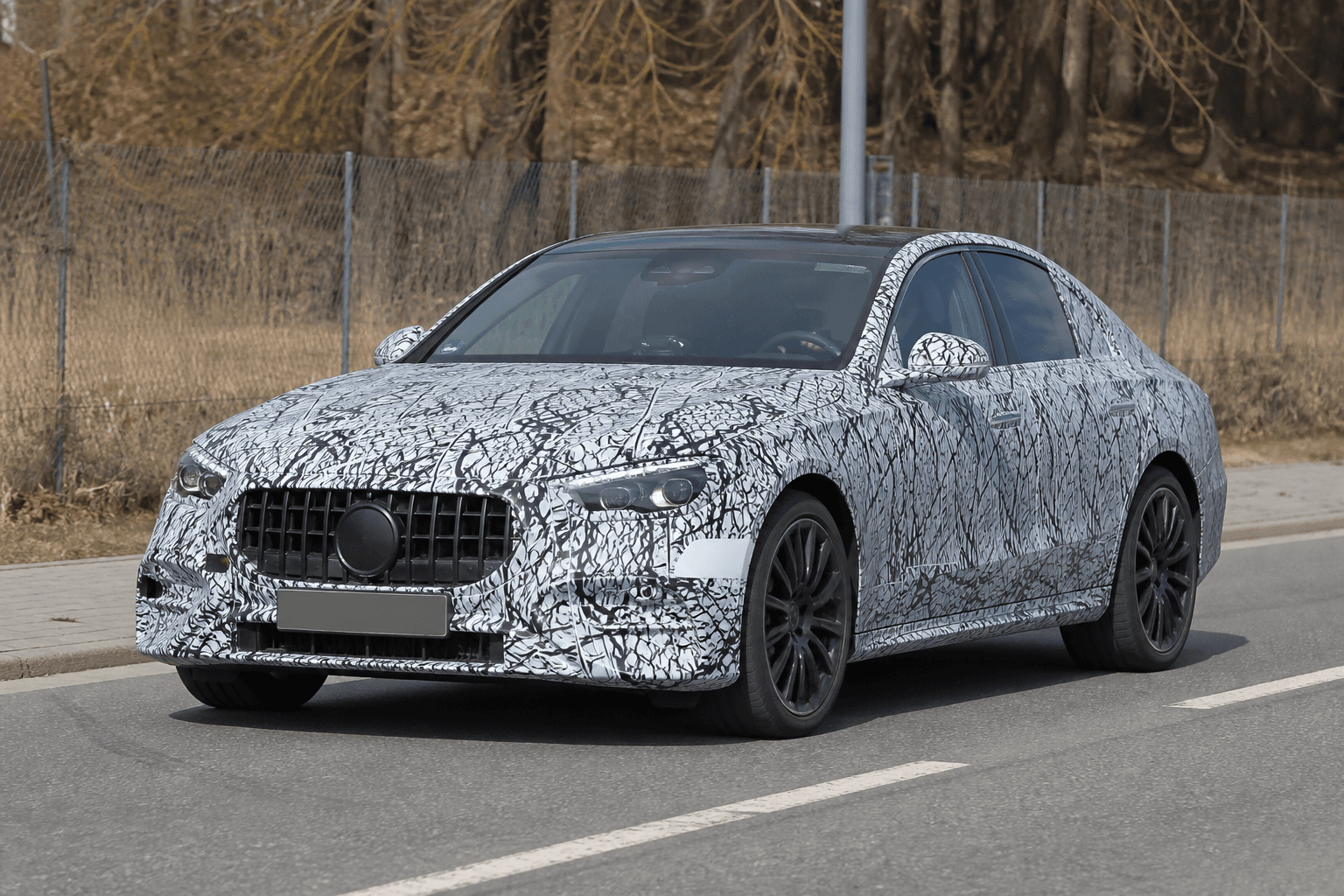
AMG E 63 with EQ Technology: Prototype shows more aggressive styling
Things get interesting at AMG: A heavily camouflaged prototype spotted for the first time points to an AMG E 63 version of the electric E-Class. The most noticeable features are a sportier body kit and an overall appearance that is significantly more “aggressive” than that of a regular test vehicle.
Naturally, an electric E 63 will no longer have a traditional V8. Instead, AMG is likely to continue using simulated sound and gearshifts, as is now seen from several manufacturers. The goal is clear: The driving experience and emotional appeal should remain, even if the hardware is completely different.
MB.EA and 800 volts: Why they matter in everyday use
Technically, the electric E-Class is expected to use the MB.EA platform and 800-volt technology. For everyday use, this primarily means one thing: high charging power with consistent charging times, provided the battery, thermal management and charging curve work together effectively. This is particularly relevant in the E-Class segment because many of these vehicles are used as company cars and long-distance sedans.
Another advantage of an 800-volt architecture is that lower currents are required at the same power output, potentially reducing the load on cables and connectors as well as power losses. In short, faster stops become more realistic when suitable infrastructure is available.
If you are interested in the technical differences, see our overview of 800 volts vs. 400 volts in an EV.
Drivetrain and battery: Output beyond 600 kW possible
Mercedes has not yet released any specific figures, but an E 63 interpretation would logically require an extremely potent configuration. Possibilities include axial-flux motors and total system output of more than 600 kW. Also likely is a large battery with more than 100 kWh, ensuring that the performance is not just impressive on paper but remains consistent at highway speeds and under repeated power delivery.
Axial-flux motors are considered particularly power-dense, delivering substantial power in a compact package. For AMG, this would be an obvious way to create a cohesive overall package despite the additional technology required for cooling, driving dynamics and simulated sound.
Charging: Mercedes could aim higher with the E-Class than before
It remains unclear how aggressively Mercedes will configure charging power in its upcoming large sedans. The only certainty is that more than 350 kW has already been demonstrated as technically possible within the wider corporate group. In this vehicle segment, that would also be a plausible way to distinguish these models at the top end, as customers paying premium prices expect not only comfort but also measurable technological advantages.
In practice, peak power matters less than how long a high charging rate can be maintained. A strong charging curve can offer greater benefits on long journeys than a brief headline figure that drops off after just a few minutes.
Assessment: Timeline and role in the Mercedes portfolio
The prototypes are currently still heavily camouflaged, so final versions should not be expected immediately. A market launch in one to two years appears realistic, while a fully developed AMG version could follow later in the model cycle.
Overall, the direction makes sense: Mercedes does not want to “discard” the EQ era but rather integrate it more closely into its traditional model ranges. This is good news for the DACH region—the German-speaking markets of Germany, Austria and Switzerland—because the E-Class and AMG names are much more familiar to many buyers than EQE and EQS.
How it fits into the market
- For anyone who wants to assess 800-volt technology in everyday use today, charging behavior and efficiency are often more important than peak kW figures alone.
- Performance sedans are facing more competition: Range, charging time and driving dynamics must work together, or the result will remain nothing more than a win on the spec sheet.