Electric E-Class Spotted During Testing
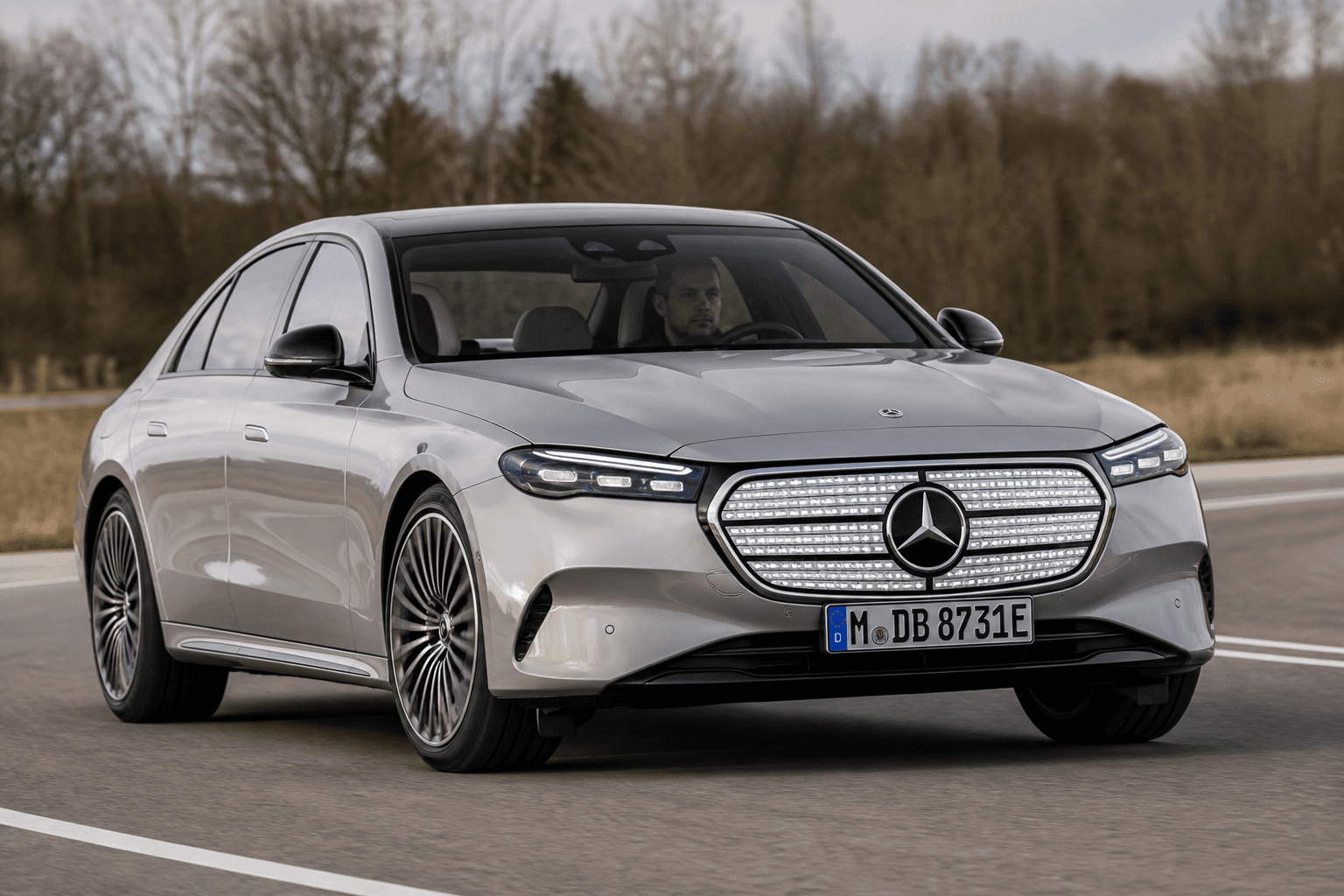
Mercedes is working on an all-electric E-Class that is now appearing more frequently as a camouflaged prototype on public roads. Current test vehicles already appear to feature near-production lighting, suggesting that development is at an advanced stage.
The market launch is currently expected in 2027 or 2028. Mercedes has not yet confirmed an official date, technical specifications, or pricing.
Classic E-Class Design Instead of the EQ Look
The proportions of the prototype are much more closely aligned with a classic Mercedes sedan than with the rounded EQE. A clearly defined hood, a separate trunk, and a more conventional roofline are intended to create a more familiar appearance without sacrificing the aerodynamic benefits of an electric car.
Mercedes is thereby addressing a key weakness of its previous EQ strategy. The EQE and EQS were technically distinct, but their styling differed significantly from the established model lines. The electric E-Class is intended to bring electric mobility and the brand’s familiar identity closer together.
Mercedes is not abandoning electric sedans; instead, it will once again package the technology in more familiar model families.
800 Volts and More Than 300 kW of Charging Power Expected
The vehicle is expected to be based on a scalable electric platform with an 800-volt architecture. This allows for lower current at high power, thinner cables, and, above all, faster DC charging. A peak charging rate of more than 300 kW appears realistic, although it has not yet been officially confirmed.
In everyday use, the charging curve is at least as important as the peak figure. If the vehicle can sustain high power across a broad portion of the battery’s charge range, short highway stops could add significantly more range than in the current EQE. Our comparison of 800-volt and 400-volt EV architectures explains the specific advantages of the higher-voltage system.
A Range of More Than 750 km Is Conceivable
A battery with around 94 kWh of usable or gross capacity is being discussed, although it remains unclear which figure this refers to. Ranges of more than 750 km are also being reported. Until Mercedes publishes homologated figures, however, these details remain preliminary.
Such a range would be technically plausible if Mercedes combines an efficient powertrain with good aerodynamics. The current Mercedes CLA-Class already demonstrates how strongly the manufacturer is prioritizing efficiency, range, and charging speed in its latest generation of electric cars.
The Electric E-Class Is Likely to Replace the EQE
There are many indications that the new electric E-Class will eventually replace the EQE. This would give Mercedes a clearer model structure: a familiar model line, a choice of powertrains, and a shared design identity.
For its larger luxury model, the brand is initially following a different timetable. The EQS will receive another round of extensive technical improvements, including an 800-volt system and steer-by-wire. We have summarized the details in our article on the Mercedes EQS 450+ with new technology.
What Is Already Considered Likely
- classic sedan shape in the style of the E-Class
- modern 800-volt electric platform
- fast charging at an expected rate of more than 300 kW
- positioning as the long-term successor to the EQE
What Mercedes Still Needs to Confirm
- market launch in 2027 or 2028
- battery capacity and official WLTP range
- powertrain options, charging times, and prices
An Important Change of Direction for Mercedes
The electric E-Class could become one of Mercedes’ most important models in the coming years. It combines a familiar name and classic proportions with the technology that many buyers now expect from a modern long-distance EV.
This approach is particularly relevant to the DACH market—the German-speaking region encompassing Germany, Austria, and Switzerland—where the E-Class has been established for decades as a company car, taxi, and comfortable long-distance sedan. If Mercedes succeeds in combining high efficiency, short charging stops, and its customary comfort, the EQE’s successor is likely to appeal to a significantly broader range of buyers.